
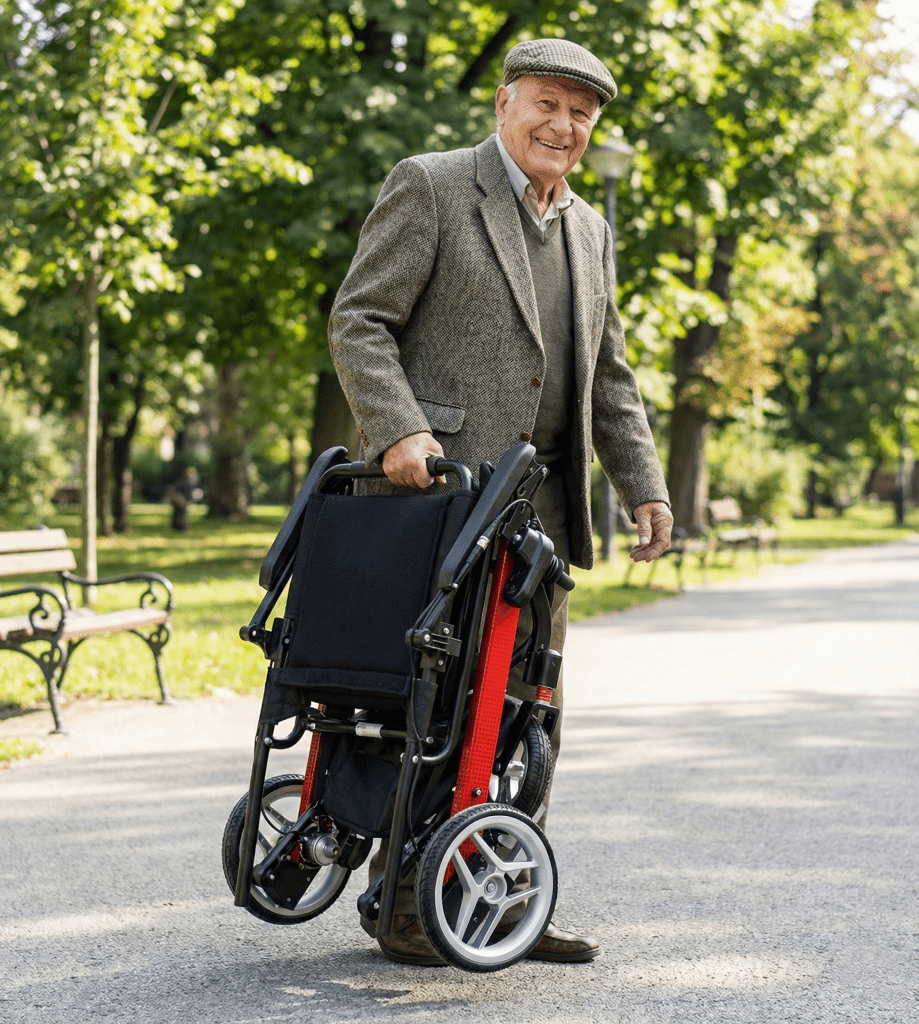
A deep-dive analysis of the aluminum alloy frame revolution, ergonomic portability, and what 13.5kg of net weight really means for your independence.
Let’s be honest: for years, the promise of mobility has been weighed down—literally—by heavy, clunky steel frames. If you have ever struggled to lift a “portable” device that feels more like a boat anchor than a travel companion, you know that true freedom requires shedding the pounds.
The mobility market is flooded with devices claiming to be “lightweight,” yet they often require a specialized vehicle lift or two strong people to move. But recently, we’ve seen a shift. We aren’t just talking about a minor upgrade or a slightly sleeker design; we are witnessing a revolution in ergonomic portability.
Enter the 15kg miracle—a compact foldable wheelchair that shatters the status quo.
Imagine an ultra lightweight power wheelchair that clocks in at a staggering 13.5kg frame weight, making it lighter than most packed travel suitcases. This isn’t just about impressive specifications on a piece of paper; it is about the lithium-ion agility that allows you to hoist your ride into a car trunk with a single hand or breeze through airport security without breaking a sweat.
In this comprehensive guide, we are going to deep-dive into the portable electric wheelchair that is currently redefining independence for travelers worldwide. We will explore the engineering behind the aluminum alloy frame, test the reality of the dual 200W motors, and help you decide if this featherweight marvel can truly handle your daily adventures.
1. The Frame Revolution: How 13.5kg is Possible
The first question everyone asks is: “How can a motorized vehicle weigh so little?” The answer lies in materials science.
For decades, the industry standard was steel. Steel is strong and cheap, but it is incredibly heavy. Even early attempts at “lightweight” chairs used standard tubular aluminum that was bulky and required thick walls to maintain structural integrity. The game-changer for this specific lightest weight electric wheelchair is the use of a high-strength aluminum alloy frame.
This is the same logic used in modern aerospace engineering and high-end bicycle manufacturing. By using varying thicknesses of alloy—thicker at stress points and thinner in non-load-bearing areas—engineers have achieved a frame that weighs just 13.5kg.
Net Weight vs. Total Weight: The Transparency Test
In the world of mobility aids, specifications can be misleading. Manufacturers often list the “shipping weight” or “frame weight” while conveniently leaving out the weight of the battery, cushions, and footrests.
We value transparency, so let’s break down the numbers for this specific model:
- Net Frame Weight: 13.5kg. This is what you are lifting if you remove the battery.
- Battery Weight: Approximately 1.5kg.
- Total Operating Weight: 15kg.
To put this in perspective, a standard manual wheelchair (one you have to push yourself) often weighs between 12kg and 18kg. This electric mobility aid gives you the power of a motor without adding any weight penalty compared to a manual chair. It is a technological leap that bridges the gap between manual portability and electric freedom.
2. Compact Foldability: The “Trunk Test”
The defining feature of a great travel power chair isn’t just how light it is, but how small it becomes. If a chair is light but awkward to hold, it fails the portability test.
This model features a “scissor-style” folding mechanism that collapses the chair in roughly three seconds. There are no complex latches to wrestle with or tools required. You simply pull a release, and the chair folds in on itself.
Dimensions that Matter
- Unfolded Size: 1100 x 570 x 940 mm. This provides a comfortable, full-size seating experience.
- Folded Size: 570 x 290 x 740 mm.
Pay close attention to that folded width: 290mm. That is roughly 11.5 inches.
Because of this slim profile, this compact foldable wheelchair passes the “Trunk Test” with flying colors. It fits easily into the trunk of a compact sedan (like a Honda Civic or Toyota Corolla) with plenty of room left for groceries or luggage. For those who travel by taxi or Uber, this is invaluable; you never have to worry if the driver’s car is big enough to accommodate your mobility device.
It also opens up storage options in your home. You no longer need to leave your wheelchair parked in the hallway or living room. It can slide into a coat closet, under a bed, or stand unobtrusively in a corner.
3. Power and Performance: Dual 200W Brush Motors
There is a common misconception that “lightweight” equates to “weak.” You might worry that a chair weighing only 15kg won’t have the torque to get you moving, particularly on carpet or slight inclines.
This model addresses that concern with dual 200W brush motors, providing a total power output of 400W.
Why Brush Motors?
In an era where everyone talks about “brushless” technology, why does this chair use brush motors? The answer is torque and control at low speeds. High-quality brush motors are robust, reliable, and provide excellent “starting torque”—that initial push needed to get the chair moving from a dead stop.
These motors are engineered to be quiet and efficient, driving the PU solid tires with precision.
- Speed Range: 1 – 6 km/h.
- The “Walking Pace” Sweet Spot: The top speed of 6 km/h is perfectly calibrated for pedestrian environments. It allows you to keep pace with fast-walking companions, yet the variable speed control allows you to dial it down to 1 km/h for navigating crowded museums or maneuvering up to a dinner table.
Climbing Ability
The spec sheet rates the climbing capability at ≤8°. While this might not sound like climbing Mount Everest, it is more than sufficient for standard ADA-compliant ramps, driveway inclines, and the gentle slopes found in most urban environments. The dual motors work in tandem to push the lightweight frame up these gradients without stalling or overheating.
4. Battery Tech: The 6Ah Lithium Advantage
The battery is traditionally the heaviest single component of any electric vehicle. To keep this a lightweight power chair with lithium battery, the engineers opted for a highly efficient 24V 6Ah lithium-ion battery.
Understanding the Range
A 6Ah battery is relatively small compared to the massive batteries found on heavy-duty scooters, but because the chair itself is so light, the battery doesn’t have to work as hard.
- Estimated Range: Depending on user weight and terrain, you can expect 10-15km of range.
- Usage Scenario: This range is ideal for a “day out.” It covers a trip to the mall, a cruise ship excursion, or a day navigating an airport and lengthy concourses.
Airline Approval and Travel
For the globetrotters, the battery specs are critical. Most airlines and the IATA (International Air Transport Association) have strict regulations regarding lithium batteries. Generally, batteries under 160Wh (Watt-hours) are permitted.
Let’s do the math: 24V x 6Ah = 144Wh.
This places the battery comfortably within the safe zone for air travel. You can typically drive the chair to the gate, remove the battery (which slides out easily), carry the battery into the cabin with you, and gate-check the folded frame. Note: Always check with your specific airline carrier beforehand, but this spec is designed specifically for compliance.
5. Maneuverability: The 770mm Turning Radius
Indoor mobility is often much harder than outdoor mobility. Narrow hallways, tight corners in restaurants, and small elevators are nightmares for standard mobility scooters.
This small turning radius wheelchair boasts a radius of just 770mm (roughly 30 inches). Combined with the 360° intelligent joystick, you can practically spin the chair within its own footprint.
Imagine being in a crowded elevator. With a standard scooter, you have to back in or wait for everyone to leave before you can turn. With this 15kg model, you can enter forward, spin around, and face the doors, ready to exit. This level of agility transforms how you interact with tight spaces, removing the anxiety of “will I fit?”
6. Safety First: The Electronic Brake System
When you are dealing with a lightweight device on wheels, you need to ensure it doesn’t roll away when you don’t want it to. This chair features a responsive electronic brake system.
This is a “fail-safe” mechanism. As soon as you take your hand off the joystick, the electromagnetic brakes engage automatically. It doesn’t matter if you are on a flat surface or stopped halfway up a ramp; the motors lock, and the chair stays put.
There is no need to fumble for a manual handbrake lever or worry about drifting backward. This feature is particularly important for elderly users or those with delayed reaction times, adding a layer of confidence to every ride.
7. The Wheels: PU Solid Tires
The last thing you want on vacation is a flat tire. Pneumatic (air-filled) tires offer a soft ride but require maintenance and carry the risk of punctures.
This model comes equipped with:
- Front Wheels: 7-inch PU (Polyurethane).
- Rear Wheels: 9-inch PU.
PU wheels are the modern solution to the “air vs. solid” debate. Polyurethane is a material that offers the durability of solid rubber but with a density that mimics the shock absorption of air. They will never go flat, they don’t require a pump, and they resist wear and tear on rough asphalt.
The 9-inch rear wheels are large enough to handle cracks in the sidewalk, door thresholds, and low-pile carpet comfortably, while the smaller front caster wheels provide the sharp steering response needed for that tight turning radius.
8. Ergonomics: Sitting Comfortably
Despite being a compact foldable wheelchair, the dimensions are designed for adult comfort. The manufacturers avoided the trap of making the seat too small just to save weight.
- Seat Width: 400mm (approx. 16 inches). This is a standard narrow-adult width, providing a snug, supportive fit that helps maintain posture.
- Seat Height: 530mm. This height is crucial; it is similar to a standard dining chair, making standing up and sitting down much easier on the knees compared to lower, bucket-style seats.
- Backrest Height: 430mm. This provides adequate lumbar support for extended sitting periods.
The upholstery is typically made from breathable, honeycomb mesh fabric. This is essential for preventing heat buildup and moisture, keeping you cool during summer outings or long waits at the airport. The fabric is also removable and washable—a practical detail for daily use.
9. Load Capacity: Realistic Expectations
We have talked about all the amazing benefits, but let’s address the limitations. To achieve the incredible 15kg total weight, the frame is engineered with precision limitations.
The spec sheet lists a load capacity of ≤100kg (220 lbs).
This is the most critical number to respect. Unlike heavy-duty steel chairs that can handle overload, this aluminum alloy frame is optimized for a specific weight class.
- Perfect for: Users weighing 50kg to 90kg (110 lbs to 200 lbs).
- The Risk: Users pushing the 100kg limit, especially on rough terrain, may put excessive strain on the motors and the frame welds.
If you are under this weight limit, the chair will feel zippy, responsive, and rigid. If you are significantly over this limit, you would be better served looking at a “Heavy Duty” folding model, which will weigh more (usually around 26kg) but provide the necessary structural support.
10. Comparison: 15kg Aluminum vs. The Competition
To truly understand the value of this ultra lightweight electric wheelchair, we need to look at what else is on the market.
| Feature | The 15kg Hero Model | Standard Power Chair | Manual Wheelchair | Folding Scooter |
|---|---|---|---|---|
| Total Weight | 15 kg | 50 kg – 80 kg | 12 kg – 18 kg | 25 kg – 40 kg |
| Propulsion | Electric (Dual Motor) | Electric | Manual push | Electric |
| Foldability | Excellent (Suitcase) | Poor (Disassembly required) | Good | Good |
| Lifting | One-hand lift | Requires ramp/lift | One-hand lift | Two-person lift |
| Braking | Electronic (Auto) | Electronic | Manual Handbrake | Mechanical |
| Travel | Car Trunk / Plane | Special Van | Car Trunk | SUV Trunk |
The Takeaway: You are getting the portability of a manual chair with the propulsion of a full power chair. It eliminates the need for a caregiver to push you, restoring your autonomy.
11. Travel Freedom: Air, Land, and Sea
This wheelchair shines brightest when you leave your house. Let’s look at a few real-world travel scenarios:
The Airport RunAirports are notoriously difficult for mobility. Distances between gates can be miles long. With this chair, you ride right up to the aircraft door. You remove the joystick (usually a quick-release) and the battery to take inside the cabin. You fold the chair in seconds, and the ground crew stows it. Upon landing, it’s waiting for you. No waiting for the airport’s generic, ill-fitting wheelchairs.
The Cruise ShipCruise cabins are famous for being small. Standard power chairs often cannot fit through the stateroom door, or if they do, they take up the entire room. With a folded width of 290mm, this chair tucks into the corner or the closet of your cabin, leaving you room to enjoy your vacation.
The Road TripNo need to buy an expensive hitch-mounted lift for your car. No need to buy a van. You can take an Uber, ride in a friend’s compact car, or rent a vehicle at your destination, knowing your mobility device will fit.
12. Maintenance and Longevity
Keeping a lightweight machine running is surprisingly simple. Because it uses brush motors and PU wheels, the maintenance requirement is low.
- Battery Care: The lithium battery prefers to be kept charged. If you store the chair for the winter, ensure you charge the battery fully and top it off once a month.
- Cleaning: The aluminum frame is rust-resistant, but you should wipe it down with a damp cloth after outdoor use to remove dust and salt (especially near the ocean).
- Motor Check: Occasional visual inspection of the wiring connected to the joystick is recommended to ensure nothing has snagged during folding.
13. Buying Guide: What to Ask Before You Buy
If you are ready to invest in this portable electric wheelchair, ensure you are getting the specific model that matches these high-end specs. Here are three questions to ask the retailer:
- “Does the 15kg weight include the battery?” Some retailers list the net weight to make it sound lighter. Confirm the total lifting weight.
- “Is the charger compatible with 110/220V?” If you plan to travel internationally, you want a global voltage charger so you don’t blow a fuse in Europe or Asia.
- “Are the armrests adjustable?” While the standard model is fixed, some variations offer flip-up armrests which are incredibly helpful for transferring sideways from the chair to a bed or car seat.
Conclusion: Reclaiming Your Horizon
The 15kg aluminum frame electric wheelchair represents a massive leap forward in mobility technology. It is not just a piece of medical equipment; it is a lifestyle enabler.
By combining a 13.5kg net weight, dual 200W motors, and a compact folding mechanism, it solves the single biggest complaint of power chair users: the burden of weight. It removes the physical barrier between you and the world.
If you fit within the weight capacity and value the ability to travel freely, pick up your chair with one hand, and store it anywhere, this is likely the best investment you can make for your independence.
The days of the “boat anchor” wheelchair are over. It’s time to travel light.
