
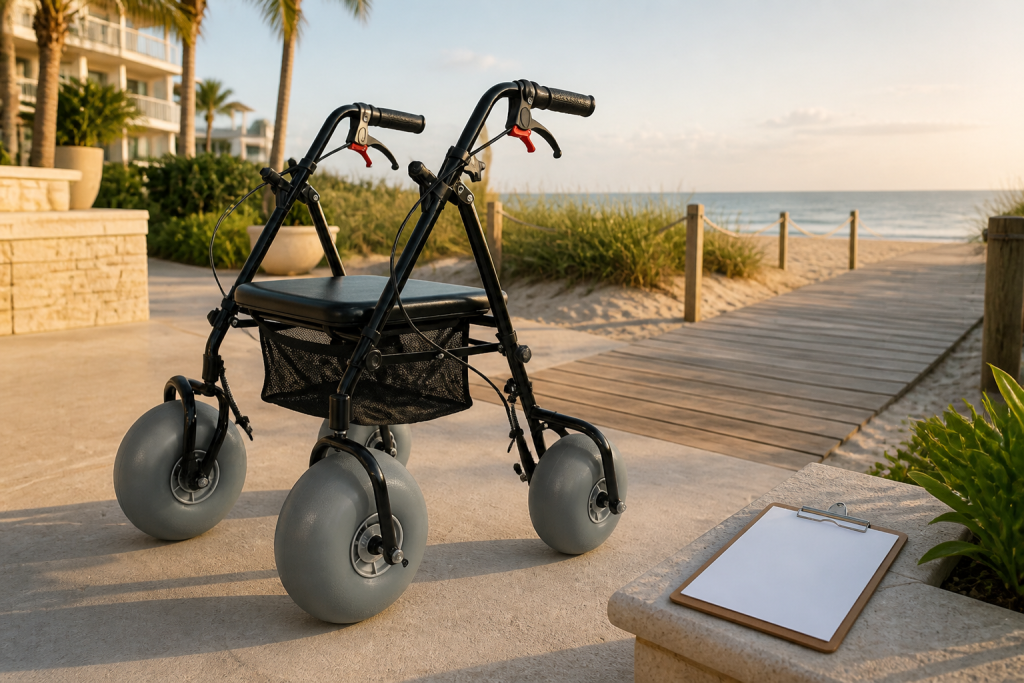
A beach walker supplier review should connect product evidence with real routes, storage, staff handling, and after-sales support. Ask for exact model records. Test a sample on the intended surface. Keep every answer tied to a purchasing decision. For U.S. facilities, review official mobility-device guidance alongside local rules and site-specific safety requirements.
Supplier comparisons often begin with a catalog, a photo, and a unit price. That approach can hide the questions that shape daily resort use: Which surface and route does the buyer need to serve? How does the sample fold, steer, stop, store, and move through the property workflow? Which manuals and replacement parts accompany the order? Who answers after delivery?
A better beach walker review turns those concerns into one written operating brief and one question set used with every supplier. Buyers can then compare like with like instead of rewarding the fastest sales reply. This article gives resort groups, distributors, rental operators, and coastal access programs a practical B2B method for reviewing product fit, samples, documents, ordering, and support.
In practice, Here’s the buyer’s advantage: clear questions create traceable answers. They also give operations and procurement teams a shared basis for discussion. Start with the AryMD beach walker product page as a product reference, then test every supplier reply against the buyer’s own site, use case, policy, and approval process.
What operating brief should a beach walker buyer prepare?
A beach walker buyer should prepare a short operating brief that describes users, routes, surfaces, storage, staffing, cleaning, order scale, and after-delivery needs. The brief should focus on the buyer’s environment rather than a supplier’s preferred sales categories. It becomes the common input for every quotation, sample request, and internal review.
Begin with the service model. A resort loan program differs from a rental counter, a distributor sample room, or a public beach access program. State where the walker will begin and end each use, who will prepare it, where it will be stored, and how staff will record a hold or maintenance referral.

Which site details should the brief contain?
Next, Write what staff can observe: name the route surfaces, narrow points, gates, storage doors, rinse areas, and handoff zones. Avoid broad labels such as “all terrain” without local context. A supplier can respond more clearly to “boardwalk, dry sand, and compacted sand between storage and service point” than to “outdoor use.”
The brief should also state what the buyer does not want assumed. If no verified load, distance, corrosion, or service-life requirement exists, ask the supplier for model documentation instead of inventing a number. Buyers comparing all terrain beach walkers can use category information to form questions, but the site brief should remain the decision anchor.
- Program type and expected operating season
- Normal route start, finish, and surface zones
- Storage doorway and equipment-area constraints
- Staff preparation and handoff process
- Cleaning, rinse, dry, and return workflow
- Sample review location and decision team
- Required documents and language
- Parts, packaging, delivery, and support questions
Keep the brief short enough for suppliers to read and specific enough for departments to review. Add photographs of the site when they clarify a route or storage condition, but remove guest information and avoid implied measurements unless staff verified them.
Who should help write the question set?
Meanwhile, Procurement should not write alone: operations, maintenance, accessibility, guest service, and receiving teams each see a different part of the product life cycle. A short cross-functional meeting can turn those views into questions before a supplier conversation begins.
Ask each department for the decisions it owns. Operations may care about route fit and handoff. Maintenance may need manuals, parts identification, and authorized repair channels. Receiving may need package labels and inspection steps. Guest service may need reservation and return language. Procurement ties those needs to quotation scope, documentation, and supplier response dates.
- Operations: route, handling, storage, and shift handoff
- Accessibility lead: service design and guest communication
- Maintenance: manuals, parts, inspection, and repair process
- Receiving: packaging, unit identification, and delivery check
- Procurement: quotation scope and written terms
- Management: approval, budget, and program ownership
Use one owner to merge duplicate questions and remove vague wording. The final list should request evidence, not adjectives. “Provide the current user and maintenance manuals” produces a reviewable answer. “Is the product high quality?” does not.
For example, Set a standard reply format before sending the questions. Give every supplier the same numbered list, space for a direct answer, and a place to name the attached file that supports that answer. Ask suppliers to mark any question they cannot answer rather than leaving a blank cell. Procurement can then route technical documents to maintenance, service details to operations, and commercial terms to the correct internal reviewer. This format also keeps later meetings focused: the team can discuss a named open item instead of searching through emails. Record the reply date and document revision so a later update does not silently replace the evidence used for the shortlist decision.
How should buyers inspect a beach walker sample?
A beach walker sample should be inspected against the same operating brief and written checklist used for supplier comparison. Buyers should confirm the sample identifier, photograph the received condition, review visible components, follow the supplier manual, and record questions without changing or stress-testing the product outside approved instructions.
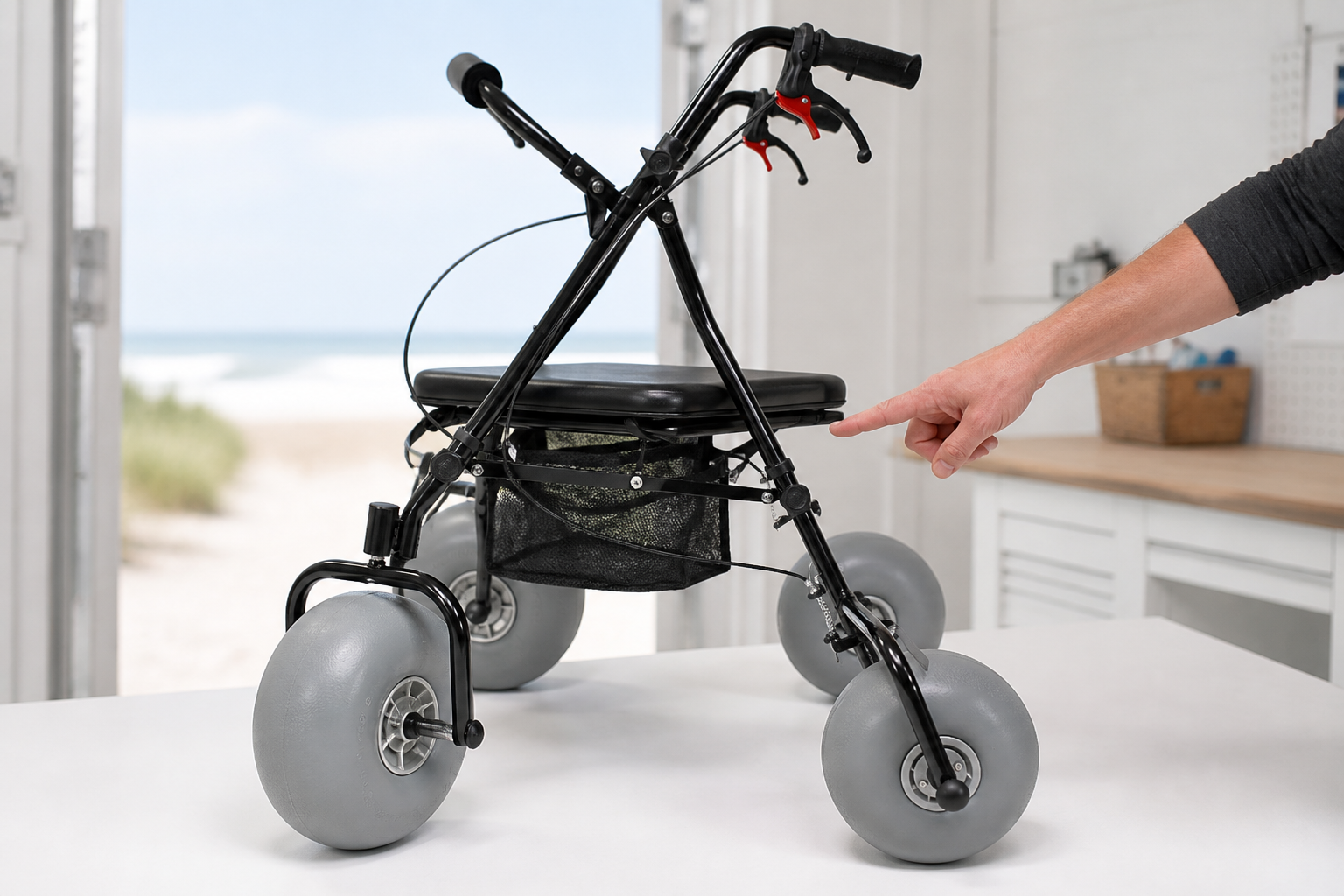
The review area should provide clear access around the walker. Observe the black folding frame, gray balloon wheels, wheel forks, padded seat, basket, handles, brake levers, cables, and fasteners. Check that the sample matches the submitted description and document any difference with neutral language.
What should the physical review ask?
Still, Turn features into questions: rather than scoring appearance alone, ask how each visible part fits the operating brief. Can trained staff follow the folding method in the manual? Does the stored form fit the designated equipment area? Are handling points clear? Can the buyer identify wear parts and their order references?
Do not infer certification, capacity, durability, or corrosion behavior from appearance. Request the relevant supplier documents and verify them through the buyer’s normal compliance process. The article on choosing a beach walker for sand may help teams discuss use context, but sample approval still needs written buyer criteria.
- Does the sample match the quoted model and revision?
- Are frame, seat, basket, wheels, handles, and controls present?
- Does the manual show folding, setup, and handling steps?
- Can staff identify the unit and related parts?
- Does the storage form match the planned space?
- Are cleaning and maintenance instructions clear?
- Which observations require a supplier reply?
Photograph each side and any questioned area under even light. Name files with the supplier, model, sample date, and view. Keep original photographs with the checklist so later reviewers can see what the team actually received.
How should buyers compare manuals and supplier documents?
Afterward, Documents reveal process maturity: a buyer needs more than a brochure. Request current user instructions, maintenance guidance, parts references, packaging information, warranty terms, and contact routes. The exact list depends on market, organization, and intended service.
Check whether documents identify the same model and components as the sample. Look for revision dates, readable diagrams, named procedures, and contact details. Send questions back in writing. If a supplier promises a document later, record that promise as an open item rather than treating it as complete.
- User and staff handling instructions
- Maintenance and inspection guidance
- Parts list or replacement reference method
- Cleaning, rinse, dry, and storage instructions
- Packaging and receiving information
- Warranty terms and claim process
- Support contacts and response route
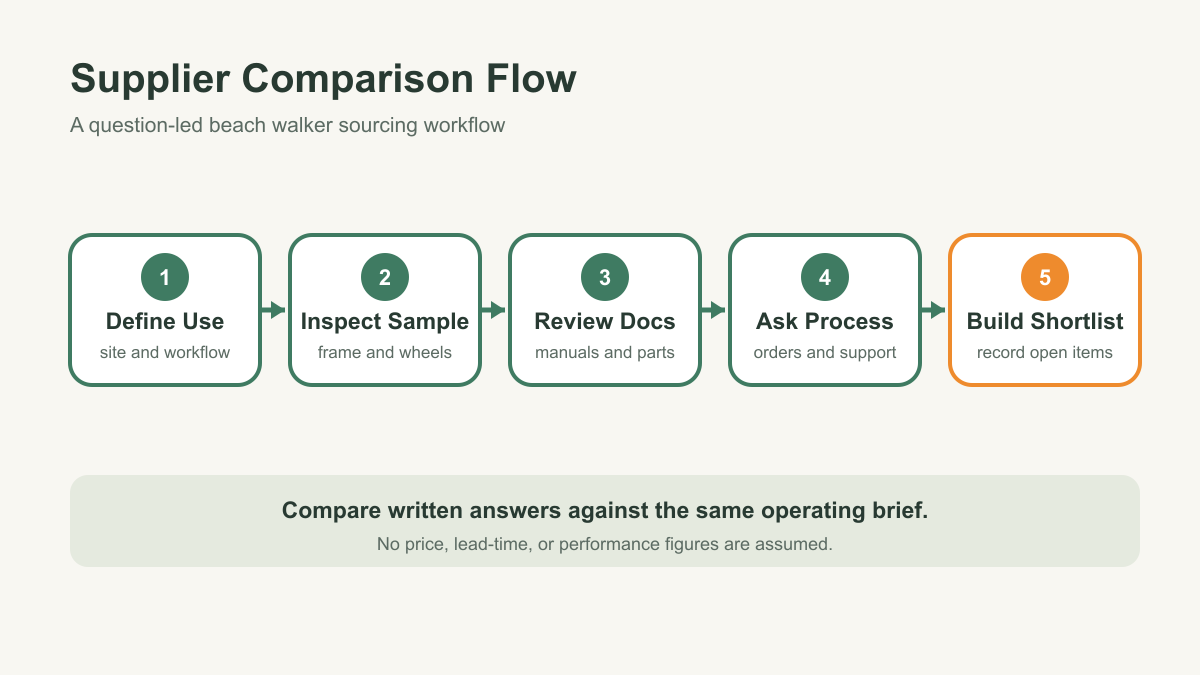
The flow below keeps the comparison question-led. It asks buyers to define use, inspect a sample, review documents, examine process, and build a shortlist without assuming price or performance figures.
How can buyers compare supplier processes fairly?
In practice, A beach walker buyer can compare supplier processes fairly by sending the same written questions, deadline, operating brief, and document request to each candidate. The comparison sheet should separate verified documents, supplier statements, buyer observations, open questions, and internal decisions. That separation prevents a confident sales statement from receiving the same weight as a reviewed manual or sample record.
Ask for replies in a consistent format. A table can list question, supplier answer, attached evidence, buyer reviewer, status, and follow-up date. Do not force every supplier into identical commercial terms if the market differs, but keep the buyer’s evaluation categories stable.
Which ordering questions belong in the comparison?
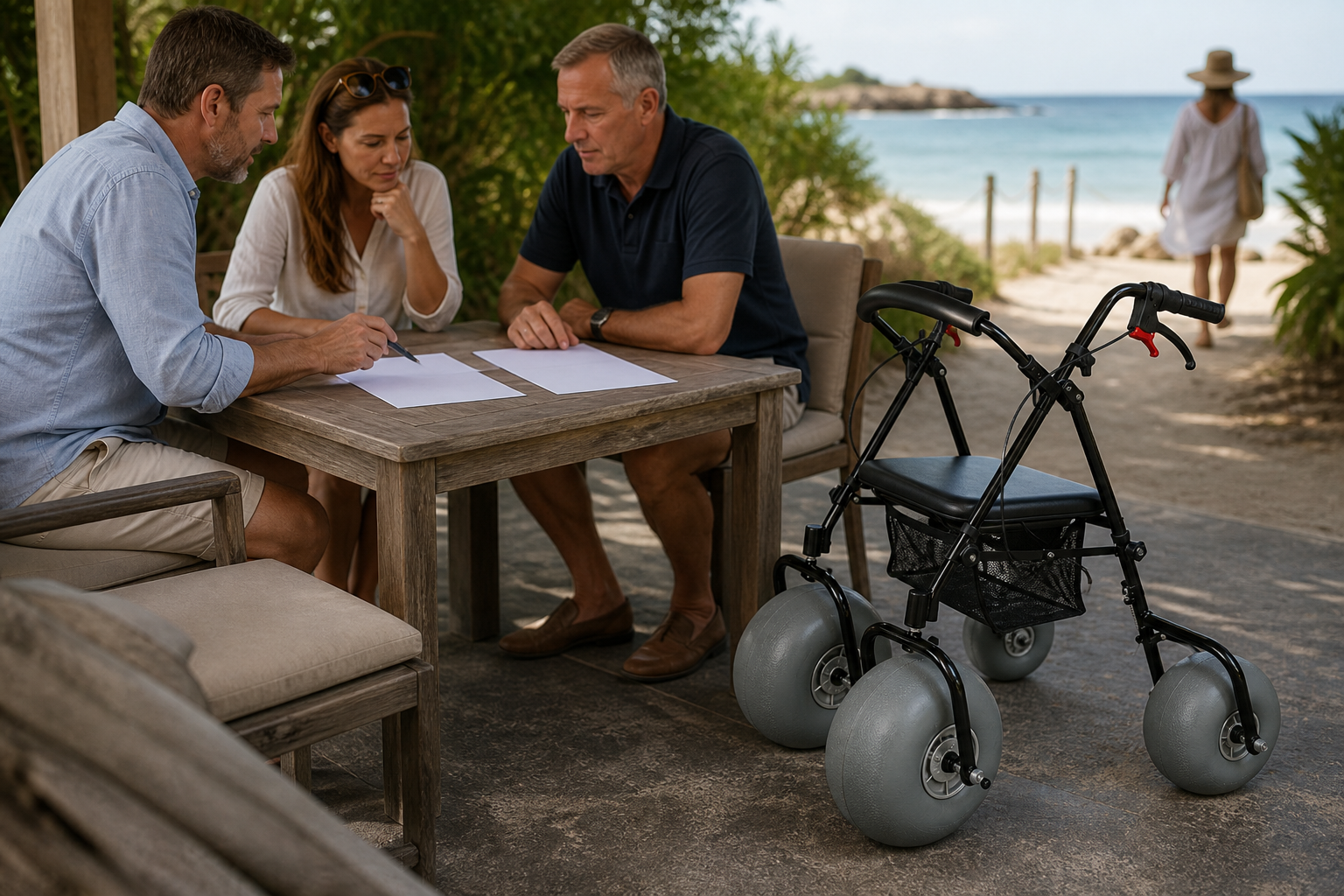
Ask about the full order path: quotation, model confirmation, sample approval, packaging, production communication, delivery documents, receiving checks, and issue handling all affect the buyer’s workflow. A low unit price can become difficult to manage when model identifiers, parts references, or response channels remain vague.
Next, Commercial details change, so request current written information without repeating it as a permanent fact in an article. Buyers should route price, lead-time, minimum order, payment, freight, tax, and warranty review through their own procurement and legal controls.
- How does the supplier confirm model and revision?
- Which documents accompany quotation and shipment?
- How are packaging labels tied to unit identification?
- What sample-approval step precedes a larger order?
- How are production or delivery changes communicated?
- What receiving evidence does the supplier request?
- How does the buyer open and track an issue?
The beach walker buyer guide offers a wider product-selection view. Use the question set here to turn that discussion into records that an internal approval team can audit.
How should buyers score support and open items?
Score the answer, not the charm: create a status scale with written definitions. “Verified” may mean the buyer reviewed a current document or approved sample record. “Supplier stated” may mean a written reply exists but evidence remains under review. “Open” means the buyer still needs an answer. “Not accepted” means the reply does not meet the brief.
Meanwhile, Weighting should follow the buyer’s program, not a generic template. A distributor may place more weight on parts references and packaging consistency. A resort may focus on route fit, staff instructions, storage, and service communication. Management should approve the scoring method before supplier replies arrive.
- Verified document or sample evidence
- Written supplier statement under review
- Open question with named owner and date
- Buyer requirement met or not met
- Risk note tied to a specific workflow
- Approval condition for shortlist entry
- Reason recorded for any exception
Keep open items visible after a supplier reaches the shortlist. Do not convert an unanswered question into a positive assumption. Close it with evidence, accept it through the buyer’s exception process, or remove the supplier from that decision stage.
What do B2B buyers ask about supplier comparison?
These beach walker answers cover common questions about briefs, samples, documents, scoring, and supplier follow-up.
For example, Q1: Should buyers request a sample from every supplier?
Not always. Use a staged review. Documents and written answers may narrow the field before sample cost and logistics make sense. Apply the same gate to every candidate.
Q2: Can a product photo replace a physical review?
Still, No. Photos support early screening, but they cannot confirm the received sample, folding method, component layout, document match, or site fit.
Q3: Should price receive the highest score?
Not automatically. The weighting should reflect the approved operating brief, commercial policy, service model, and risk controls. Price remains one category among several.
Afterward, Q4: How should buyers handle different supplier answer formats?
Map each reply back to the buyer’s standard question sheet. Quote the supplier accurately, link the evidence, and mark gaps instead of rewriting weak answers as complete.
Q5: What belongs in the final shortlist record?
In practice, Include the operating brief, question sheet, supplier replies, evidence links, sample review, score definitions, open items, exceptions, reviewers, and approval decision.
A supplier comparison becomes easier to defend when every candidate receives the same operating brief and better questions. Define the site, review the sample, verify documents, examine the order path, and keep open items visible. For a product-focused sourcing conversation, contact us today with your intended beach walker workflow and the documents your buying team needs to review.
Related planning resources: Compare basic beach walker use, route suitability checks, coastal staff training before approving a sample, staff plan, or service workflow.