
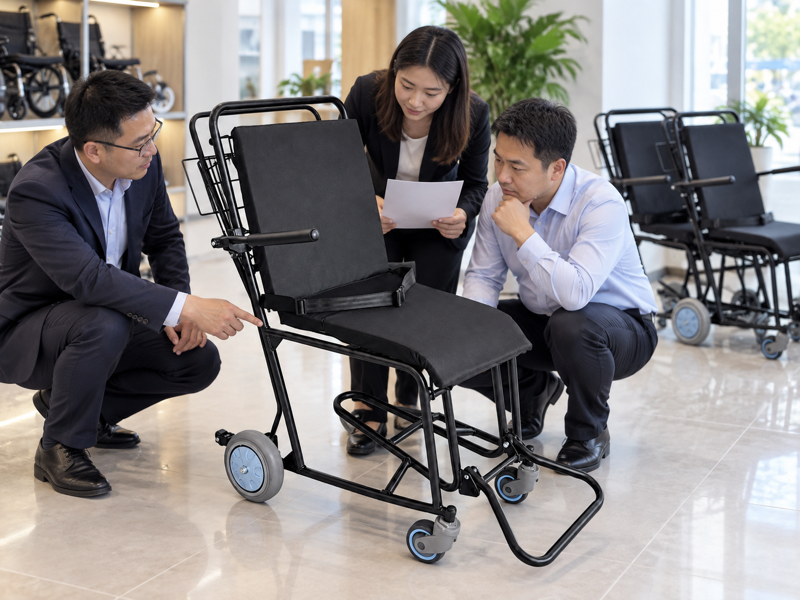
Plan airport wheelchair procurement for France by defining the exact attendant chair, the airport service route and the evidence needed before a fleet tender. Nested black chairs look compact in the supplied photos, but those images cannot prove aisle fit, load capacity or airline acceptance. Ask for measured model data, trained trials, applicable EU files and written service terms before placing an order.
What chair does airport wheelchair procurement cover?
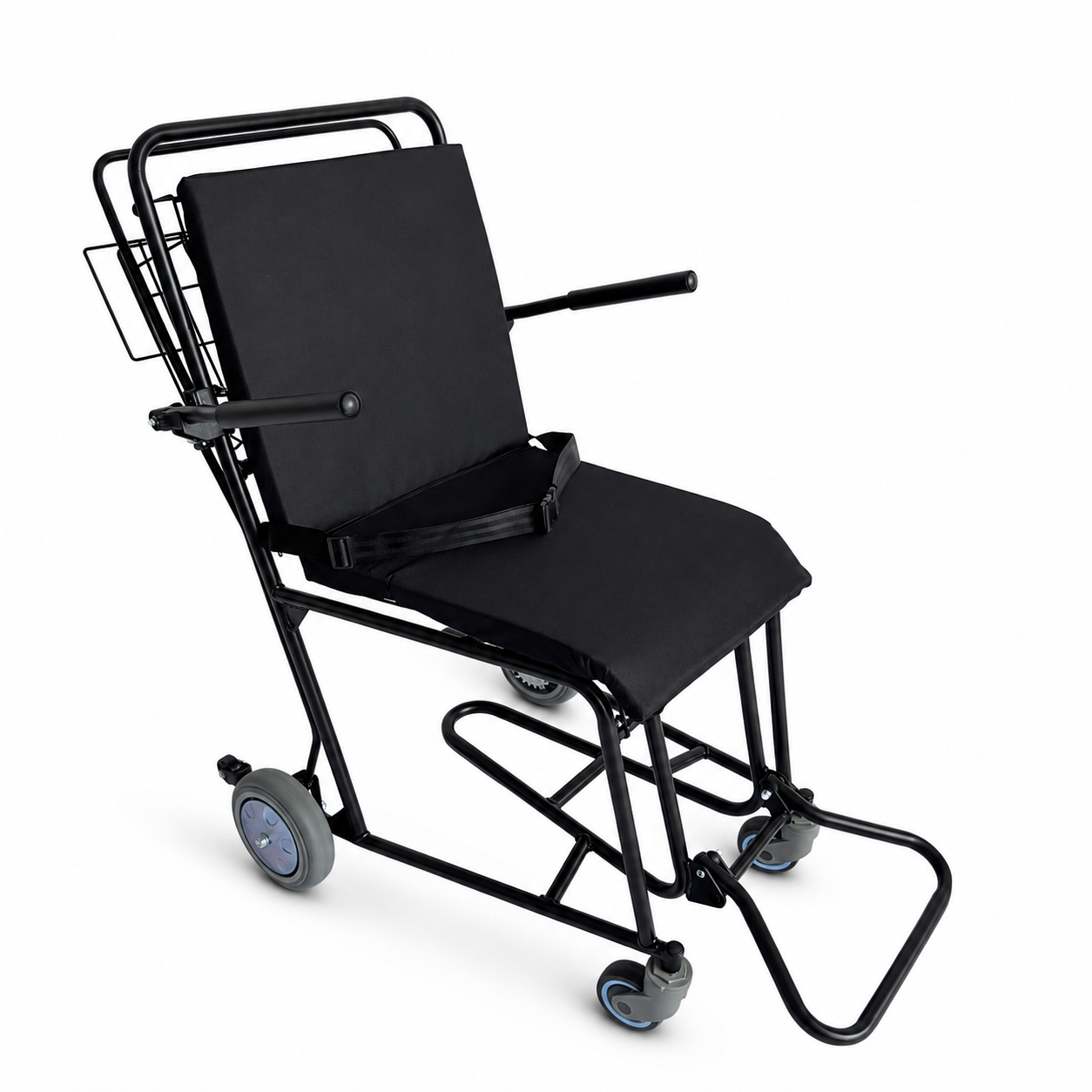
Airport wheelchair procurement must identify the exact black attendant-pushed chair, its version and included equipment. The full product image shows seat, belt, rear basket, large grey rear wheels, small front casters and a front foot loop. It gives no verified size or load figure.
What should the tender line include?
Name the service chair before the fleet size. Request model drawing, parts list and maker's intended use. A manual wheelchair with push-rims is a different design and cannot supply this chair's measurements or handling guide.
- Record exact model and revision.
- List included seat, belt, basket and wheel parts.
- Keep each claim linked to a current file.
| Tender field | Why it matters |
|---|---|
| Chair identity | Defines what is delivered |
| Included equipment | Supports receiving and service |
A broad 'airport chair' label leaves too much open. Key Takeaway: French buyers can compare a specific product rather than a category.
What route should airport wheelchair procurement test?
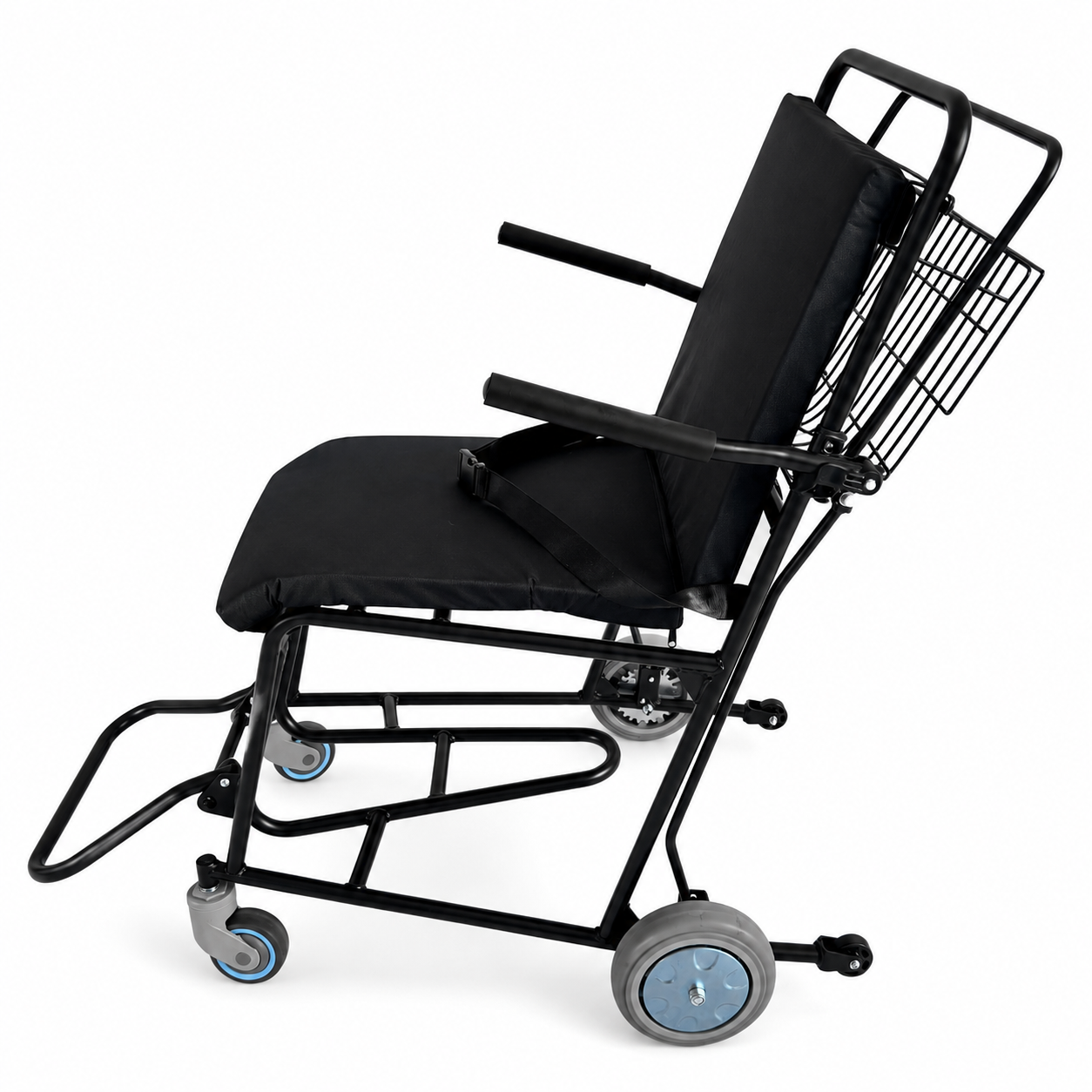
Airport wheelchair procurement should test the actual service route for the intended chair and trained attendant. The side photo cannot prove doorway, turn, lift or aisle fit. Ask the airport operator for route constraints and compare them with measured chair data.
Which route facts belong in the brief?
Follow the chair from handover to destination. Record doors, turns, slopes, lift openings and transfer points without inventing a national width rule. A route sample should use the chosen model and the staff who will handle it.
- Measure relevant openings and turns.
- Request complete product dimensions.
- Plan a controlled route trial with attendants.
| Route point | Review |
|---|---|
| Door or lift | Actual chair clearance |
| Turn or slope | Trained handling plan |
A chair that fits storage may not fit a transfer route. Key Takeaway: The tender can name the places that matter.
Who should run airport wheelchair procurement trials?
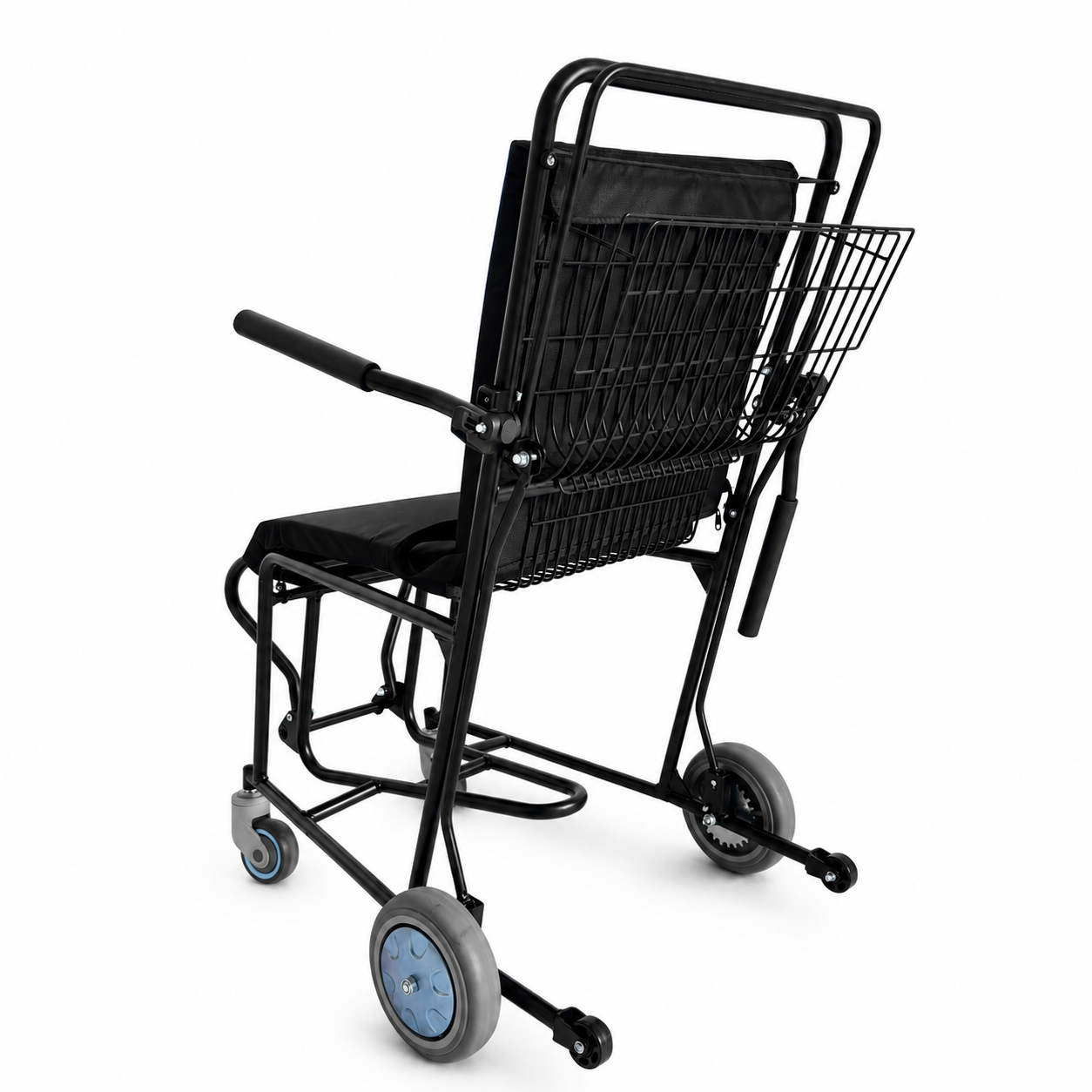
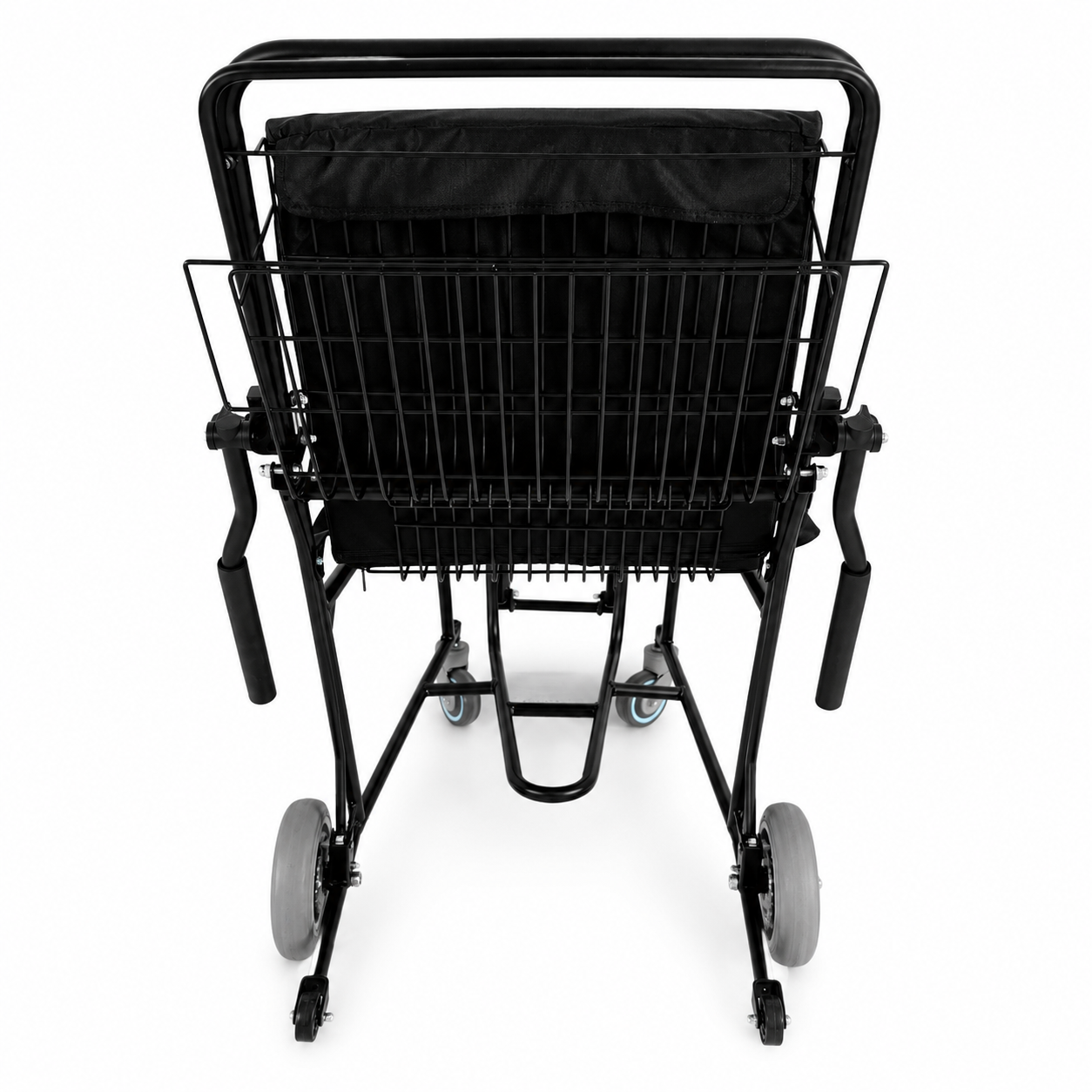
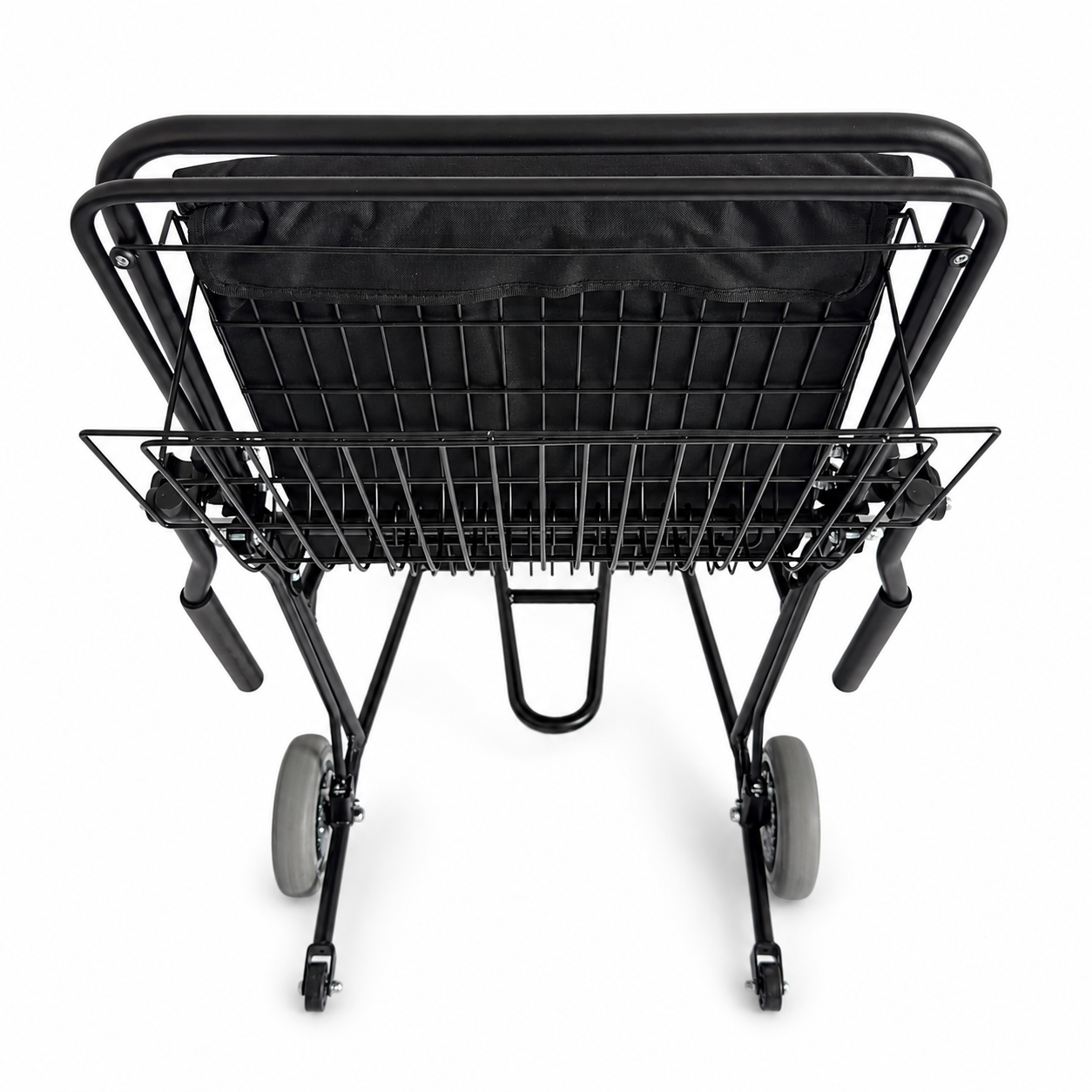
Airport wheelchair procurement trials should involve trained attendants and the relevant service or fit team. The rear view shows push handles and basket, but not the approved pushing, parking or passenger-transfer method. Follow maker guidance and an individual service plan.
What should a trial record?
Separate equipment handling from personal care. WHO's wheelchair provision guidance links selection, fitting, training and follow-up. A transfer device has its own plan; do not treat the basket or chair handle as an improvised transfer aid.
- Identify approved attendant control points.
- Record route and transfer roles.
- Keep user-specific fit with trained personnel.
| Trial task | Owner |
|---|---|
| Chair handling | Trained airport staff |
| Passenger fit or transfer | Appropriate assessed service team |
One successful empty-chair push cannot settle a personal transfer. Key Takeaway: The buyer can design a trial that covers both product and service.
How should airport wheelchair procurement compare nesting?
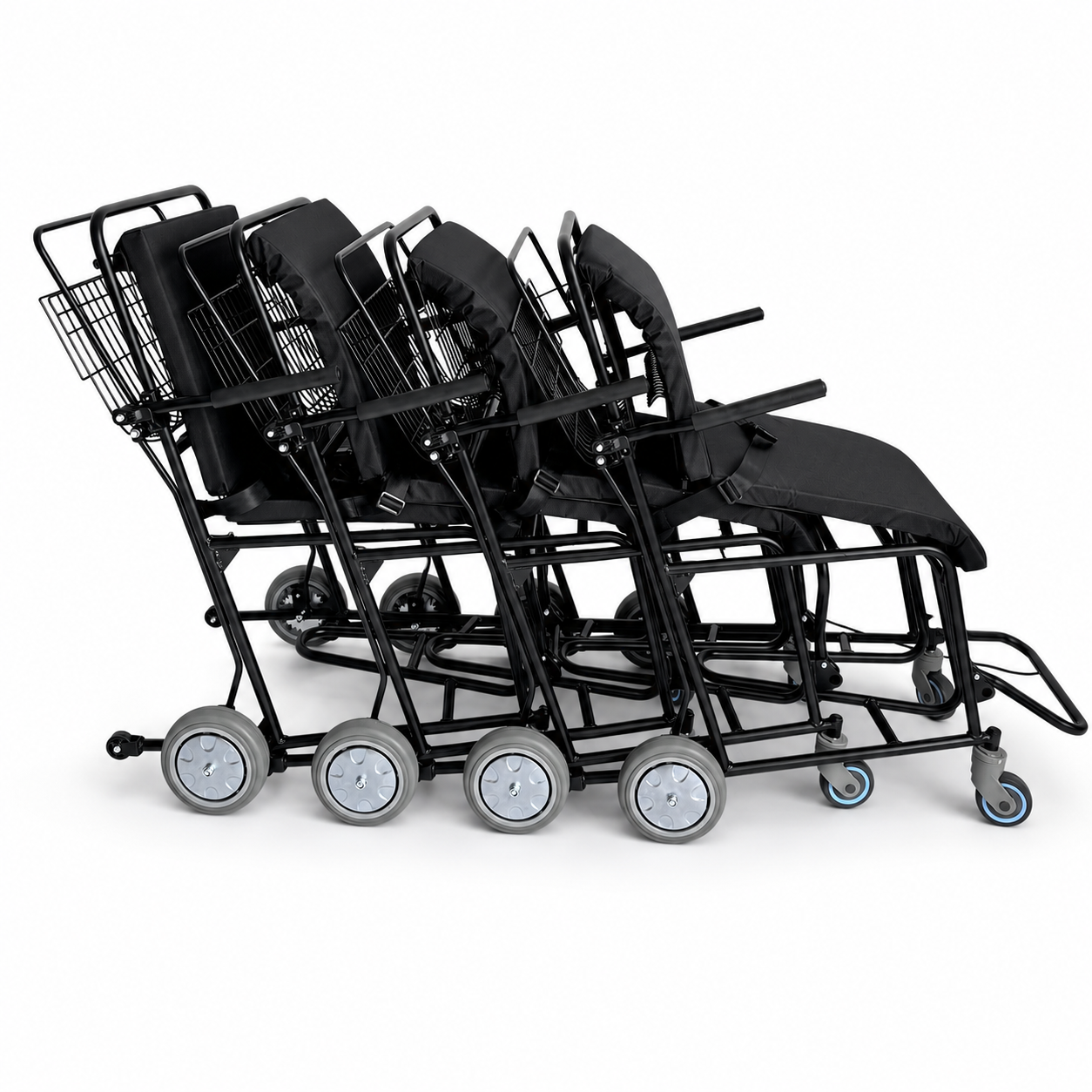
Airport wheelchair procurement may compare nested storage layouts, but only through measured chairs and the actual storage bay. The supplied image shows several chairs together without a trustworthy footprint. Do not quote a space saving from the photograph.
What should the storage trial measure?
Count the floor space and access path. Record how chairs are placed under the maker's method and how one is retrieved. Keep staff movement and any fire or site rule with the airport operator, not a generic sales claim.
- Measure the nested group and aisle.
- Check the approved nesting sequence.
- Record retrieval and service access.
| Storage fact | Question |
|---|---|
| Group footprint | What was measured on site? |
| Retrieval path | Can staff remove the needed chair? |
Nesting helps only when the whole workflow is workable. Key Takeaway: The tender can demand a measured layout.
What wheel proof helps airport wheelchair procurement?
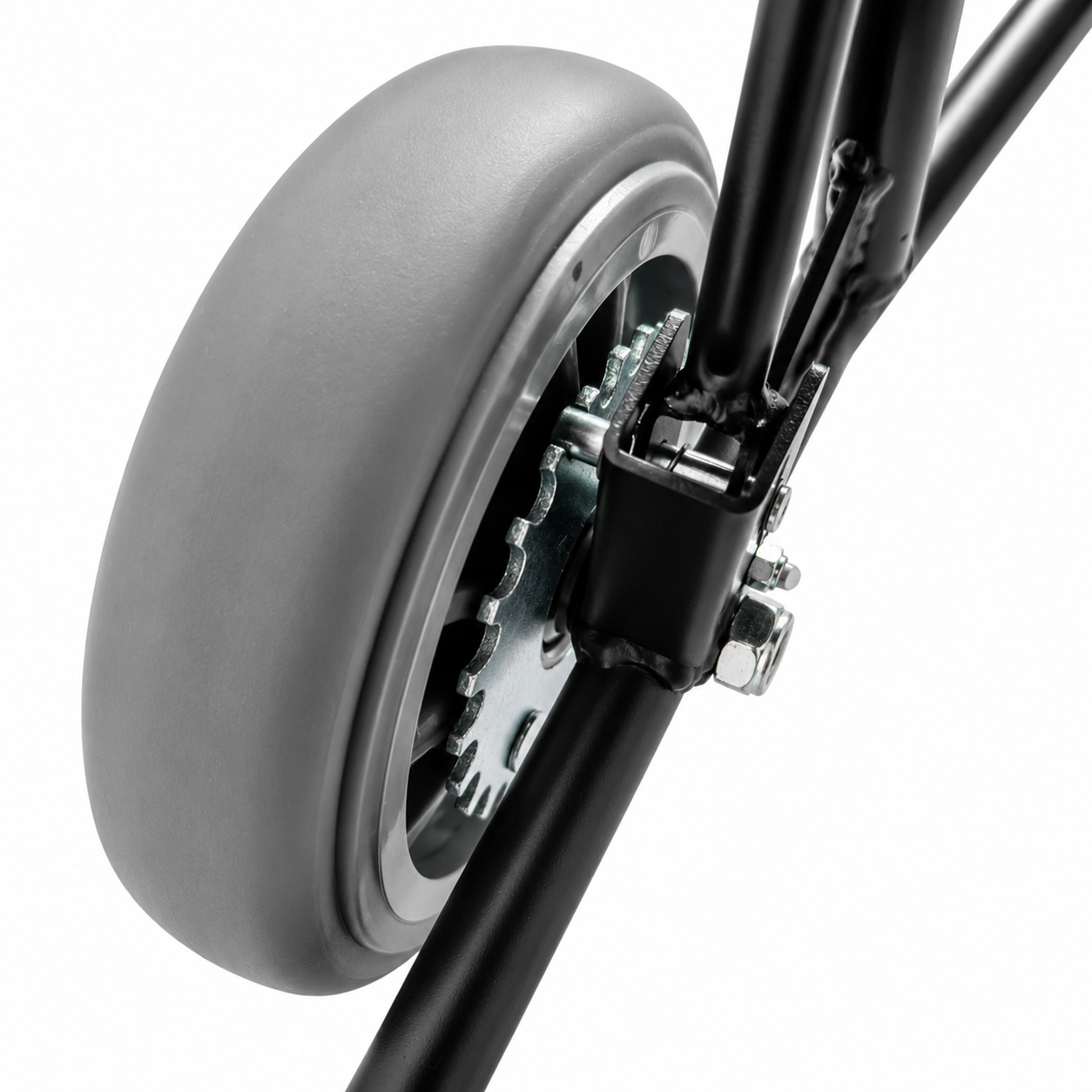
Airport wheelchair procurement should request model-specific wheel, caster and brake information for fleet use. The close-up shows a large grey rear wheel and a mechanism but not its stopping result or service interval. Ask for maker data and a trained trial.
Which items matter after delivery?
Plan maintenance with the tender. Specify approved rear-wheel and front-caster part codes, service checks and fault route. Avoid a generic wheel substitute based on hub color.
- Request wheel and caster specifications.
- Ask how brakes are checked under the guide.
- Name the service owner for failures.
| Wheel area | Evidence |
|---|---|
| Rear wheel | Part and service record |
| Front caster | Model-matched assembly |
A fleet cannot rely on a close-up to maintain braking parts. Key Takeaway: Procurement can price and plan service honestly.
Can airport wheelchair procurement set load limits from photos?
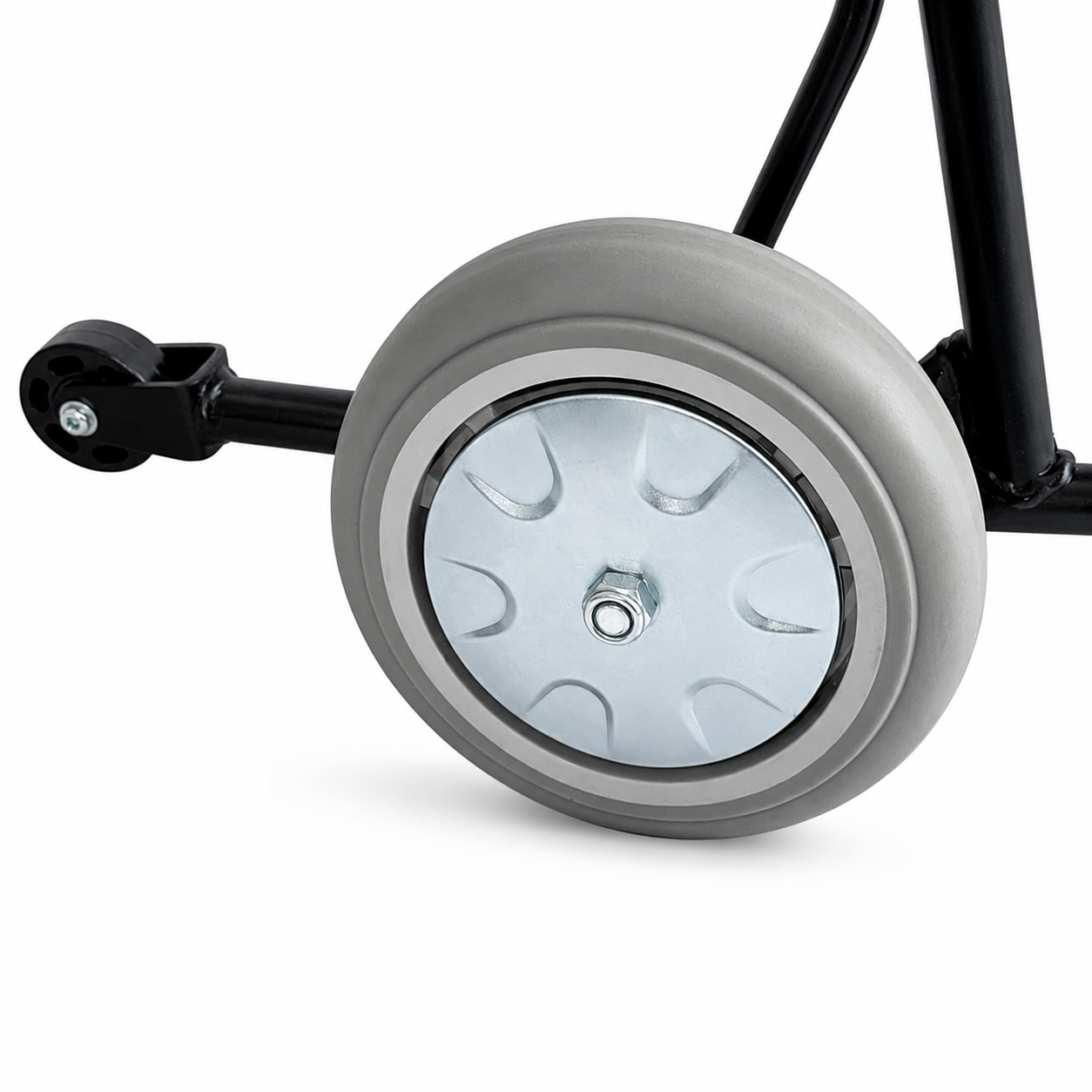
Airport wheelchair procurement cannot set a user load, basket limit or aisle claim from product photos. The rear-wheel detail gives no tested rating. Request current limits and the exact conditions under which the maker states them.
Which claims need a clear source?
Put numbers only where evidence exists. Ask for verified seat, basket and handling limits tied to the offered model. Keep any passenger-assistance use within trained staff procedures.
- Request documented product limits.
- Separate basket use from chair handling.
- Remove unverified performance numbers from the tender.
| Claim | Needed source |
|---|---|
| User or basket limit | Current maker file |
| Route fit | Measured airport trial |
A photo can identify a basket without rating it. Key Takeaway: The contract avoids a number nobody can defend.
Which EU files affect airport wheelchair procurement?
Airport wheelchair procurement for France needs an applicable-law decision for the exact product and stated purpose. If the Medical Device Regulation applies, the manufacturer must follow its conformity route and supply the required user information. The photos do not prove CE status.
What should the file index show?
Ask for scope before a badge. The EU MDR defines the covered route; the Commission language overview lists country information for covered devices. Confirm current French user-text duties and any other applicable rule with the responsible partners.
- State intended purpose and model.
- List applicable EU and French requirements.
- Request matching declaration and user files where required.
| Legal question | Answer owner |
|---|---|
| Which route applies? | Manufacturer and French partner |
| Which files exist? | Model-matched document review |
A marketing label cannot substitute for a legal-scope record. Key Takeaway: The buyer can request the correct documents without claiming approval.
What terms should airport wheelchair procurement fix in writing?
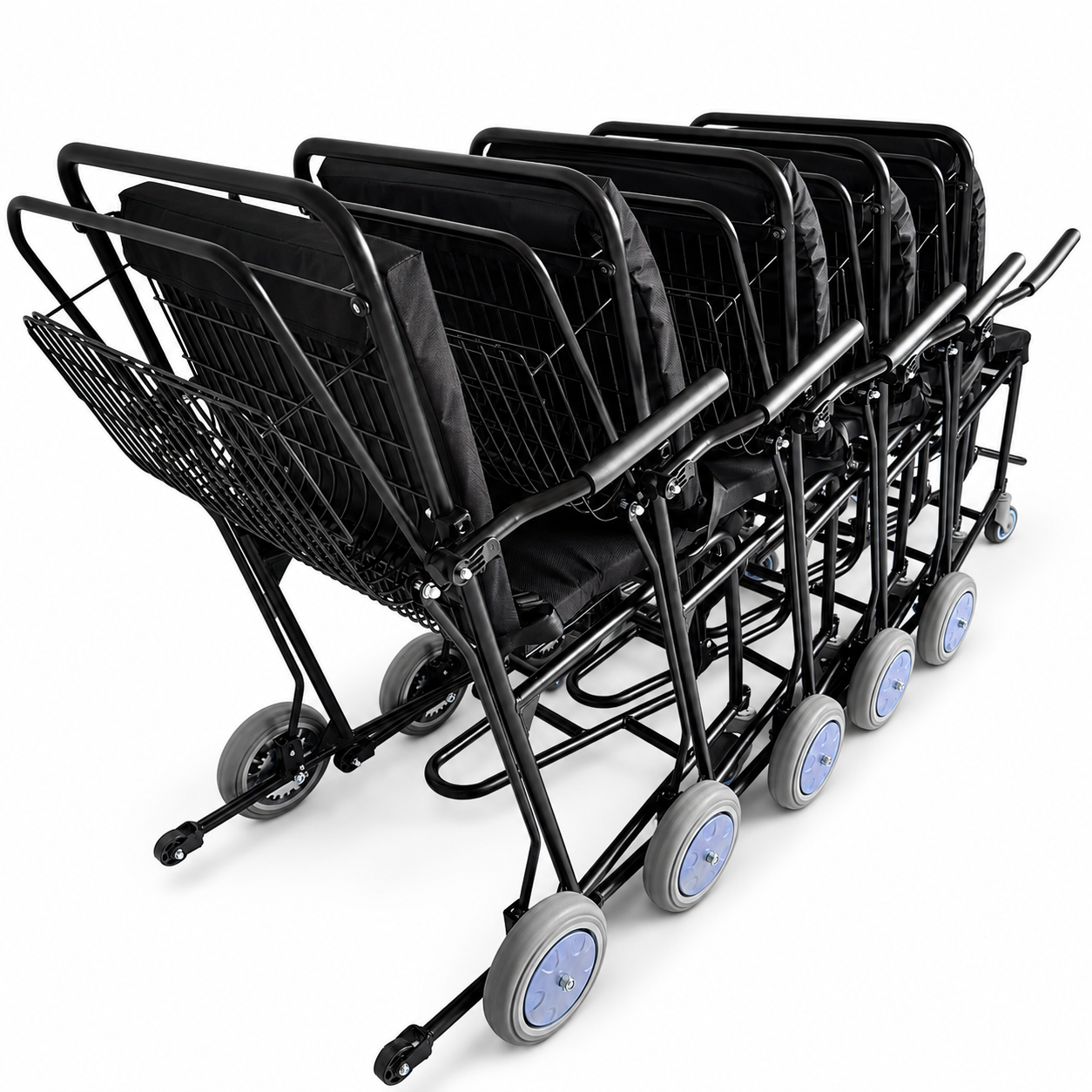
Airport wheelchair procurement terms should state the model, quantity, sample, price, delivery, spare-parts support and warranty in a dated offer. The nested fleet photo establishes none of those commercial promises. Ask for current terms instead of inventing a minimum order or lead time.
What needs a separate line?
Make service part of the deal. Clarify carton contents, training, replacement parts and what happens when a chair fails incoming checks. Keep quote revisions linked to the agreed product version.
- Request dated pricing and lead time.
- Define sample and final order scope.
- Record warranty and service response.
| Term | Question |
|---|---|
| Order and delivery | What is promised now? |
| After-sales | Who repairs and supplies parts? |
A low chair price cannot cover missing service terms. Key Takeaway: France buyers can compare offers on complete costs and support.
What service plan should airport wheelchair procurement include?
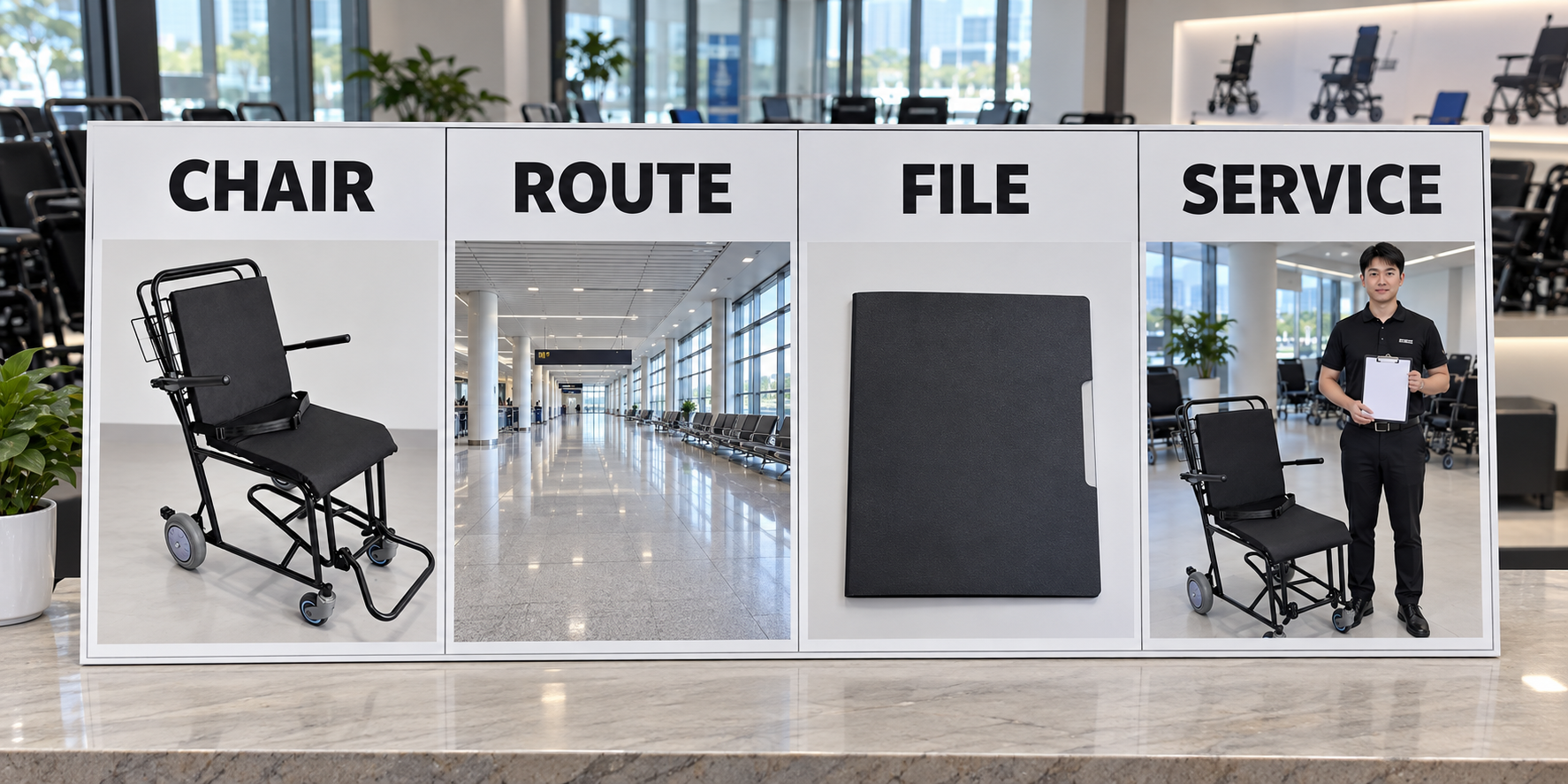
Airport wheelchair procurement should include receiving checks, fleet IDs, spare-part codes, repairs and follow-up. The chart above is a planning aid, not a performance certificate. Keep the service plan tied to actual chair use and site conditions.
What should be reported over time?
Track the chair, not just the shipment. Ask the supplier team for current parts and repair guidance. Record repeat wheel, belt or basket issues by chair ID and address them under the maker's process.
- Assign fleet ID to each chair.
- Set inspection and repair routes.
- Keep user and attendant feedback with service records.
| Fleet record | Purpose |
|---|---|
| Chair and part history | Supports repair decisions |
| Staff feedback | Flags recurring handling concerns |
A tender that ends at delivery misses the life of the fleet. Key Takeaway: The operator can plan ongoing support.
How do you choose airport wheelchair procurement for France?
Choose airport wheelchair procurement for France by testing the exact attendant chair on the real route and checking applicable law, product evidence and long-term service. Treat nesting, load and airline acceptance as open questions until the proper parties confirm them. Keep each passenger's fit and transfer plan with trained staff.
What should the enquiry include?
Send the fleet job, not a chair photo. Name the airport routes, model candidate, staff roles, storage bay and France partner. Request samples, measured files, current legal-scope note and service terms.
- Define route and attendant trials.
- Request product and applicable EU files.
- Agree parts, training and commercial support.
| Buyer input | Response to seek |
|---|---|
| Chair and site | Sample and measured trial |
| Market and fleet | Documents and support plan |
The best choice is one the operator can use and maintain responsibly. Key Takeaway: For model and tender details, contact us. Ary Medical supports airport assistance built on measured routes, trained staff and serviceable chairs.
Frequently asked questions
Q1: Can I assume this chair is approved by every airline?
No. Ask each airline or airport operator about its own acceptance and service requirements.
Q2: What's the best way to compare nesting space?
Measure the actual chair group and storage bay under the maker's method; photos have no scale.
Q3: How do I know if MDR documents are required?
Ask the manufacturer to assess intended purpose and applicable EU law for the exact model.
Q4: Can one empty-chair trial prove passenger fit?
No. Keep individual assessment and transfer planning with trained personnel.
Q5: What should a fleet tender include beyond the unit price?
Include samples, measured route checks, training, parts, repair and written delivery terms.