
Everything you need to know about these power sources involves understanding their deep-cycle chemistry, terminal configurations, and maintenance protocols to ensure long-term mobility independence.
Maintaining mobility is a constant challenge for users who rely on power chairs for daily professional and personal tasks. If your device loses power mid-day, your productivity and freedom are immediately compromised, creating a stressful cycle of range anxiety. electric wheelchair batteries from ARYMD provide the reliable, high-capacity energy storage needed to solve these performance gaps and keep you moving forward.
What are electric wheelchair batteries?
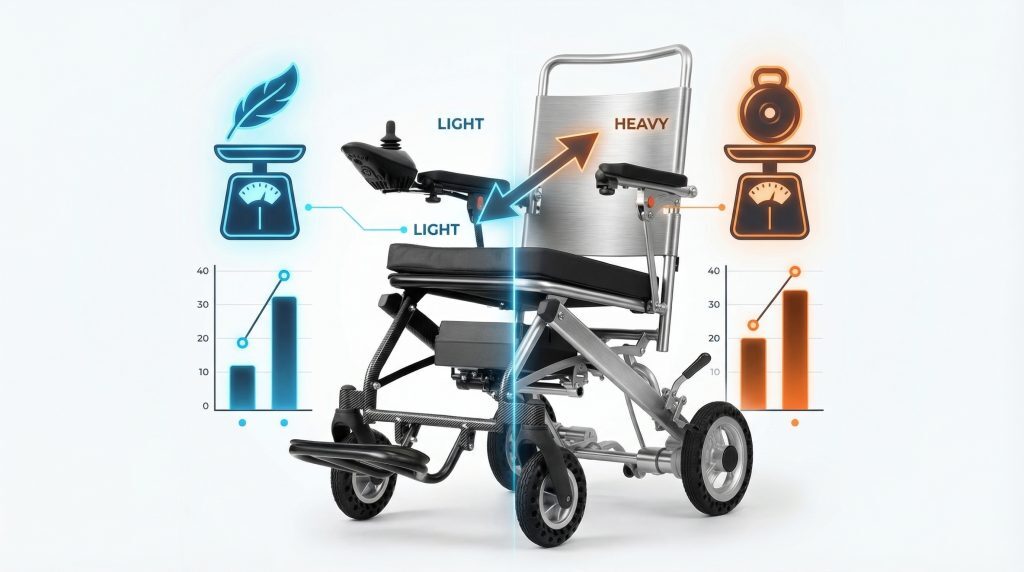
Electric wheelchair batteries are specialized deep-cycle power units designed to provide a steady flow of electricity over an extended period. Unlike automotive batteries that provide a high burst of energy to start an engine, these batteries are built for sustained discharge. They are the heart of any mobility device, determining both the range and the reliability of the equipment.
Understanding deep-cycle technology
Deep-cycle technology allows the battery to be discharged and recharged hundreds of times without damaging the internal plates. This is critical for users who require their wheelchairs for 12 to 16 hours of daily use.
Here is why deep-cycle matters:
- Resilience: They withstand frequent “deep” discharges of up to 80%.
- Consistency: Power delivery remains stable until the battery is nearly empty.
- Longevity: Specialized internal construction prevents premature cell death from heavy cycling.
Believe it or not, using a standard car battery in a wheelchair will likely destroy the electronics within weeks.
What makes them different from car batteries?
Car batteries are designed for “SLI” (Starting, Lighting, and Ignition) purposes, providing quick bursts of power. In contrast, wheelchair units prioritize thick lead plates to handle the constant drain of electric motors.
Consider these differences:
- Plate Thickness: Wheelchair batteries have much thicker plates for durability.
- Energy Release: They release energy slowly rather than all at once.
- Safety Features: Most are sealed and spill-proof for indoor use.
The bottom line is: Deep-cycle units are the only safe and effective choice for mobility.
Key Takeaway: Choosing dedicated deep-cycle technology ensures your mobility device operates safely and efficiently over thousands of cycles.
| Feature | Car Battery (SLI) | Wheelchair Battery (Deep-Cycle) |
|---|---|---|
| Primary Goal | Engine cranking | Sustained travel |
| Discharge Depth | 5% to 10% | 50% to 80% |
| Internal Structure | Thin, porous plates | Thick, solid plates |
This comparison highlights why using the correct battery type is non-negotiable for equipment safety.
How do electric wheelchair batteries work?
Most electric wheelchair batteries function as part of a 24-volt system, utilizing two 12-volt units wired in a series configuration. This setup allows the motors to receive sufficient voltage to climb ramps and navigate rough terrain while maintaining a slim profile. By storing chemical energy and converting it into electrical current, these batteries power the joystick, controller, and dual motors.
The role of 24-volt systems
The 24-volt standard is the industry benchmark because it balances power efficiency with component size. Standardized systems make it easier to find replacement chargers and universal connectors across different brands.
Why 24-volts is the standard:
- High Torque: Provides the necessary force for heavy-duty motors.
- Efficiency: Reduces the amount of current needed, which minimizes heat.
- Compatibility: Works with standard controllers like those on the MHL 1007-A.
Make no mistake: Wiring your batteries incorrectly can lead to a complete system failure.
How does the battery discharge?
Discharge occurs as the chemical reaction inside the cells releases electrons that travel through the wheelchair’s wiring to the motors. As the battery depletes, the internal resistance increases, which is why your chair might feel “sluggish” when the charge is low.
Essential discharge facts:
- Rate of Discharge: Higher speeds and inclines drain power faster.
- Temperature Effects: Cold weather significantly reduces the available discharge capacity.
- Voltage Drop: A healthy battery maintains a steady voltage until the end of its cycle.
In other words: Your driving habits directly dictate how long your power will last each day.
Key Takeaway: Understanding the 24-volt series connection is vital for maintaining the high-torque performance required for navigating obstacles.
| System Voltage | Battery Configuration | Common Application |
|---|---|---|
| 12V | Single 12V Battery | Small travel scooters |
| 24V | Two 12V Batteries (Series) | Most power wheelchairs |
| 36V+ | Specialized Packs | High-speed mobility units |
This data confirms that a dual-battery setup is the most common configuration for professional-grade wheelchairs.
Why choose AGM electric wheelchair batteries?

AGM (Absorbent Glass Mat) electric wheelchair batteries are a popular choice because they offer a cost-effective, spill-proof, and maintenance-free power solution. They utilize a fiberglass mat to soak up the electrolyte, which makes them highly resistant to vibration and leaks. For many B2B fleet managers, AGM represents the ideal balance between initial investment and reliable performance.
Cost-effectiveness of AGM
AGM units typically have a lower upfront cost compared to Gel or Lithium-ion alternatives. This makes them highly attractive for institutional settings or for users who need a reliable replacement on a tight budget.
Key economic benefits:
- Initial Savings: Significantly cheaper than Gel batteries of the same capacity.
- Availability: Widely stocked and easy to source in standard sizes.
- No Upkeep: Eliminates the labor costs associated with “watering” old-style lead batteries.
But wait, there’s more. AGM batteries also charge faster than Gel batteries, reducing downtime for the user.
Are AGM batteries maintenance-free?
Yes, AGM batteries are completely sealed, meaning you never have to check acid levels or add distilled water. This “set it and forget it” nature is perfect for users who may have limited hand dexterity or access to tools.
Maintenance-free features:
- Sealed Design: No gas leakage under normal operating conditions.
- Vibration Resistance: The glass mat sandwich protects internal components from shocks.
- Position Flexibility: Can be mounted in various orientations without leaking.
In other words: You get reliable power without the mess or danger of acid spills.
Key Takeaway: AGM batteries provide a worry-free, budget-friendly entry point for users who prioritize safety and ease of use in their daily routines.
| Factor | AGM Battery | Standard Lead-Acid |
|---|---|---|
| Maintenance | None required | Requires “watering” |
| Spill Risk | Zero (Sealed) | High (Vented) |
| Charge Speed | Fast | Moderate |
This table illustrates why the transition to AGM technology is a major upgrade for any mobility equipment user.
Are gel electric wheelchair batteries better?
Gel electric wheelchair batteries are often considered superior for heavy-duty, daily users because they offer a significantly higher number of recharge cycles. By turning the electrolyte into a thick silica gel, these batteries prevent acid stratified and offer enhanced protection against deep discharge damage. They are the gold standard for full-time power chair users who cover long distances on varied surfaces.
Benefits of gel for daily users
Daily users benefit from the “recovery” ability of Gel batteries, which can bounce back from deep discharges that might kill an AGM unit. This durability results in a longer overall lifespan, often saving money over the course of several years.
Why daily users choose Gel:
- Higher Cycle Count: Typically lasts 20% to 30% longer than AGM equivalents.
- Deep Discharge Recovery: Better protection against being left in a discharged state.
- Stability: Maintains power even when the charge level is critically low.
Here is the kicker: Gel batteries are virtually immune to “internal shorting” due to their thick electrolyte consistency.
Do they handle extreme weather?
Gel technology is exceptionally resilient to temperature fluctuations, making them ideal for both hot summers and freezing winters. The gel prevents the electrolyte from freezing or evaporating, ensuring consistent voltage in harsh environments.
Weather resilience factors:
- Heat Tolerance: Less prone to “thermal runaway” in high-temperature climates.
- Cold Performance: Maintains capacity better than AGM when the thermometer drops.
- Storage Stability: Very low self-discharge rate during seasonal storage.
In other words: If you live in a region with extreme seasons, Gel is your safest bet.
Key Takeaway: Investing in Gel technology pays dividends in longevity and climate resilience, ensuring your chair stays operational regardless of the season.
| Metric | Gel Battery | AGM Battery |
|---|---|---|
| Expected Lifespan | 18–24 Months | 12–18 Months |
| Heat Resistance | Excellent | Moderate |
| Best Use Case | Heavy daily travel | Occasional/Light use |
Choosing Gel over AGM is a strategic decision that prioritizes long-term reliability over immediate cost savings.
How to charge electric wheelchair batteries?
You should charge electric wheelchair batteries after every use, regardless of how short the trip was, to prevent the lead plates from hardening. This habit, known as “opportunity charging,” is the single most effective way to extend the life of your power source. Modern chargers are “smart” and will automatically switch to a float mode once the batteries are full to prevent overcharging.
Best practices for daily charging
Developing a consistent charging routine is the key to avoiding being stranded with a dead chair. It is best to charge the batteries overnight for 8 to 10 hours to ensure a full saturation of the cells.
Daily charging rules:
- Charge Nightly: Connect the charger every night before bed.
- Use Dedicated Chargers: Only use the charger that came with your specific chair.
- Ventilation: Ensure the charging area is well-ventilated to dissipate heat.
The long and short of it is: A fully charged battery is a healthy battery.
Should I leave it plugged in?
While modern smart chargers can be left plugged in, it is generally recommended to unplug them once the “Full” light has been on for a few hours. This prevents the very minor risk of a surge or a charger malfunction causing damage over a long period.
Tips for long-term plugging:
- Check for Heat: If the battery feels hot to the touch while charging, unplug it immediately.
- Smart Tech: Verify your charger has an “automatic shut-off” feature.
- Visual Cues: Monitor the LED indicators for any red flashing error codes.
In other words: Trust the smart charger, but verify the status occasionally.
Key Takeaway: Proper charging habits can double the lifespan of your batteries, saving you hundreds of dollars in replacement costs.
| Charging Phase | Duration | Battery Status |
|---|---|---|
| Bulk Charge | 0–4 Hours | Reaches 80% capacity |
| Absorption | 4–8 Hours | Topping off the last 20% |
| Float/Trickle | Ongoing | Maintains 100% safely |
Following this schedule ensures your mobility device is always ready for a full day of activity.
When to change electric wheelchair batteries?
You should change electric wheelchair batteries when you notice a significant drop in daily range or if the chair struggles to climb familiar inclines. Most lead-acid units last between 12 and 24 months depending on usage intensity and maintenance quality. Waiting until the battery is completely dead can leave you stranded in an unsafe or inconvenient location.
Signs of a failing battery
One of the first signs of failure is when the battery gauge drops rapidly during acceleration but recovers when the chair is stopped. This indicates high internal resistance, meaning the battery can no longer hold a stable voltage under load.
Common warning signs:
- Reduced Range: You can’t make it through the whole day on one charge.
- Slow Speed: The chair feels sluggish even on flat surfaces.
- Warning Lights: The controller displays battery error codes or flashing lights.
But wait, there’s more. If the battery casing appears swollen or bloated, it must be replaced immediately for safety.
How do I test the voltage?
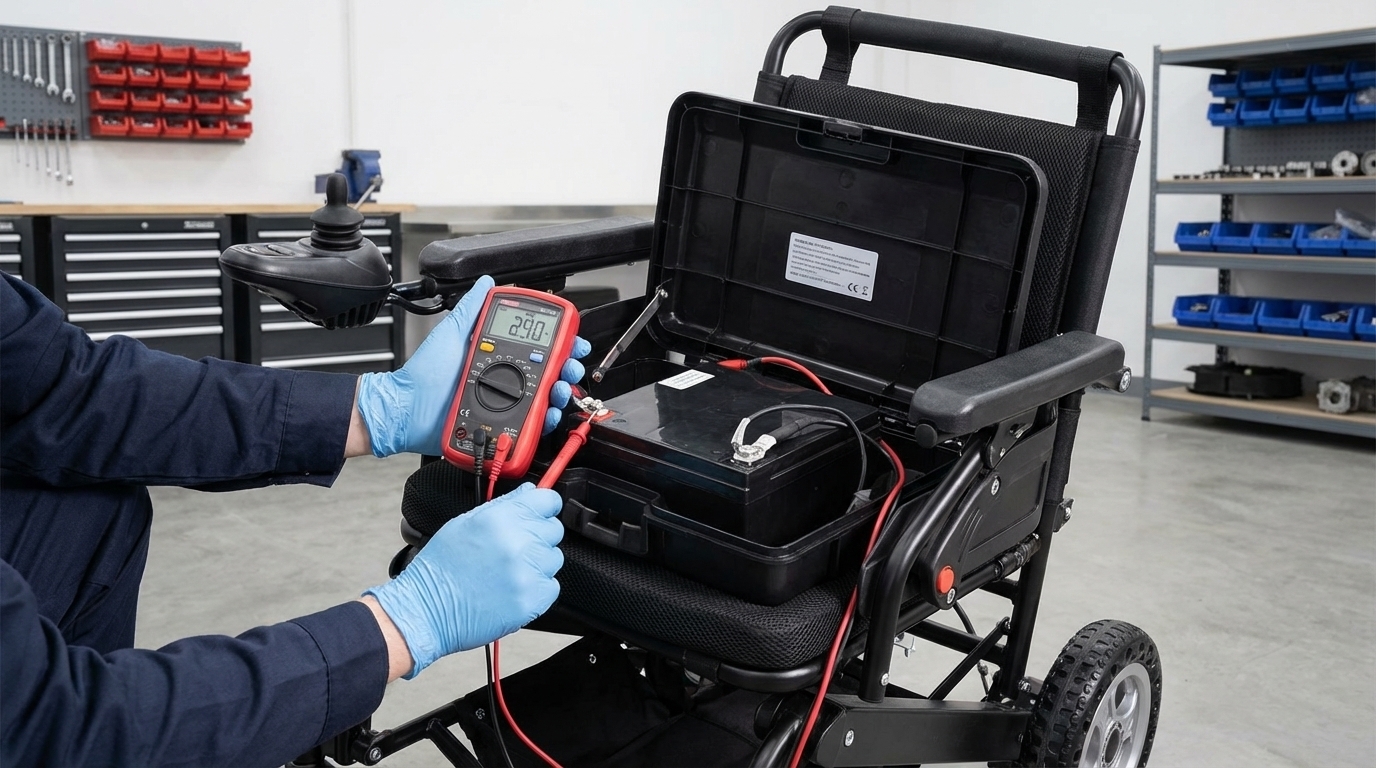
Testing voltage with a multimeter provides a clear, numerical answer to your battery’s health. A healthy 24V system should read around 25.2V to 26.4V when fully charged and disconnected from the charger.
Testing steps:
- Rest the Battery: Wait 30 minutes after charging before testing.
- Check Individual Cells: Test each 12V battery separately; they should be within 0.2V of each other.
- Load Test: If possible, check the voltage while someone is sitting in and operating the chair.
In other words: Numbers don’t lie, so use a multimeter to get the facts.
Key Takeaway: Being proactive about battery replacement prevents mechanical strain on your motors and ensures you are never left without mobility.
| Voltage Reading | Battery Health | Action Needed |
|---|---|---|
| 12.7V – 13.1V | Excellent | None |
| 12.3V – 12.5V | Fair | Monitor closely |
| Below 12.0V | Poor | Replace immediately |
Regular testing allows you to plan your maintenance budget effectively rather than dealing with an emergency.
Where to buy electric wheelchair batteries?

The best place to buy electric wheelchair batteries is from a specialized mobility equipment provider that understands the technical requirements of your specific chair model. Buying from a reputable B2B supplier ensures you receive fresh stock that has not been sitting in a warehouse for months. Always verify that the supplier offers a warranty and has expertise in deep-cycle technology.
Finding reliable suppliers
Reliable suppliers prioritize quality brands and provide detailed technical specifications for every battery they sell. They should be able to assist you in matching the correct Group size (e.g., U1, Group 22NF) and terminal type for your device.
Look for these supplier traits:
- Technical Support: Ability to answer questions about AGM vs. Gel.
- Fresh Inventory: High turnover ensures the lead plates are in peak condition.
- Warranty Support: Clear policies for defective units or premature failure.
Here is the kicker: Local showrooms often allow you to bring your chair in for a professional fitting.
Online vs. in-store purchasing
Online shopping offers convenience and often lower prices, while in-store buying provides immediate access and expert installation services. For many users, a hybrid approach—researching online and buying from a local expert—is the safest route.
Pros of each method:
- Online: Wider selection of high-capacity lithium or gel options.
- In-Store: Instant disposal of old batteries and professional testing.
- ARYMD Options: Direct access to foldable black electric wheelchair parts.
In other words: Choose the path that offers the most peace of mind for your specific situation.
Key Takeaway: Sourcing from a mobility specialist ensures you get the exact voltage and capacity needed to keep your wheelchair under warranty.
| Buying Channel | Advantage | Disadvantage |
|---|---|---|
| Online Specialist | Best Pricing | Shipping delays |
| Local Showroom | Hands-on Help | Higher Markup |
| Manufacturer Direct | Guaranteed Fit | Limited Brands |
Selecting the right partner for your battery needs is the first step toward long-term mobility success.
Can I travel with electric wheelchair batteries?

Yes, you can travel with electric wheelchair batteries , but you must comply with TSA and airline regulations regarding sealed lead-acid or lithium-ion types. Most AGM and Gel batteries are classified as “non-spillable” and are allowed on planes if they are securely attached to the chair. Modern foldable black electric wheelchairs are specifically designed to meet these travel standards for seamless air transport.
TSA and airline regulations
The key to a smooth airport experience is declaring your battery type early and having the “non-spillable” label clearly visible on the battery casing. If you use lithium batteries, you must ensure they are under the 300Wh (watt-hour) limit for air travel.
Airline compliance tips:
- Call Ahead: Notify the airline 48 hours before your flight.
- Labeling: Ensure the “Non-Spillable” sticker is intact and legible.
- Disconnect: Be prepared to disconnect the battery cables if requested by the crew.
Make no mistake: Airlines have the right to refuse batteries that appear damaged or leaking.
How to pack them safely?
When traveling, the battery terminals should be protected from short circuits by using the original battery box or covering the contacts with electrical tape. If you are using a foldable chair, the battery is often protected within the frame, which is a major advantage for frequent flyers.
Safe packing checklist:
- Terminal Protection: Use plastic caps or heavy-duty tape.
- Secure Mounting: Ensure the battery cannot shift during turbulence.
- Documentation: Carry the battery’s safety data sheet (SDS) for the flight crew.
In other words: Preparation is the difference between a great trip and a travel nightmare.
Key Takeaway: Choosing a “non-spillable” battery type like AGM or Gel makes air travel significantly easier and compliant with international safety standards.
| Battery Type | Allowed in Cargo? | Passenger Cabin? |
|---|---|---|
| AGM / Gel | Yes (Attached) | No |
| Lithium (<300Wh) | No | Yes (Removed) |
| Wet Cell (Leaking) | Never | Never |
This travel guide ensures you can explore the world without leaving your independence behind.
Are lithium electric wheelchair batteries safe?

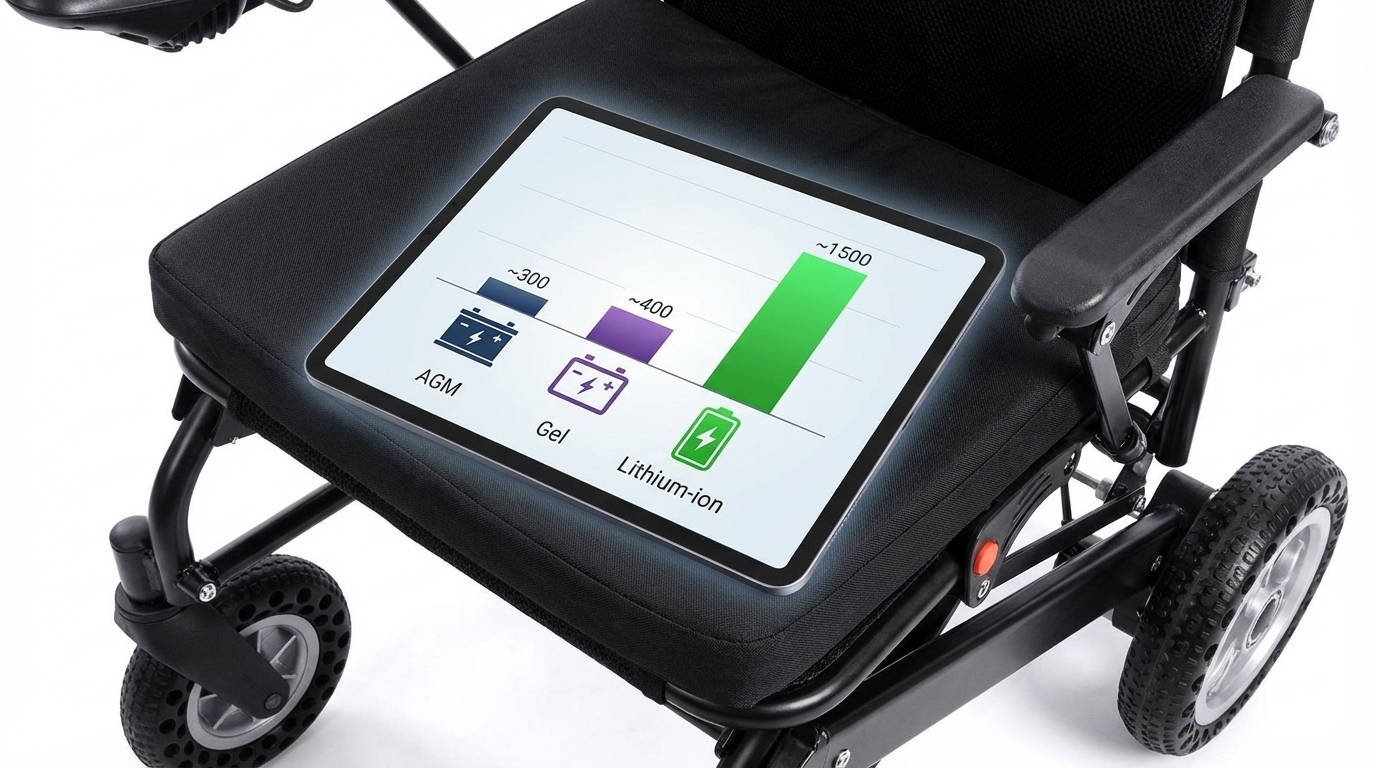
Lithium electric wheelchair batteries are extremely safe when equipped with a high-quality Battery Management System (BMS) that monitors every cell. They offer a massive advantage in weight reduction, often weighing 70% less than lead-acid batteries while providing double the range. As seen in the Esleh Classic models, lithium technology is the future of lightweight, portable mobility.
Understanding lithium technology
Lithium Iron Phosphate (LiFePO4) is the specific chemistry used in high-end wheelchairs because it is much more stable than the lithium found in cell phones. It provides a flat voltage curve, meaning your chair won’t slow down as the battery drains.
Lithium advantages:
- Lightweight: Greatly improves the portability of foldable chairs.
- Life Cycles: Can last up to 10 times longer than lead-acid.
- Fast Charging: Typically reaches full capacity in under 4 hours.
But wait, there’s more. Lithium batteries maintain their health even if they aren’t charged to 100% every single time.
What is a Battery Management System?
The BMS is the “brain” of a lithium battery, preventing issues like overcharging, overheating, and short-circuiting. It ensures each internal cell is balanced, which is essential for both safety and maximizing the battery’s lifespan.
BMS functions:
- Thermal Cutoff: Stops the battery if it gets too hot.
- Cell Balancing: Ensures all cells have equal voltage.
- Low-Voltage Protection: Prevents the battery from draining to a point of damage.
In other words: The BMS makes lithium just as safe, if not safer, than traditional lead-acid batteries.
Key Takeaway: Switching to lithium technology offers the best performance-to-weight ratio, making your foldable chair much easier to transport.
| Feature | Lithium (LiFePO4) | AGM Lead-Acid |
|---|---|---|
| Weight (Approx) | 10 lbs | 35 lbs |
| Cycle Life | 2000+ | 300 – 500 |
| Charge Time | 2–4 Hours | 8–10 Hours |
This technical shift represents the most significant performance upgrade available for modern mobility users.
How to store electric wheelchair batteries?
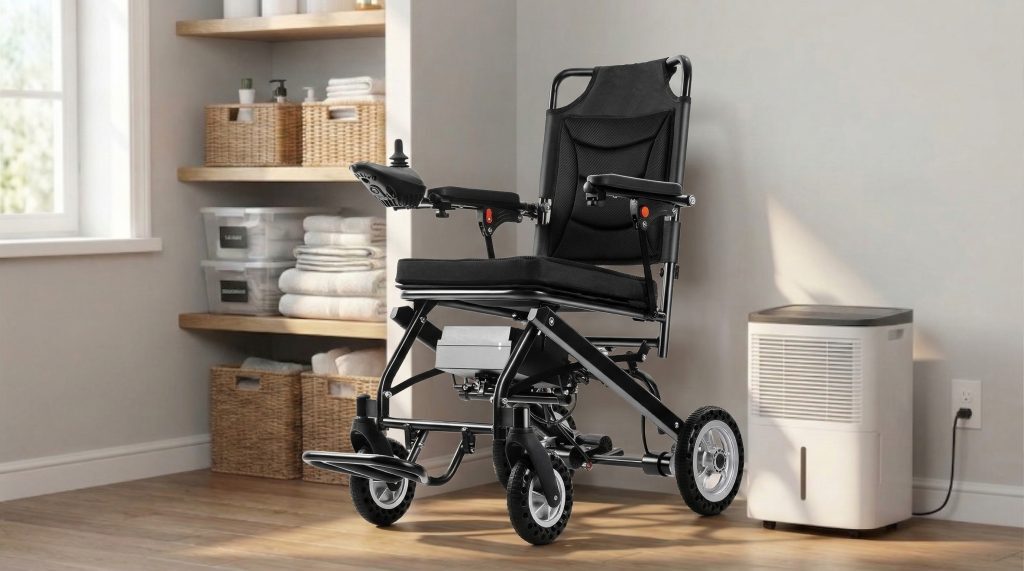
You should store electric wheelchair batteries in a cool, dry, climate-controlled environment with a full charge to prevent permanent capacity loss. Lead-acid batteries naturally discharge over time; if they drop below a certain voltage during storage, they may never charge again. If you plan to store your chair for more than two weeks, disconnecting the battery from the controller is a critical step.
Climate control importance
Extreme heat accelerates the chemical degradation of battery plates, while extreme cold can cause a discharged battery to freeze and crack. A consistent room temperature (around 68°F or 20°C) is the “sweet spot” for long-term storage health.
Storage climate tips:
- Avoid Garages: Uninsulated garages are often too hot or too cold.
- Keep Dry: High humidity can cause corrosion on the battery terminals.
- Off the Floor: Store batteries on a shelf rather than directly on cold concrete.
Believe it or not, a battery stored in a hot attic can lose half its lifespan in a single summer.
How long can they sit unused?
Lead-acid batteries should be topped off at least once every 30 days during storage to keep the chemistry active. Lithium batteries are more resilient but should still be checked every 3 to 6 months to ensure they stay within a healthy voltage range.
Long-term inactivity rules:
- Top-Off Charge: Monthly for AGM/Gel; quarterly for Lithium.
- Disconnect Cables: Prevents “parasitic” drain from the chair’s joystick.
- Visual Inspection: Check for any signs of corrosion or leakage before restarting use.
In other words: Regular attention during the “off-season” ensures your chair is ready when you are.
Key Takeaway: Investing five minutes a month in storage maintenance saves you the high cost of replacing a “bricked” battery next season.
| Battery Type | Self-Discharge Rate | Max Storage (No Charge) |
|---|---|---|
| AGM / Gel | 3% – 5% per month | 3 Months |
| Lithium | 1% – 2% per month | 6–12 Months |
| Standard Lead | 5% – 10% per month | 1 Month |
Following these storage guidelines protects your equipment investment and ensures immediate mobility when needed.
Conclusion
This guide has addressed the most critical aspects of mobility power, from selecting the right chemistry to mastering travel regulations and maintenance. We have explored how high-quality deep-cycle technology and proactive charging habits are the foundation of a reliable, independent lifestyle.
At ARYMD, we specialize in providing cutting-edge mobility solutions like our foldable black electric wheelchairs, designed for professionals who demand portability without sacrificing range. Our products feature advanced battery systems that empower users to navigate their world with confidence and ease.
Take control of your independence by upgrading your power system today. Our team is ready to help you find the perfect energy solution— contact us today to speak with a mobility specialist.
FAQ: Common Questions About Wheelchair Batteries
Can I use a standard car charger for my mobility device?No, because car chargers provide high-amperage bursts that can overheat and warp the thick plates inside deep-cycle wheelchair batteries. Mobility-specific chargers use a multi-stage charging profile designed specifically to protect and saturate sealed AGM or Gel cells safely.
What’s the best battery type for someone who uses their chair outdoors every day?Gel batteries are the best choice for heavy daily outdoor use because they handle deep discharge cycles and temperature extremes better than AGM units. While they cost more upfront, their higher cycle count ensures a lower total cost of ownership for active users.
How do I know if my current battery is completely dead or just needs a reset?If your charger immediately shows a “Full” light but the chair dies within minutes, the battery has likely lost its ability to hold a load and is dead. You can verify this by checking the voltage with a multimeter; a reading below 10.5V on a 12V unit usually indicates a permanent cell failure.
Can I replace only one battery if the other one still holds a charge?No, you must always replace batteries in pairs to ensure they have matched internal resistance and discharge rates. Replacing only one will cause the older battery to drain the new one, significantly shortening the lifespan of your new investment.
What’s the best way to clean battery terminals to prevent corrosion?The most effective method is using a mixture of baking soda and water with a stiff brush to neutralize acid buildup, followed by a thorough drying. Applying a thin coat of petroleum jelly or a dedicated terminal protector spray will help prevent future oxidation and ensure a strong electrical connection.
