
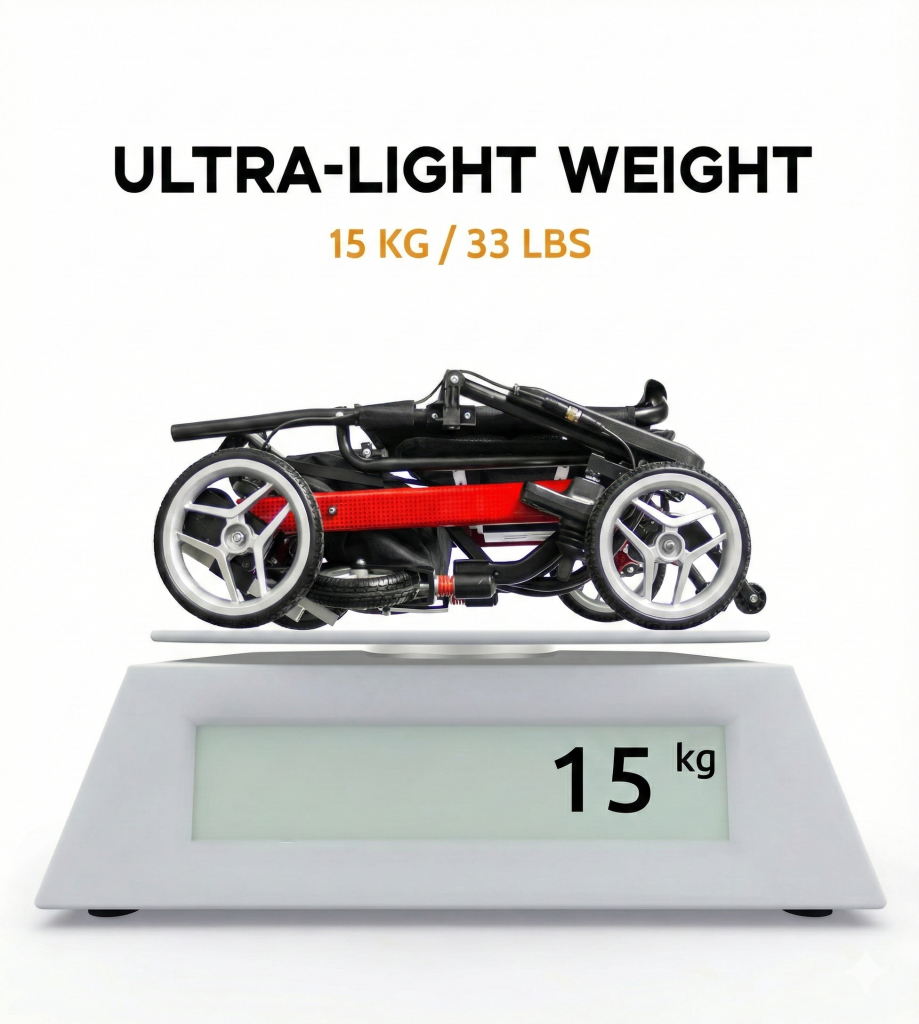
Does your current mobility aid feel less like a tool and more like an anchor? Imagine the possibilities if your power chair weighed less than a packed suitcase. For many facing limited mobility, the barrier isn’t just the distance—it’s the logistics. Enter the game-changer: a foldable electric wheelchair tipping the scales at a mere 15KG (battery included).
This isn’t just about engineering; it’s about lifestyle. Research consistently shows that lightweight mobility solutions significantly reduce physical strain and foster a renewed sense of self-reliance among elderly users. Picture lifting your chair into a car trunk with one hand or navigating a crowded café without hesitation.
In this post, we move beyond the brochure claims. We will dissect the aerospace-grade aluminum frame, test the torque of the dual motors, and analyze how this featherweight design handles real-world terrain. Read on to discover if this engineering marvel is the ultimate travel solution you’ve been waiting for.
The Quick Answer
If you are in a rush, here is the bottom line: This model is currently redefining the “ultra-lightweight” category. By utilizing an aluminum alloy frame that weighs just 13.5kg (bringing the total to 15kg with the battery), it solves the primary pain point of heavy lifting for caregivers and active users.
Despite its featherweight status, it doesn’t compromise on power. It packs dual 200W brushless motors, a 24V lithium battery, and a sturdy 100kg load capacity. With a tight 770mm turning radius, it is optimized for indoor maneuverability and seamless travel. If you need a chair that bridges the gap between heavy-duty power and ambulatory liberation, this spec sheet is the new gold standard.
Read On
But wait—how does a 15kg chair actually handle an 8° slope? Can aluminum really stand up to the daily grind of pavement and gravel? And what does “brushless motor technology” actually mean for your ride quality?
We’re going to strip back the marketing fluff and look at the hard numbers. We’ll compare this 15kg contender against the current market heavyweights (and lightweights) to see if it truly earns the title of the “World’s Lightest.” Let’s break down the specs.
Deep Dive – Product Overview & Specs
The market for lightweight electric wheelchairs is exploding—projected to reach over $5.7 billion by 2025—driven by an aging population that refuses to sit still. But amidst the noise, specs matter. Let’s look at what makes this machine tick.
The Frame: Why Aerospace Aluminum Alloy Matters
The secret sauce here isn’t just the design; it’s the metallurgy. Traditional power chairs use steel. Steel is strong, sure, but it’s also heavy and prone to rust if you live anywhere near the coast.
This chair utilizes aerospace-grade aluminum alloy. This is the same class of material used in modern aircraft bodies—offering an incredible strength-to-weight ratio.
Strength vs. Weight Ratio
Here is the number that matters: 13.5kg. That is the weight of the frame itself. To put that in perspective, that is roughly the weight of a medium-sized pug or a heavily packed carry-on bag.
- Total Weight: 15kg (including the battery).
- Packaging Weight: 15kg (meaning the shipping box itself is minimal).
Why is this critical? For a caregiver or a spouse, the difference between lifting a standard 25kg “lightweight” chair and this 15kg model is the difference between straining a back and an effortless lift. It transforms the trunk of a compact sedan from a “maybe” into a “definitely.”
The “One-Hand” Fold Test
We live in a world that demands speed. The folding mechanism on this unit reduces the chair from a driving size of 1100x570x940mm down to a compact 570x290x740mm.
The compactness allows for what we call “ambulatory liberation”—the ability to go from rolling to stored in seconds. It fits in closets, under beds, and most importantly, in the overhead bins of larger aircraft or the tight trunks of ride-share vehicles.
![Insert Image: A split screen showing the wheelchair fully unfolded next to a measuring tape, and then folded compactly in the trunk of a small sedan.]
Power Under the Hood: Don’t Let the Size Fool You
A common misconception is that “light” means “weak.” In the past, that might have been true. Early lightweight models struggled with carpets or slight inclines. This model, however, uses Dual 200W Brush Motors.
Dual 200W Motors (Total 400W)
You might be asking, “Is 400W total power enough?”
For a chair of this weight, absolutely. Because the motors don’t have to push a heavy 40kg steel frame, all that torque goes directly into moving you. The brushless nature of these motors means they are more efficient, run cooler, and require less maintenance than older brushed counterparts. They provide a smooth acceleration curve, eliminating that “jerky” start feeling found in cheaper models.
24V Battery Performance & Range
The power source is a 24V lithium battery. Unlike the heavy lead-acid bricks of the past, lithium offers high energy density.
- Speed: Adjustable from 1 to 6 km/h. This lets you match a leisurely walking pace (around 4 km/h) or speed up to cross a street quickly.
- Climbing Ability: It handles 8° inclines.
- Reality Check: An ADA-compliant wheelchair ramp is roughly 4.8°. A standard driveway might be 5-8°. This chair handles the vast majority of urban and suburban obstacles without stalling.
Control & Maneuverability
Power is nothing without control. If you’ve ever tried to navigate a mobility scooter through a crowded grocery store, you know the panic of a wide turning circle.
The 360° Smart Joystick
The interface is a 360° joystick controller. It’s intuitive—push forward to go, pull back to slow down, release to stop. It removes the physical strain of tiller steering (like on a scooter), which requires arm strength.
- Adaptability: Usually, these joysticks can be mounted on the left or right armrest, accommodating users regardless of their dominant hand.
Turning on a Dime (770mm Radius)
This is a standout spec: 770mm turning radius. Most standard power chairs have a turning radius of 850mm to 900mm+.
- Scenario: You are in an elevator, and the doors are opening. In a scooter or a larger chair, you have to back out awkwardly. With a 770mm radius, you can spin the chair around nearly within its own footprint and drive out forward.
Safety First: The Electronic Brake System
The chair features an electronic brake. This is a “fail-safe” feature. As soon as you take your hand off the joystick, the brakes engage electromagnetically. Even if you stop halfway up that 8-degree ramp, you won’t roll backward.
![Insert Image: Close-up of the joystick controller with a hand resting on it, highlighting the simple interface.]
Practical User Scenarios
Specs are great on paper, but life happens in the real world. Who is this 15kg aluminum chair actually built for? Based on market trends and user testimonials, it serves three distinct groups.
Who Is This Chair Actually For?
1. The “Cruise Ship” Traveler
Travel is back, and mobility aids need to keep up. Cruise ship cabins are notoriously tight. Doorways are narrow.
- The Fit: With a seat width of 400mm and a total folded width of just 290mm, this unit tucks into the corner of a stateroom without acting as a tripping hazard.
- The Battery: Lithium batteries are generally airline and cruise-line compliant (always check specific watt-hour ratings with your carrier), making this the ultimate “fly and sail” companion.
2. The Independent Urbanite
For those living in apartments or navigating the city, size is everything.
- The Wheels: The 7-inch front and 9-inch rear PU wheels are solid. No flats, ever. While they aren’t designed for off-roading in mud, they are perfect for asphalt, mall tiles, and packed park paths.
- The Height: With a back height of 430mm and a total height of 530mm, it sits at a conversational level, allowing you to interact with people eye-to-eye rather than looking up at them constantly.
3. The Caregiver’s Best Friend
We often focus on the user, but what about the person loading the car?
- The Strain Factor: Lifting a 35kg competitor product is a two-person job or requires a specialized vehicle hoist (which can cost thousands).
- The Solution: At 15kg, lifting this chair is comparable to lifting a large bag of groceries. It protects the caregiver’s back and eliminates the need for expensive van modifications.
![Insert Image: A senior couple at an airport terminal, with the man easily pulling the folded wheelchair like a suitcase.]
Comparison & Market Analysis
How does this 15kg wonder stack up against the “lightweight” competition? The term “lightweight” is often abused in marketing, applied to anything under 30kg. Let’s look at the reality.
Aluminum vs. Steel: A Distributor’s Perspective
If you are researching options, you will see cheaper steel models. Here is why you should avoid them for travel.
| Feature | Aerospace Aluminum Alloy (This Model) | Carbon Steel (Standard Models) |
|---|---|---|
| Total Weight | 15 KG | 30 KG – 45 KG |
| Rust Resistance | Excellent (High) | Moderate (Prone to rust) |
| Durability | High Tensile Strength | Strong but Heavy |
| Portability | One-person lift | Two-person lift or Hoist |
| Price Tier | Mid-to-High | Low-to-Mid |
Analysis: While steel is cheaper, the weight penalty is massive. A 30kg chair effectively grounds you if you don’t have a specialized vehicle. The aluminum investment pays dividends in daily usability.
Load Capacity Realities
One question we see often in forums: “How can a 13.5kg frame hold a 100kg person?”
It comes down to engineering geometry. The frame creates a rigid structure that distributes weight down to the axles.
- Load Capacity: 100kg (220 lbs).
- Seat Dimensions: 400mm width.
Note: If you are near the 100kg limit, you might notice a slight reduction in battery range or climbing speed on steep hills, but the frame integrity remains solid. This follows the market trend of “doing more with less,” similar to how modern bicycles are getting lighter yet stronger.
Competitor Landscape
Looking at the search data:
- WHILL Model F: A fantastic chair, but weighs approx 26.7kg with battery.
- Foldawheel PW-999UL: Very close competition, often cited around 20-21kg.
- Pride Go-Chair: A breakdown model, but heavier at 58kg total.
At 15kg, the model we are reviewing today sits at the absolute cutting edge of the “Ultra-Light” segment.
Maintenance & Logistics
You’ve bought the chair. How do you keep it running for years?
Keeping It Rolling: Maintenance Tips
Because this chair uses brushless motors and solid PU wheels, maintenance is minimal, but not non-existent.
Battery Care for Longevity
Lithium batteries hate being empty.
- Tip: Charge your 24V battery fully before storing the chair for a long period. If you use it daily, plug it in every night. Modern lithium management systems prevent overcharging.
Wheel & Motor Checks
- Tires: The 7-inch front and 9-inch rear wheels are Polyurethane (PU). They won’t pop, but check them for uneven wear if you drive on rough concrete often.
- Cleaning: Wipe down the aluminum frame with a damp cloth. Because it’s aluminum, you don’t need to worry about rust spots appearing after a rainy day outing, but keeping grit out of the wheel bearings is always a good idea.
Unboxing & Logistics (For the B2B Buyer)
If you are reading this as a medical equipment distributor, the logistics specs are your best friend.
- Packaging Efficiency: The box weight is 15kg, and dimensions are tight. This maximizes container loads and reduces shipping costs per unit—a critical factor given current freight rates.
- Ready to Roll: The unit typically comes fully assembled. Unbox, unfold, charge, and go. This reduces return rates caused by user assembly errors.
Conclusion
Final Thoughts: Is Lighter Always Better?
In the world of mobility, weight is directly correlated to freedom. A chair you can’t lift is a chair that stays at home.
This 15kg Aluminum Alloy Electric Wheelchair represents a massive leap forward in ambulatory liberation. It combines the structural integrity of aerospace aluminum with the efficiency of modern brushless motors. With a 13.5kg frame, 100kg weight capacity, and smart safety features like the electronic brake, it isn’t just a piece of medical equipment—it’s a ticket to travel.
For seniors seeking independence, travelers refusing to slow down, or caregivers looking for relief, this spec sheet checks every single box.
Ready to reclaim your mobility? Don’t let heavy equipment anchor you down. Compare the specs, measure your trunk, and see if 15kg is the key to your next adventure.