
Have you ever hesitated to join a spontaneous weekend getaway simply because your mobility gear felt like an anchor? Navigating crowded sidewalks or wrestling heavy equipment into a car trunk shouldn’t be the price of admission for daily life. Fortunately, the landscape of mobility is shifting. Enter the era of portable power propulsion. Modern lightweight electric wheelchairs are more than just medical devices; they are sophisticated, ergonomic perambulation aids designed to restore your autonomy and shrink the world back down to a manageable size.
But does reclaiming this freedom require a heavy financial investment? The market is vast, with options ranging from budget-friendly steel frames to aerospace-grade carbon fiber marvels. Whether you are curious about entry-level models starting around
600orconsideringtheadvancedtechfoundinthe
4,000+ tier, understanding the correlation between cost and quality is essential. This guide breaks down the real price of independence, exploring how foldable designs, lithium battery options, and material choices impact your wallet—and your lifestyle. Let’s navigate the numbers to find the perfect companion for your next adventure.
Quick Summary: The 30-Second Answer for Busy Readers
2,500. Why the difference? It almost always comes down to three things: the frame material (standard steel vs. aluminum alloy vs. carbon fiber), the weight of the unit, and the sophistication of the battery technology. Spending a bit more often gets you a chair that is significantly lighter and easier to lift into a car.
Top 3 Recommendations at a Glance
- Best Budget Pick (Under $1,000): Great for occasional use, mostly indoor activities, or short trips to the mall. Expect heavier frames and basic features.
- Best Value/All-Rounder ($1,500 range): This is where you find the workhorses. Look for aerospace-grade aluminum alloy frames and lithium-ion battery technology.
- Best Premium Ultra-Lightweight ($2,500+): If travel is your life, these carbon fiber frame units are incredibly light and often feature intelligent navigation systems.

[Image: A user navigating a busy urban environment with ease, highlighting the independence a lightweight chair provides.]
Introduction: Mobility, Independence, and the Freedom to Roam
Why Weight Matters for Independence
There was a time when “power wheelchair” meant a 200-pound beast that required a specialized van, a ramp, and a lot of planning to move anywhere. Those days are fading. The modern shift is heavily focused on the portable mobility aid.
Think about the psychology of it. When your chair weighs less, your anxiety about going out drops. You stop worrying, “Will my taxi driver be able to lift this?” or “Can I fit this in my friend’s trunk?” The physical benefit is obvious—less strain on your back (or your caregiver’s back)—but the mental freedom of having a travel-friendly device that is TSA compliant is priceless. It transforms a medical necessity into a lifestyle enabler.
Navigating the Market in 2025
We are going to dive deep into this guide. We aren’t just looking at price tags; we are looking at value. We will break down the specifics of what makes a foldable power chair tick—from brushless motors to electromagnetic brakes. By the end of this, you’ll know exactly why a 15kg chair might be worth its weight in gold compared to a cheaper, heavier alternative.
Detailed Price Breakdown: What Do You Get for Your Money?
Budget-Friendly Options (Under $1,000)
In the sub-$1,000 category, you are looking at the entry-level of the foldable power chair world. These are excellent for users who need mobility assistance primarily inside the home or for short, flat excursions.
- What to expect: You will likely find frames made of steel or heavier standard aluminum. The overall weight often exceeds 25kg (55 lbs), which can be a challenge to lift solo. The batteries might be the older, heavier lead-acid type, or smaller, basic lithium packs.
- Pros and Cons: The biggest pro is affordability—it gets you moving without breaking the bank. However, the trade-off is durability and portability. They aren’t always the best travel-friendly companions due to their bulk.
The Mid-Range “Sweet Spot” (1,000–2,000)
This is where the magic happens for most buyers. In this tier, you start seeing high-quality aerospace-grade aluminum alloy frames that drastically cut down weight while maintaining strength.
- Performance: You get better suspension (hello, shock-absorbing suspension!), meaning a smoother ride over bumpy sidewalks.
- Tech: Expect reliable lithium-ion battery technology that offers a decent extended drive range. These chairs are designed to be your daily driver, capable of handling a maximum slope and varying terrain better than budget models.
Premium and Ultra-Lightweight Designs (2,000–4,000+)
Welcome to the luxury class. Here, money buys you lightness. We are talking about carbon fiber frames and magnesium alloys that are incredibly strong yet featherlight.
- Advanced Tech: These often feature smart wheelchair features like app connectivity, obstacle avoidance sensors, and ultra-compact, sometimes even automatic, folding mechanisms.
- Support: You typically get better warranties and customer service. If you plan to travel the world or live a very active lifestyle, this investment pays dividends in ease of use.
The Anatomy of a Perfect Lightweight Chair: Deconstructing the Specs
When you are shopping, you’ll see a wall of numbers. Let’s decode them using a prime example of modern engineering—a specialized ultra-light 13.5kg electric wheelchair that represents the gold standard in this category.
Ideal Weight and Dimensions
Weight is the single most critical spec for a portable chair.
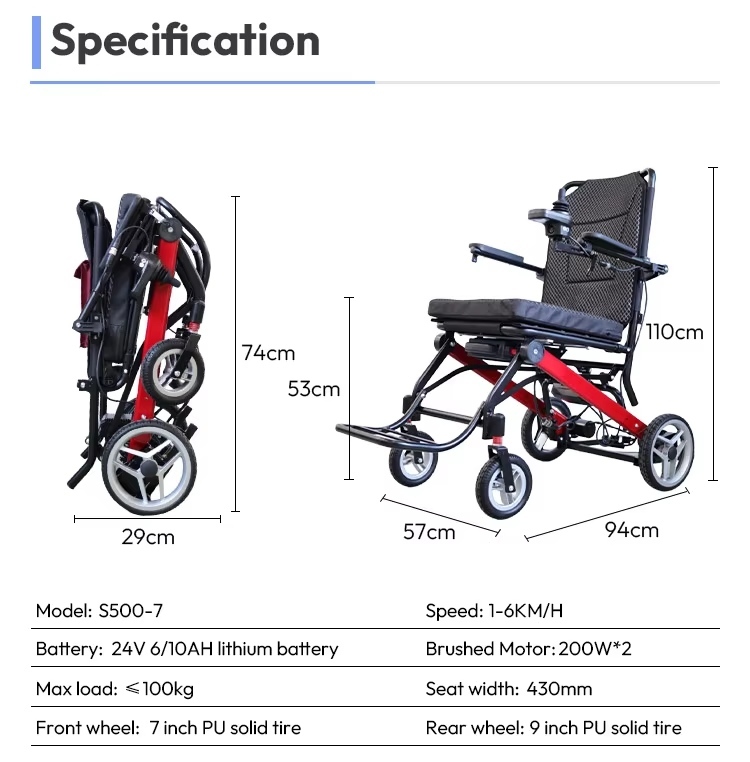
- Frame Weight: A truly lightweight contender features a frame weight of just 13.5kg without the battery. This is light enough for most adults to lift into a trunk with one hand.
- Total Weight: Even with a 6Ah lithium battery installed, the total weight should ideally hover around 15kg. This is the “magic number” for true portability.
- Size Matters: Look for an unfolded size of roughly 1100x570x940mm—large enough to be comfortable but compact enough to fit through standard doorways. Crucially, the folded size (570x290x740mm) is what allows it to vanish into a closet or a small car trunk.
- Shipping: A packaging weight of 15kg indicates that the manufacturer has kept the design lean and efficient right out of the box.
If you want to see exactly what a model with these perfect specs looks like, check out this specific 13.5kg ultra-light model .

[Image: A lightweight electric wheelchair folded down compactly, sitting easily in the trunk of a small car.]
Motor Power and Climbing Ability
Don’t let the small size fool you; these chairs need to perform.
- Dual Motor System: You want stability and power. A setup with dual 200W brush motors is reliable and provides steady torque. While brushless motors are efficient, high-quality brush motors are robust and cost-effective.
- Climbing: A climbing angle of ≤8° is standard and sufficient for almost all ADA-compliant ramps and typical urban inclines. You aren’t climbing Everest, but you’ll handle the steep driveway just fine.
- Speed: Safety is key. Programmable speed settings of 1-6 km/h allow you to dial it down for indoors (so you don’t clip the sofa) and speed it up for a brisk walking pace outdoors.
Battery Tech and Range
The heart of your chair is the battery.
- Options: You generally see 24V 6Ah or 10Ah lithium battery options. The 6Ah is lighter (great for short trips), while the 10Ah gives you that extended drive range.
- Travel Ready: Crucially, these lithium batteries are usually airline approved. Always check that your battery is TSA compliant before you fly, but these capacities generally fall within the safe limits for carry-on mobility devices.
- Charging: Expect off-board charging capabilities, meaning you can leave the chair in the garage and take just the battery inside to charge.
Comfort and Control: It’s Not Just About the Frame
A chair can be light as a feather, but if it hurts to sit in, it’s useless.
Seating Dimensions and Ergonomics
Comfort is a game of millimeters.
- Seat Width: A 400mm seat width is a standard that fits most average-sized adults comfortably without making the chair too wide for narrow doorways.
- Height: A seat height of 530mm and a back height of 430mm provide good ergonomic support, promoting posture during long sits.
- Capacity: Despite being light, a robust aluminum alloy frame should support a load capacity of ≤100kg. This covers the majority of users while maintaining structural integrity.
- Cushion: Look for a breathable seat cushion. You don’t want to stick to your chair on a hot day.
[Image: A realistic, high-quality photograph of a modern lightweight electric wheelchair showing the seat texture and frame finish.]
Precision Handling
You need to be the captain of your ship.
- Joystick: A 360° joystick is non-negotiable. It gives you intuitive control—push forward to go, let go to stop. It should be responsive but not twitchy.
- Turning Radius: A tight turning radius of 770mm is a hero feature. It means you can spin the chair around in a typical hallway or elevator without doing a 10-point turn.
- Brakes: Safety first. An electronic brake system is superior to mechanical locks. It engages automatically when you release the joystick, stopping you safely even on a slope. It’s essentially regenerative braking logic applied to safety.
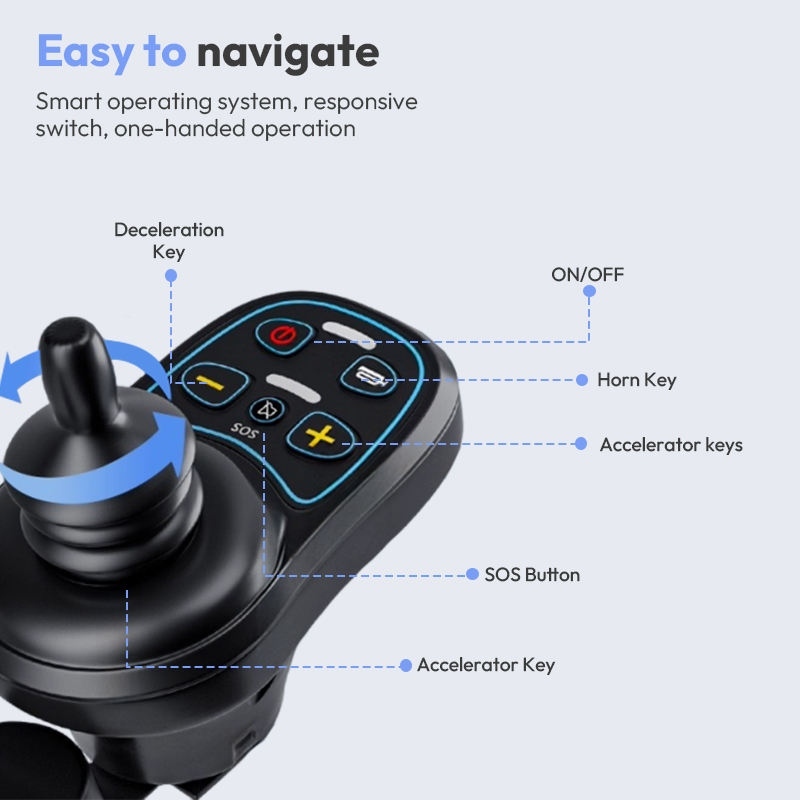
[Image: A close-up of a 360-degree joystick controller, highlighting the intuitive design and speed setting buttons.]
Tires and Suspension
The rubber meets the road—literally.
- Wheel Size: A configuration of 7-inch front wheels and 9-inch rear wheels is a classic stability setup. The smaller front wheels allow for sharp turning, while the larger rear wheels provide push and stability.
- PU Tires: PU (Polyurethane) wheels are the industry standard for a reason. They are puncture-proof wheels. No flats, no air pumps, no worries. They offer a bit of cushion compared to solid plastic but the durability of a solid tire.
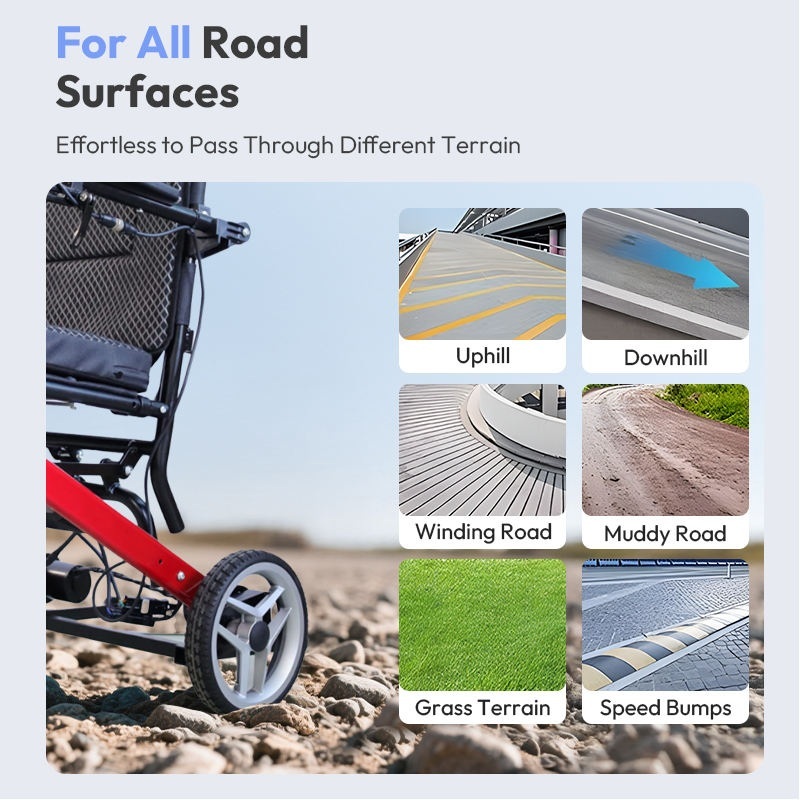
[Image: Detailed view of the 9-inch rear PU tires and 7-inch front caster wheels, showing the tread pattern.]
Major Factors That Influence the Price Tag
Material Science: Aluminum vs. Carbon Fiber
This is the biggest cost driver. Standard aluminum alloy frames are fantastic—durable, relatively light, and affordable. They are the backbone of the mobility independence movement. Carbon fiber, on the other hand, is “space-age” tech. It shaves off those last few kilograms but adds hundreds of dollars to the price. For most users, a high-quality aluminum frame like the one in the 15kg ultra-light models is the perfect balance of cost and performance.
Motor and Battery Technology
Brushless motors are quieter and last longer than brush motors, but they cost more. However, modern dual 200W brush motors have become incredibly reliable and help keep the price in that “sweet spot.” Similarly, lithium-ion battery technology is more expensive than old-school lead-acid, but the weight savings (often 10kg or more!) and longevity make it a mandatory upgrade for anyone looking for a portable mobility aid.
Additional Features and Accessories
Do you need a remote control to fold the chair? Do you need headlights? USB ports to charge your phone? Every bell and whistle adds to the cost. Stick to the essentials—electronic brake, 360° joystick, and a solid folding mechanism—if you want the best value.
Brand Comparison and Popular Models
Top Brands in the 2025 Market
The market is flooded with options, but reliable names rise to the top. You have giants like Pride Mobility and Golden Technologies, known for their extensive dealer networks. Then you have innovative challengers focusing on the direct-to-consumer market with budget-friendly options. When comparing, always look at the warranty. A cheap chair with no support is an expensive paperweight.
Model Showdowns
Let’s do a quick mental comparison.
- Chair A: Traditional power chair. Weight: 50kg. Price: $1,800. Motor: Powerful but heavy. Foldable: Barely.
- Chair B (Our Spec Model): 15kg total weight. Price: Competitive. Motor: Dual 200W. Foldable: Instantly.
For someone living in a walk-up apartment or who loves to travel, Chair B is the clear winner, even if the raw motor power is slightly less than the heavy tank. For a deeper dive into various models, you can browse our comprehensive wheelchair series .
Smart Buying Guide: How to Choose the Right Chair
Assessing Your Lifestyle Needs
Be honest with yourself.
- Indoor vs. Outdoor: If you are 90% indoors, priority goes to turning radius (770mm) and seat width (400mm).
- Traveler: If you dream of cruises and flights, the unfolded size and folded size are your bible. You need that airline approved battery.
- Terrain: If you live on a hill, check that climbing angle (≤8°). Don’t buy a flat-land chair for San Francisco streets.
Where to Buy: Online vs. Local Dealers
Buying online often gets you the best price and direct shipping (remember that efficient packaging weight of 15kg? It makes shipping cheaper). Local dealers offer the advantage of a test drive, but often at a markup. If you know your specs—like needing a 100kg load capacity—buying online is safer than ever.
Financial Options: Insurance and Medicare
Don’t forget to check your coverage. Medicare coverage (Part B) often covers power wheelchairs if they are deemed medically necessary for use inside the home. Insurance reimbursement can take time, so many users opt for financing options (like CareCredit) to get their chair immediately while fighting the paperwork battles.
User Experiences: Real Reviews from 2025
What Users Love
The most common praise in 2025? “I got my life back.” Users love the ultra-lightweight design. Stories abound of people putting their chair in the trunk of an Uber and going to a concert—something they couldn’t do with a 50kg chair. The electronic brake is another favorite; feeling secure on a ramp is a big deal.
Common Complaints to Watch Out For
No product is perfect. Common gripes usually revolve to seat width—if you are larger than average, a 400mm seat width might feel snug. Always measure your hips! Another is range anxiety. If you plan to be out all day at Disney World, get the 10Ah battery upgrade over the 6Ah. Don’t skimp on juice.
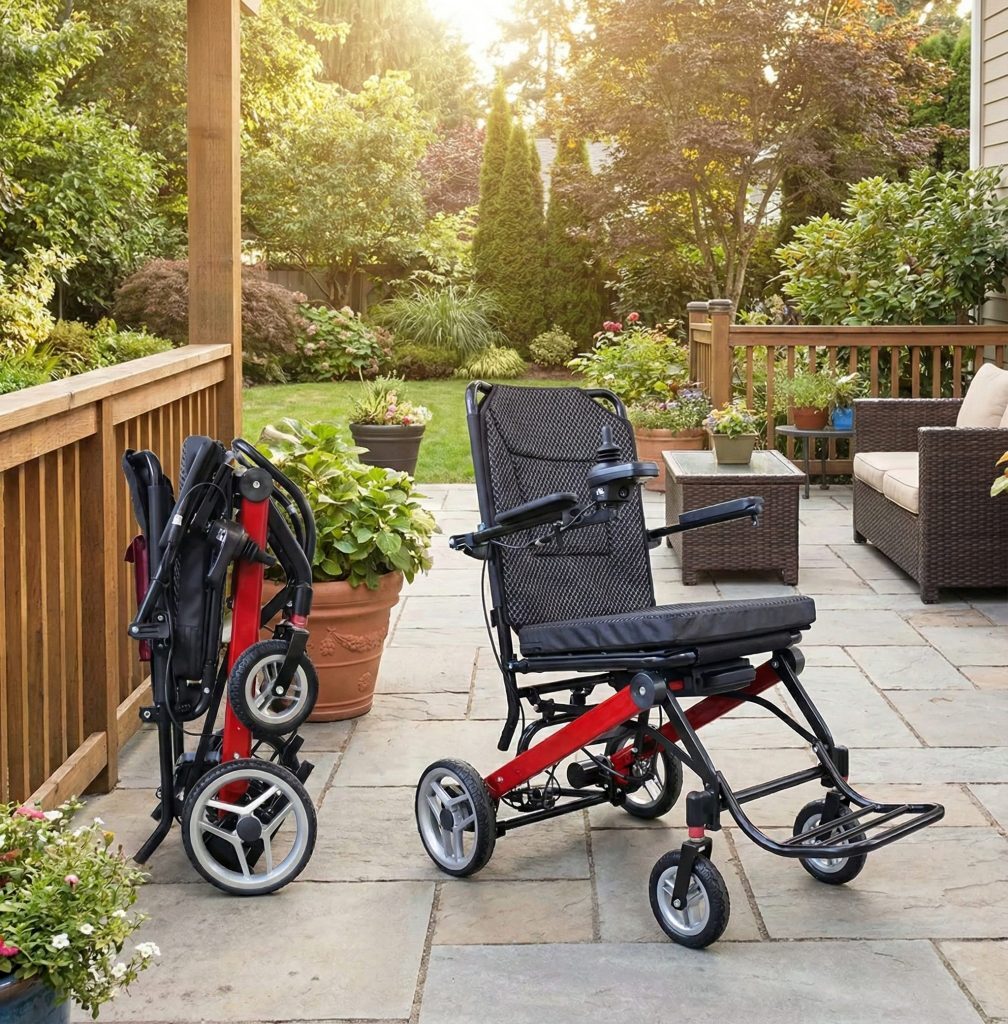
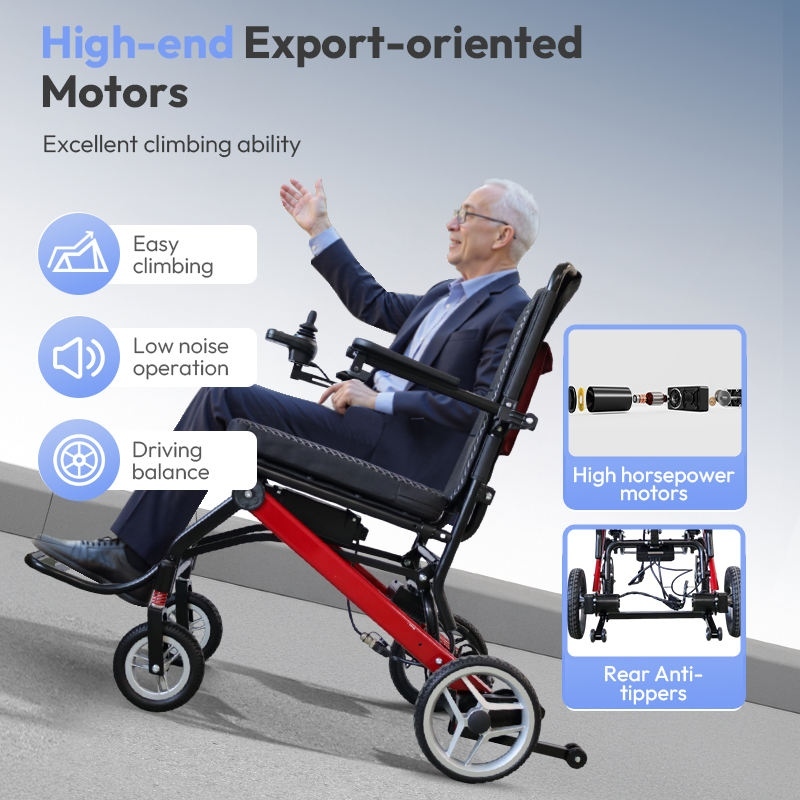
[Image: A demonstration of the wheelchair tackling a moderate incline, showcasing the motor torque and stability.]
Future Trends in Portable Mobility Aids
The Next Generation of Lightweight Tech
We are just getting started. The future holds even lighter materials—think advanced magnesium alloys becoming standard. Intelligent navigation and obstacle avoidance sensors (like those on cars) are starting to trickle down to wheelchairs, helping to prevent bumps and scrapes. We are also seeing better integration with smart home ecosystems, where your chair might one day open your front door for you.
Conclusion
Final Thoughts on Value vs. Cost
The “best” price isn’t the lowest number on the sticker. The best price is the one that buys you reliability, safety, and independence. A
600chairthatbreaksinthreemonthscostsmorethana
1,500 chair that lasts five years.
When you look at a spec sheet featuring an aluminum alloy frame, 13.5kg weight, and dual motors, realize you aren’t just buying metal and rubber. You are buying the ability to say “yes” to lunch dates, “yes” to vacations, and “yes” to simply going to the park. Before you buy, double-check those specs: ensure the load capacity meets your needs and the folded size fits your trunk.
Invest in your freedom. It’s worth every penny.
