

The best seat matches the user's measurements, support needs, daily tasks, and control reach in a Lightweight electric wheelchair. A dealer can deliver a chair that fits through every doorway yet leaves its user sliding forward or reaching awkwardly. Changing a cushion after delivery may alter foot support and joystick height as well. A structured sample fitting helps you catch those conflicts before a wholesale order reaches customers.
1. Where Does Lightweight Electric Wheelchair Fit Start?
Lightweight electric wheelchair fitting starts with an individual assessment of the user and expected tasks. Ask about sitting time, transfers, reach, home routes, and existing supports before comparing seat dimensions. A catalog's broad user category cannot substitute for that information.

Which needs should a distributor record?
Listen before adjusting hardware. The WHO wheelchair provision guidance places individual assessment, fitting, training, and follow-up within a connected service. Use trained personnel for fitting work and obtain clinical advice where support needs require it. For a distributor, the immediate task is collecting accurate information and arranging a suitable review.
- Ask which daily tasks feel difficult now.
- Record current seating and mobility arrangements.
- Identify who will assist with transfers or setup.
- Note concerns that need a qualified seating assessment.
| Information | Why it changes selection | Next step |
|---|---|---|
| Daily tasks | Defines reach and support | Plan relevant trial |
| Existing supports | Affects compatibility | Seek fitting advice |
| User feedback | Identifies unresolved discomfort | Record and review |
These records help separate buying questions from clinical decisions. Key Takeaway: Build a fitting brief around a person rather than a general product label.
2. How Wide Should a Lightweight Electric Wheelchair Seat Be?
Lightweight electric wheelchair seat width should suit the user with suitable clearance while preserving support and control access. Wider does not automatically mean more comfortable. A broad seat can change arm position, available support, and clearance through a doorway, so compare usable space with actual needs.

What should the specification actually measure?
Measure between the obstructions. Compare clear space at the seat, armrests, and any support hardware rather than trusting one width label. The wide-seat wheelchair page can help frame configuration questions, but a wider model still needs individual review. Ask whether padding or optional parts change usable clearance.
- Separate external chair width from clear seat width.
- Check armrest spacing at the user's body level.
- Record installed cushions and support hardware.
- Repeat measurements after any configuration change.
| Width measure | Describes | Useful for |
|---|---|---|
| External frame | Total chair envelope | Doorway planning |
| Clear seat | Available sitting space | Fitting review |
| Armrest gap | Upper-body clearance | Reach and support |
Different dimensions answer different questions during a sample trial. Key Takeaway: Record the actual fitted configuration with every seat-width claim.
3. How Deep Should a Lightweight Electric Wheelchair Seat Be?
Lightweight electric wheelchair seat depth should support the user's thighs while allowing appropriate knee clearance and contact with back support. Too much depth may prevent a settled sitting position. Too little depth can leave support needs unresolved, so check the relationship with a trained fitter.

Why does the backrest change a depth measurement?
Use the seated surface as your reference. Back upholstery, extra pads, and cushions can reduce usable depth even when frame dimensions stay constant. Measure the sample as delivered, then observe the user's sitting position during an appropriate fitting session. Do not move supports merely to match a catalog number.
- Identify the starting point of each measurement.
- Record cushion position and back support thickness.
- Check knee clearance without forcing posture.
- Retain the fitter's approved setup in delivery notes.
| Variable | What can change? | Record |
|---|---|---|
| Back padding | Usable seat depth | Installed thickness |
| Cushion position | Front support edge | Approved placement |
| Seat adjustment | Relationship with knees | Fitted setting |
Depth makes sense only with the surrounding supports in place. Key Takeaway: Compare usable seated depth rather than bare-frame dimensions.
4. Which Cushion Suits a Lightweight Electric Wheelchair?
Lightweight electric wheelchair cushions should match assessed support needs and the chair's permitted configuration. Thickness, cover, firmness, mounting, and loaded height all affect the result. A new cushion may change control reach, arm support, foot position, and folding clearance, even when its width appears correct.

Can you judge a cushion by softness alone?
Check what changes after installation. A soft showroom impression does not prove support over a user's normal sitting period. Review wheelchair configurations with your supplier and fitter before approving an alternative cushion. Avoid promising pressure protection or clinical benefits without suitable evidence for that product and user.
- Check approved mounting and retention methods.
- Note seat height with the user appropriately seated.
- Review cover care instructions and replacement options.
- Repeat footrest and joystick checks after changes.
| Cushion factor | Connected check | Buyer question |
|---|---|---|
| Loaded height | Feet and armrests | Does the setup still fit? |
| Retention | Sliding or movement | Is mounting approved? |
| Cover care | Cleaning and drying | Can staff follow instructions? |
A cushion decision affects the complete seated setup. Key Takeaway: Review support, compatibility, and care together before changing the supplied cushion.
5. Where Should Lightweight Electric Wheelchair Feet Rest?
Lightweight electric wheelchair foot support should match fitted leg position while maintaining the model's required ground clearance. Unsupported feet, crowded knees, or an awkward foot angle deserve review. Adjustments must stay within approved settings because moving one part can affect posture and driving clearance elsewhere.

Which checks connect legs, seat, and floor?
Follow the support from seat to feet. Ask the fitter to review seat height, cushion compression, lower-leg position, and foot contact as a complete arrangement. Include normal footwear in the fitting record. Then check route clearance separately, using the manufacturer's limits rather than changing support simply to clear an obstacle.
- Record the approved footrest setting.
- Check feet remain supported during ordinary tasks.
- Confirm components secure after adjustment.
- Review any contact with terrain or thresholds.
| Check | Fitting concern | Action |
|---|---|---|
| Foot contact | Unstable or partial support | Qualified review |
| Knee position | Crowding or awkward angle | Review complete setup |
| Ground clearance | Contact with route surface | Check model suitability |
Fitting and route checks should support one another. Key Takeaway: Keep an approved footrest setting with each user's delivery record.
6. Can You Reach Lightweight Electric Wheelchair Controls?
Lightweight electric wheelchair controls should sit within comfortable reach while supporting the arm and avoiding unwanted contact. A joystick position that suits one user may strain another. Test control access with the actual seat, cushion, armrest setting, clothing, and preferred control side.

What should a control-reach trial include?
Test an ordinary movement. Start with the joystick handover process and a supervised trial suitable for the user. Confirm comfortable access to power, speed, and stopping controls without changing software settings outside your authority. Also check cable routing after moving a permitted mount.
- Observe reach with the back comfortably supported.
- Review left or right mounting where supported.
- Check contact with tables and doorway edges.
- Recheck mounting security after folding.
| Task | Observation | Follow-up |
|---|---|---|
| Start and stop | Clear intended control | Training if unclear |
| Reach forward | Arm stays supported | Fitting review |
| Fold and reopen | Mount retains safe position | Setup check |
Usable controls matter through real tasks, not only a static pose. Key Takeaway: Verify joystick reach after every seating change.
7. How Does Lightweight Electric Wheelchair Fit Affect Transfers?
Lightweight electric wheelchair transfer planning depends on user capability, assistance, nearby surfaces, and the exact chair design. Armrests, foot supports, brakes, seat height, and available space may affect the agreed method. Transfer technique needs appropriate training; a product article cannot prescribe one method for every person.

Which product questions should sales teams ask?
Plan the space before the movement. Ask whether your proposed model supports the method established by qualified personnel. A manual-chair comparison may reveal different release points or support arrangements, so do not assume a familiar technique transfers unchanged. Keep all handling steps tied to the model instructions and user's plan.
- Confirm permitted armrest and footrest movement.
- Record suitable positioning and working space.
- Review power and brake steps with trained staff.
- Identify assistance needs before delivery.
| Product feature | Planning question | Responsible input |
|---|---|---|
| Armrest movement | Does it suit the agreed method? | Fitter and manual |
| Seat height | Does it match nearby surfaces? | Individual assessment |
| Available space | Can assistance work safely? | User and care team |
Transfer planning belongs within product selection, not an improvised delivery demonstration. Key Takeaway: Confirm compatibility with the user's existing assistance plan.
8. How Long Should a Lightweight Electric Wheelchair Trial Last?
Lightweight electric wheelchair trials should be long enough and varied enough for a suitable review of normal tasks and user feedback. No universal showroom duration proves all-day comfort. Agree on a trial with trained personnel, then record when discomfort, fatigue, or loss of support appears.

What should you observe beyond sitting still?
Include the tasks your customer names. Reaching a table, turning indoors, using controls, and managing a normal break can reveal problems a static photograph misses. Review those tasks against the intended route and product limits. Stop and seek appropriate advice if the trial causes pain or other concerning symptoms.
- Capture user feedback in their own terms.
- Note the task and elapsed time for concerns.
- Avoid changing several settings at once.
- Record the approved next step before another trial.
| Trial element | What it reveals | Record |
|---|---|---|
| Seated rest | Initial support and comfort | User comments |
| Routine reach | Relationship with supports | Task observation |
| Driving task | Control access under use | Supervised notes |
Context makes feedback useful to a fitter and supplier. Key Takeaway: Document what the user did when a concern appeared.
9. How Do You Keep Lightweight Electric Wheelchair Fit Consistent?
Lightweight electric wheelchair fit stays repeatable when the approved settings, parts, and revisions travel with each delivery. A sample decision can become useless if production arrives with different armrests or cushion thickness. Link the fitting record to a precise model configuration and check changes before release.
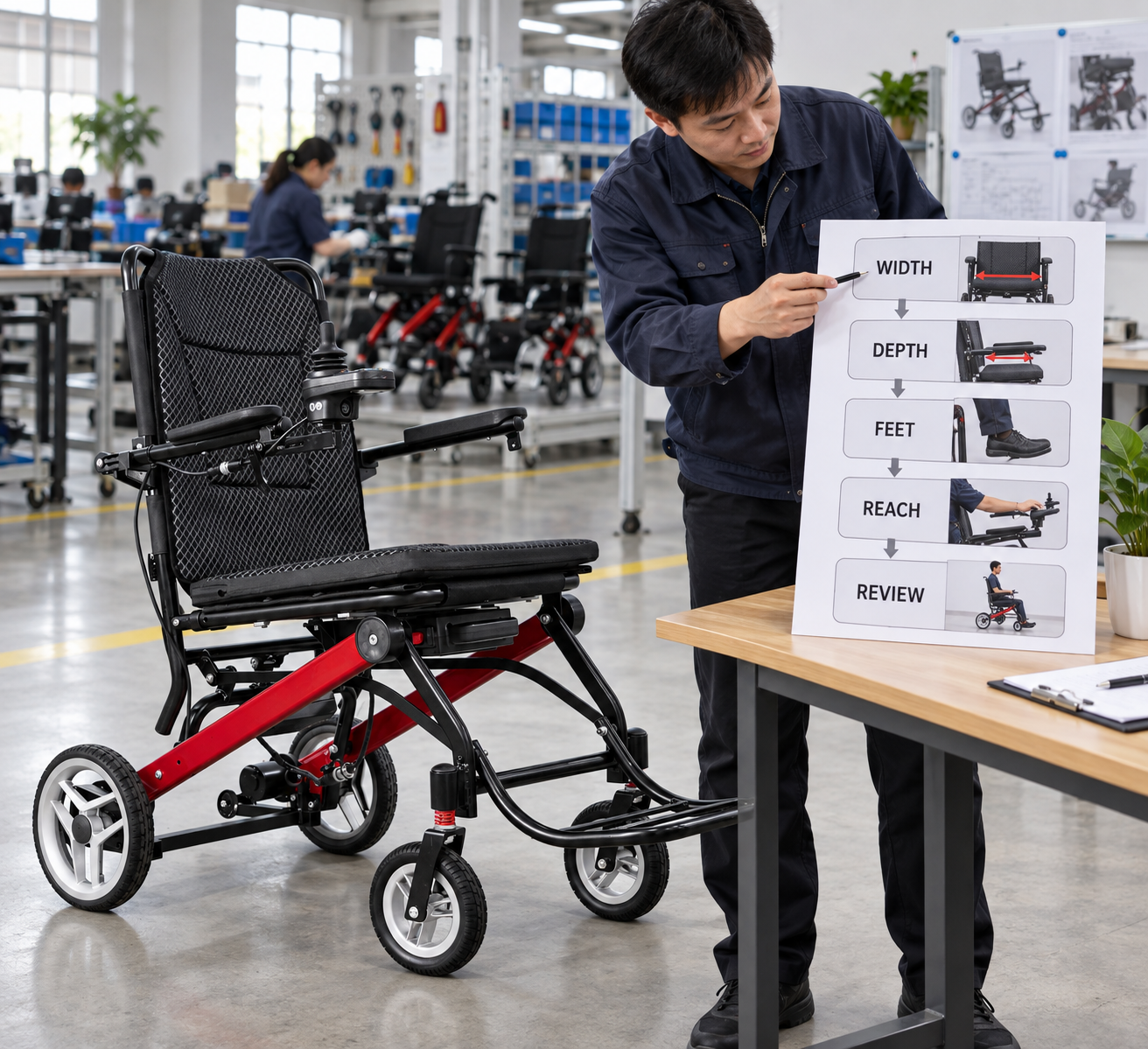
What belongs in the approved setup file?
Make the next handover repeatable. Record fitted components, adjustment positions, care instructions, and any referral or follow-up required. Use photos only with consent and protect personal information. If you change a part, route that change through the relevant fitting review instead of treating similar appearance as proof of equivalence.
- Identify chair, cushion, controls, and support parts.
- Record approved settings and adjustment boundaries.
- Keep clear instructions for reset after transport.
- Assign a contact for unresolved fitting questions.
| File item | Prevents | Update trigger |
|---|---|---|
| Component identity | Wrong replacement | Supplier revision |
| Fitted settings | Lost configuration | Adjustment or transport |
| Follow-up plan | Unanswered concerns | User needs change |
The chart shows review steps rather than a clinical scoring system. Key Takeaway: A fitting record must remain useful after the sample leaves your showroom.
10. What Completes a Lightweight Electric Wheelchair Seat Review?
Lightweight electric wheelchair seat review is complete when fit, task performance, training, and follow-up responsibilities are clear. Width, depth, cushion height, foot support, and joystick reach should work together. Your service team should also know when a complaint needs product support and when it needs qualified seating advice.

How can you prepare a more useful supplier brief?
Send the fitting questions with the sample request. Ary Medical can discuss model dimensions, permitted configurations, replacement parts, and sample options. Include your intended market and the product questions raised by your fitting team. Our position is that clear fit information should accompany every chair offered to a buyer.
- Confirm the required configuration before ordering.
- Arrange fitting and training through suitable personnel.
- Plan follow-up and a clear route for concerns.
| Review result | Next action | Owner |
|---|---|---|
| Product suitable | Confirm configuration | Buyer and supplier |
| Fit needs review | Arrange qualified assessment | Service team |
| Setup approved | Record and teach it | Trained personnel |
This process connects product selection with the support a customer needs after delivery. Key Takeaway: Contact us with your seating brief to prepare a better-informed sample review.
Frequently Asked Questions
Q1: What's the best seat width for every adult?
There is no single best width. Individual measurements, support needs, armrest spacing, and normal tasks determine what should be assessed.
Q2: Can I add a thicker cushion for comfort?
Only after checking compatibility and fit. Cushion height can change foot support, armrest position, control reach, and stability-related setup.
Q3: How do I know if a seat is too deep?
Ask a trained fitter to review seated position and knee clearance. Back padding and cushion placement can change usable depth.
Q4: Can I fit every customer using a product photo?
No. A photograph cannot establish individual support, comfort, transfer, or control needs.
Q5: How do I know when follow-up is needed?
Follow the agreed service plan and respond to changing needs or new concerns. Persistent discomfort or loss of support calls for an appropriate review.