
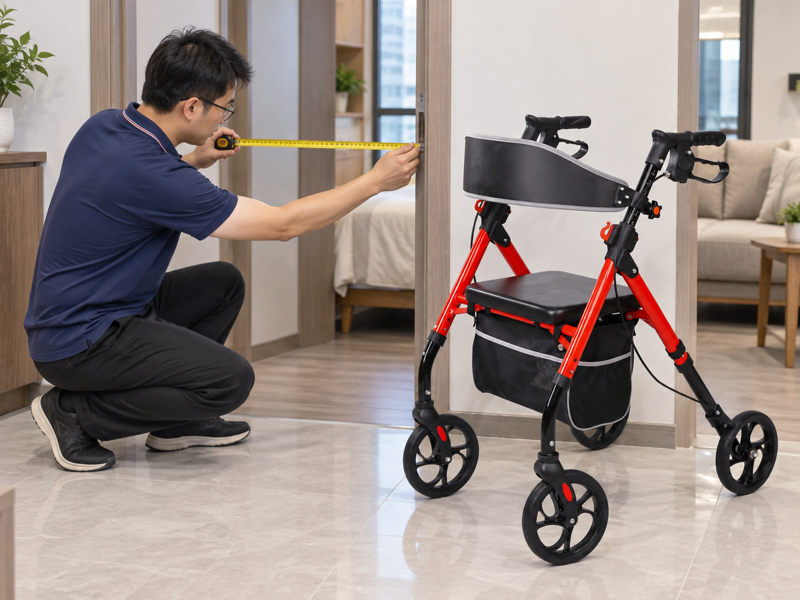
Choose a narrow rollator by measuring the open device and walking its full route through the smallest real spaces, with the intended user and proper adviser involved. A Singapore dealer may hear “small flat” and assume a compact-looking frame will clear every doorway. A wheel, bag or turn can still catch at a narrow spot. Request current dimensions for the exact model, then check doors, turns, storage and personal fit before placing an order.
What makes a narrow rollator suitable for small rooms?
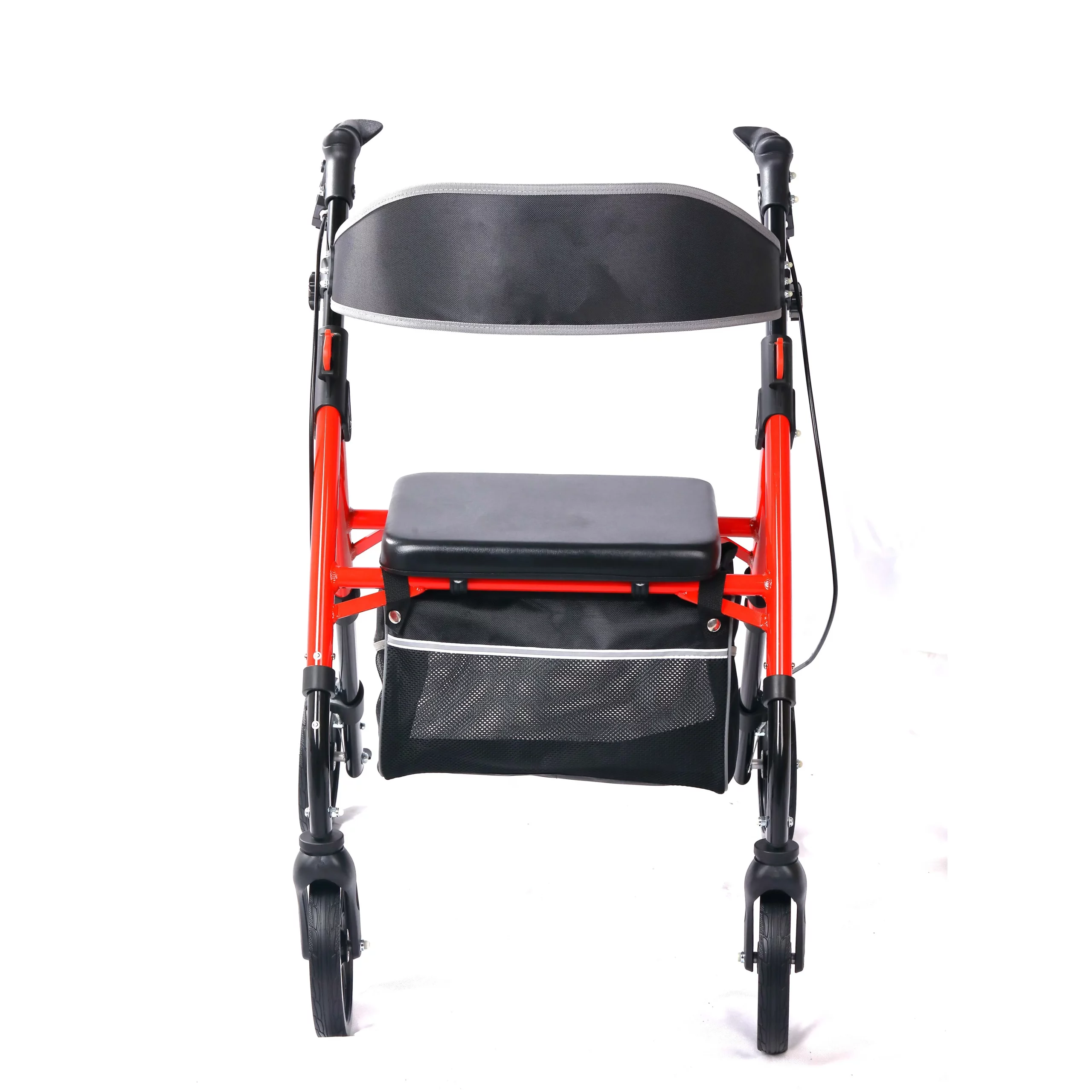
A narrow rollator suits small rooms when its measured open envelope and the user’s assessed setup clear the whole planned route. A narrow-looking photo is not a dimension. The red Shopping Walker pictured here is a model example, not proof that any Singapore room fits.
Which parts define the full envelope?
Measure the parts that stick out. Ask for the exact model drawing and include wheels, handles, seat and bag in the check. Compare the opened device with the usable space at the tightest location.
- Request current opened dimensions.
- Note projecting wheels and handles.
- Identify the intended user and route.
| Review item | Why it matters |
|---|---|
| Device envelope | Shows space the product occupies |
| Usable route | Shows where it must pass |
The smaller of those two spaces controls the decision. Key Takeaway: You can rule out a poor fit before a sample is shipped.
How should you measure for a narrow rollator?
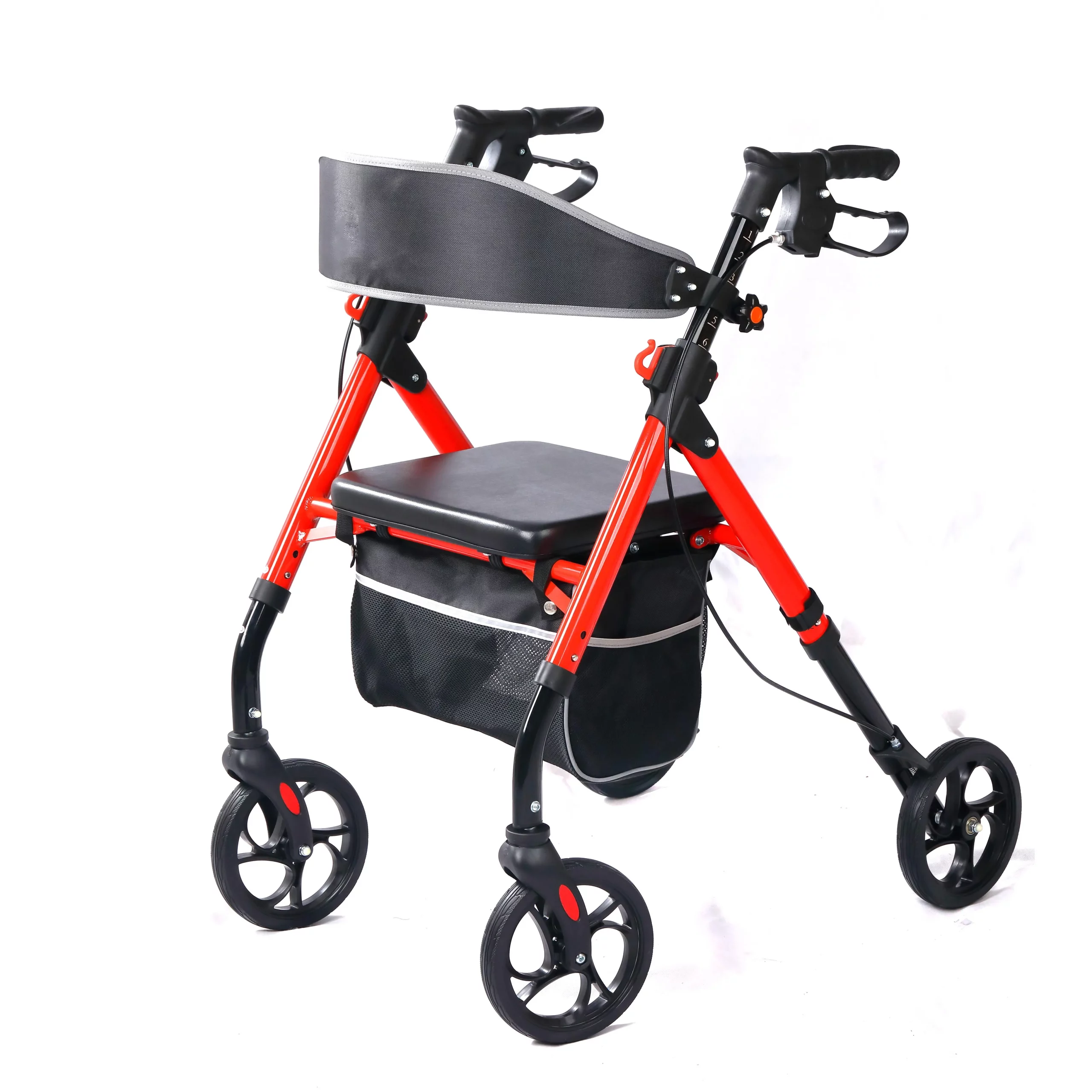
Measure for a narrow rollator at the narrowest usable opening on the actual route, then compare it with the exact opened product. Include door swing, furniture and the user’s walking position. A nominal door label will not capture all of that.
What belongs on a doorway sheet?
Take the measurement where the device travels. The NHS walking-aid guide asks buyers to think about height, indoor use, a seat or basket, and folding needs. Record your own route dimensions; it does not supply a universal room-width answer.
- Measure usable clear opening rather than frame size.
- Note hinges, thresholds and nearby turns.
- Keep the model and setup beside every reading.
| Doorway field | Purpose |
|---|---|
| Clear passage | Checks the actual opening |
| Approach space | Checks alignment before entry |
A doorway that clears a straight pass may still fail the approach. Key Takeaway: Your route review can reflect the flat as used, not a plan drawing alone.
Can a narrow rollator turn in a tight corner?
A narrow rollator can turn only if the full device and user have enough space in that particular corner. Straight-line width does not answer a turn. Use a supervised route trial with the intended setup when possible.
What should a corner trial record?
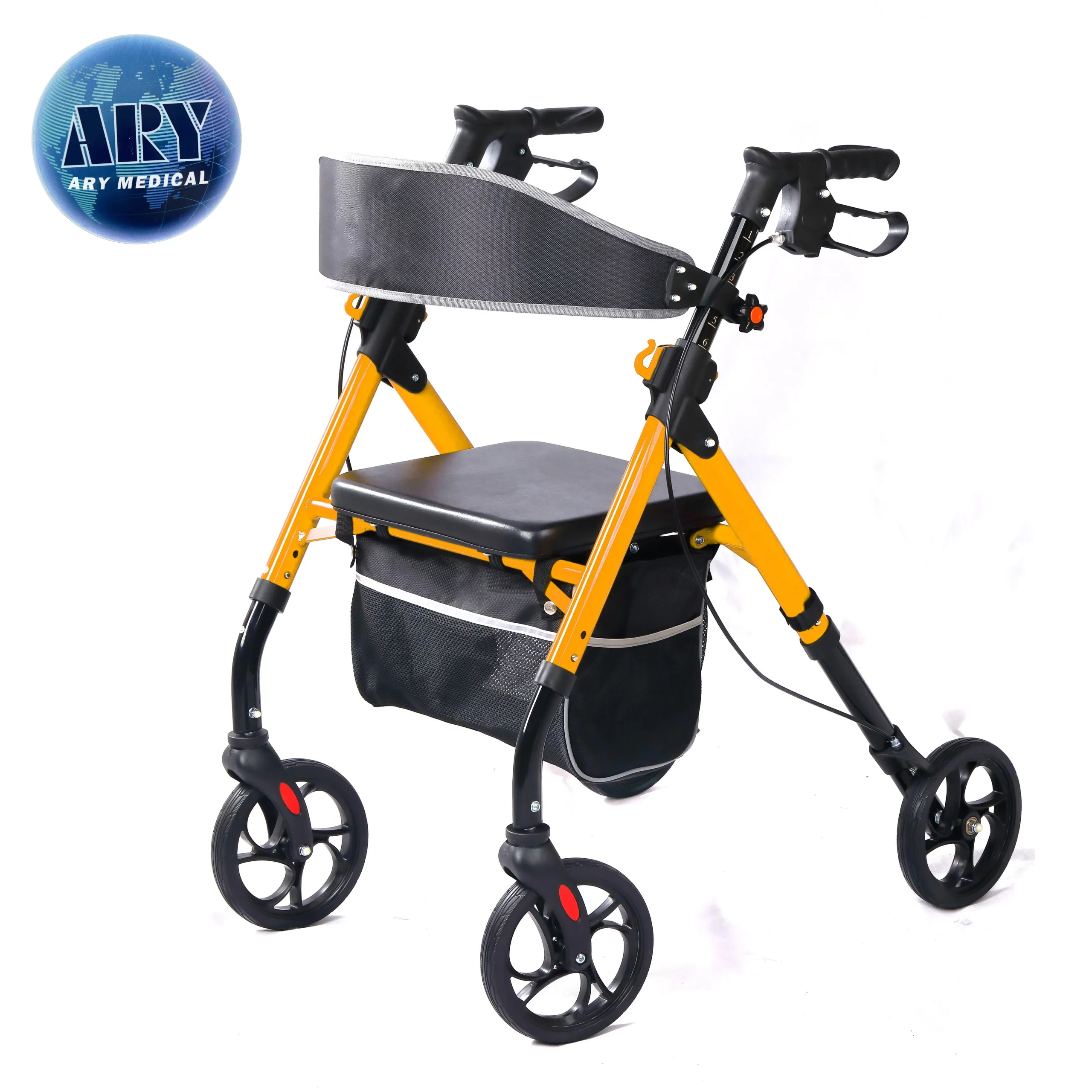
Watch the exit as well as the entry. A four-wheel frame needs space for wheels, handles and the person walking behind it. Do not infer a turning diameter from the yellow product photo or from another model.
- Mark the corner and nearby obstacles.
- Note wheel and handle clearance.
- Record the user setup and assistance plan.
| Turn stage | Observation |
|---|---|
| Entry | Can the device approach in line? |
| Exit | Can the person continue without a catch? |
A good turn includes the person, not only the front wheels. Key Takeaway: You can compare candidates against the same difficult corner.
Does handle setup change a narrow rollator fit?
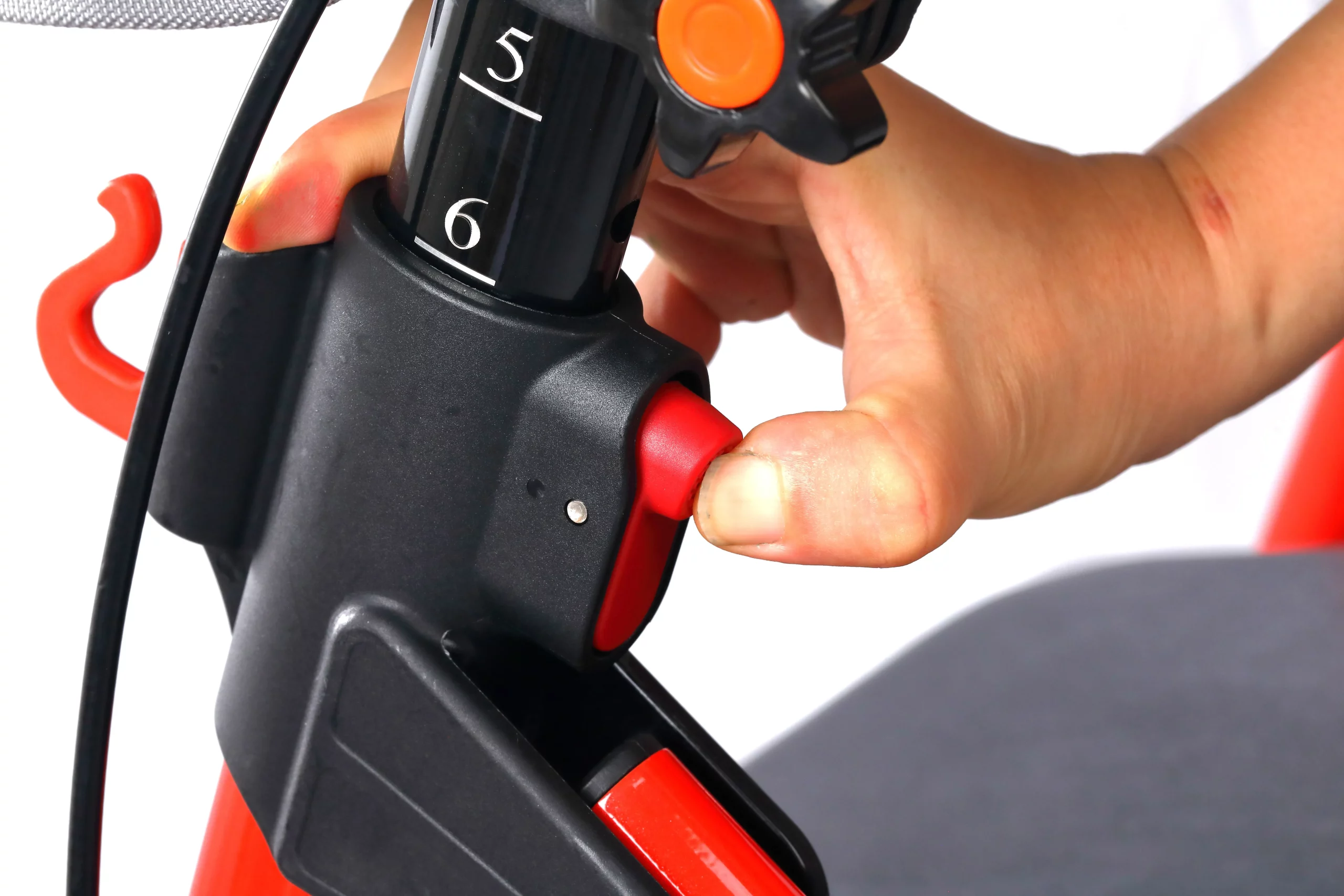
Yes, handle setup can change how a narrow rollator fits a person and how the handles pass nearby furniture. Use the maker’s permitted positions and the appropriate fit review. A close-up latch photo cannot establish a safe height for every user.
Which details should be confirmed?
Keep the user and the frame in one check. Ask for the current instructions and record the final approved handle positions. Use the walking-aids range to compare product types, then assess the chosen model itself.
- Confirm the permitted adjustment method.
- Record the person’s reviewed handle position.
- Recheck route clearance after adjustment.
| Check | Decision |
|---|---|
| Handle position | Personal use setup |
| Outer clearance | Room and furniture route |
Changing a handle for comfort can change the route envelope. Key Takeaway: Your handover can keep fit and clearance aligned.
Can the bag affect a narrow rollator route?
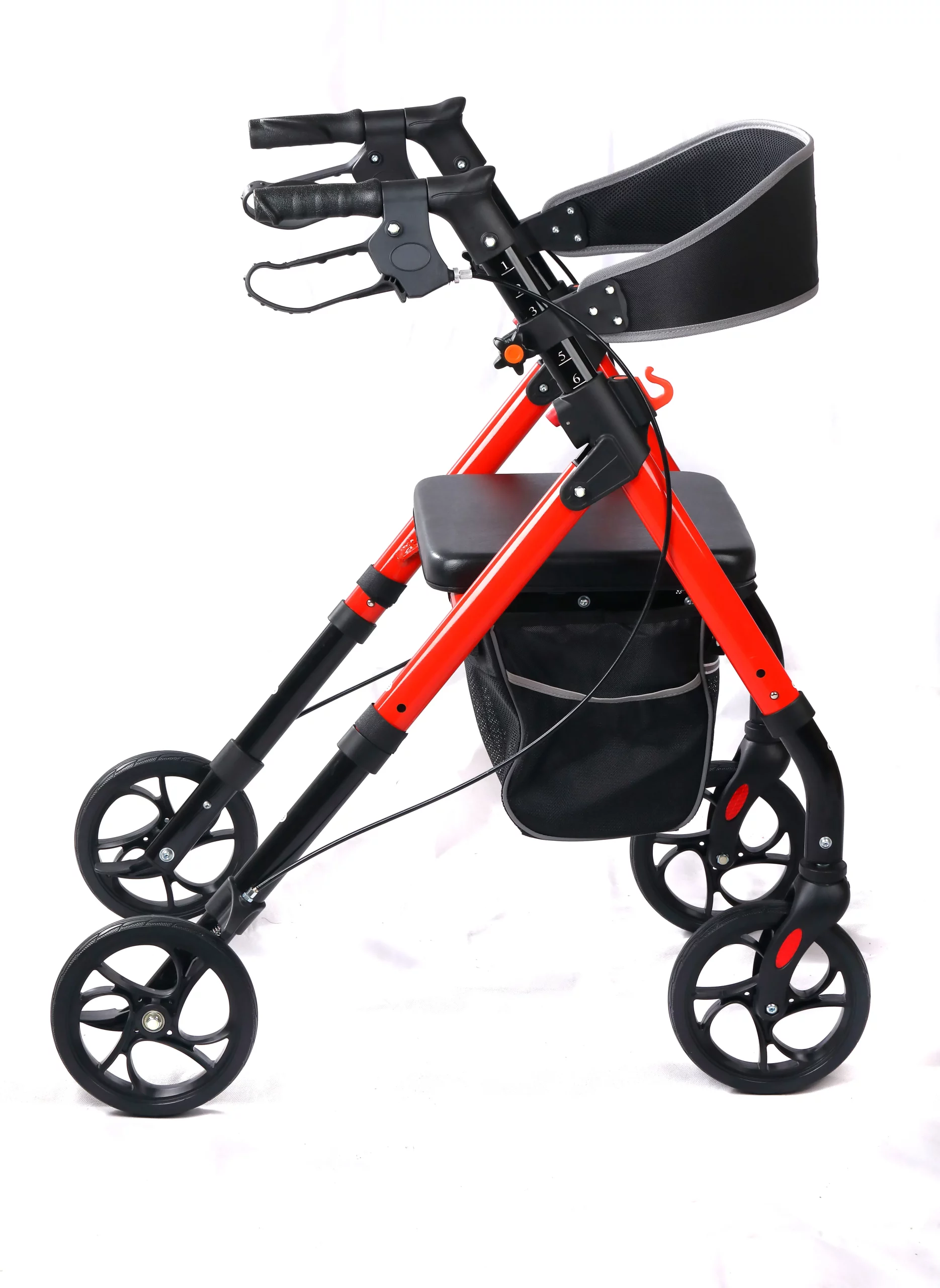
Yes, the bag on a narrow rollator can affect access, clearance and handling even when it sits under the seat. Check the fitted bag without guessing its capacity. Keep contents within the maker’s guidance and the user’s plan.
What should the buyer ask about storage?
Look below the seat. The side view shows a dark bag hanging within the frame, but it does not establish an approved load or whether loose items alter use. Ask for the current bag attachment and care instructions.
- Identify the installed bag and mounting.
- Check the route with the bag fitted.
- Request any stated content limits from the maker.
| Bag question | Evidence |
|---|---|
| Installed shape | Exact product sample |
| Permitted contents | Current model guidance |
A low bag may clear a doorway yet still change daily handling. Key Takeaway: You can specify the actual equipped device rather than an empty frame.
How should brakes enter a narrow rollator choice?
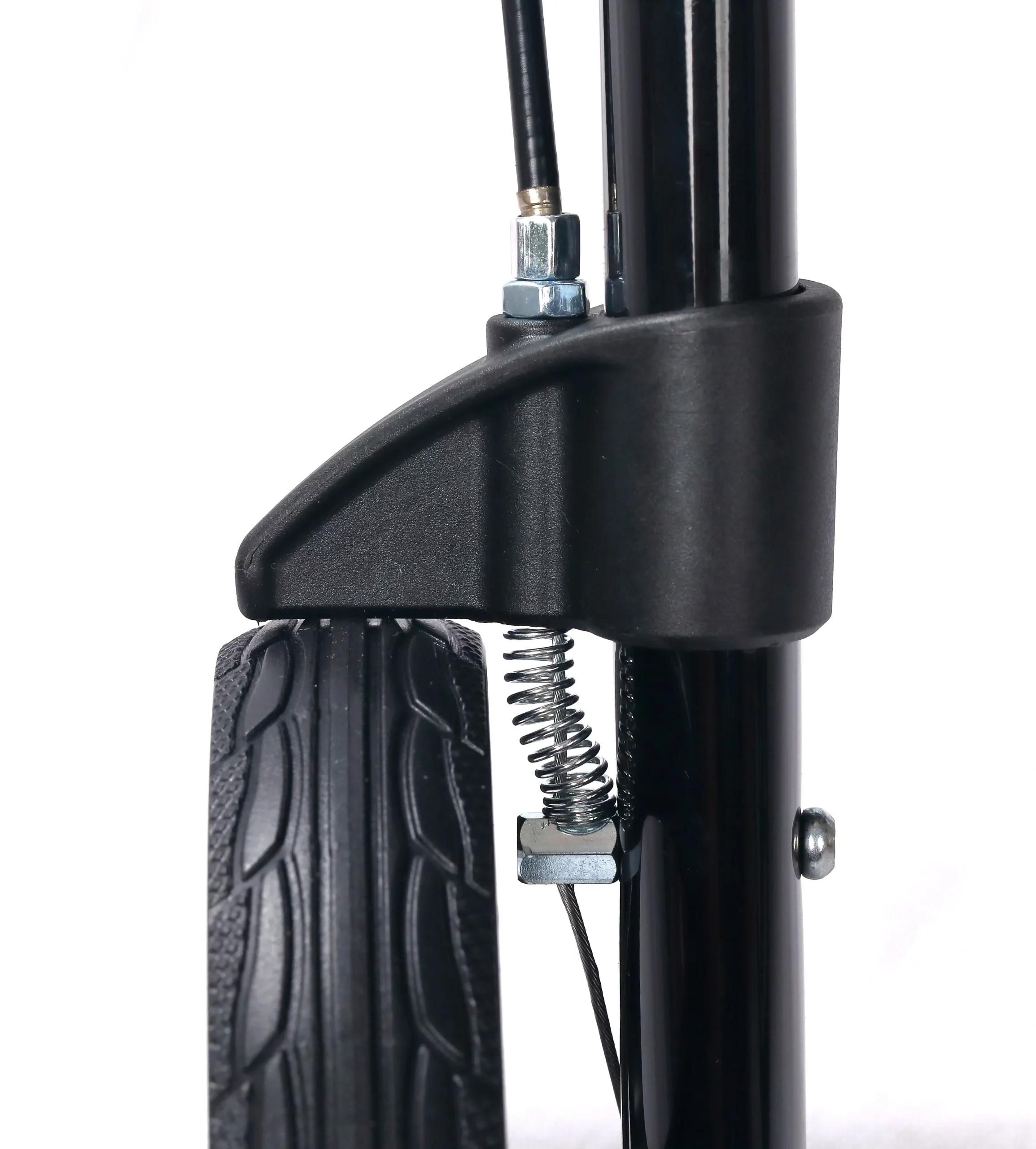
Brakes on a narrow rollator must work in the intended setup under the maker’s instructions. Tight rooms can complicate stopping and sitting positions, so include them in the route plan. The cable close-up does not prove brake performance.
What should a dealer demonstrate?
Check the prescribed method, not a showroom stunt. Use the model guide for lever use and any parking step. If there is damage or doubtful operation, refer it for service instead of adjusting by guesswork.
- Identify both hand levers and routed cables.
- Review stop and park instructions.
- Record any service concern before use.
| Review point | Question |
|---|---|
| Lever and cable | Does the installed setup match the guide? |
| Parking place | Is there room for the prescribed action? |
A tight passage can be a poor place to plan a rest stop. Key Takeaway: Your route brief can include control access as well as width.
Will folding solve a narrow rollator storage problem?
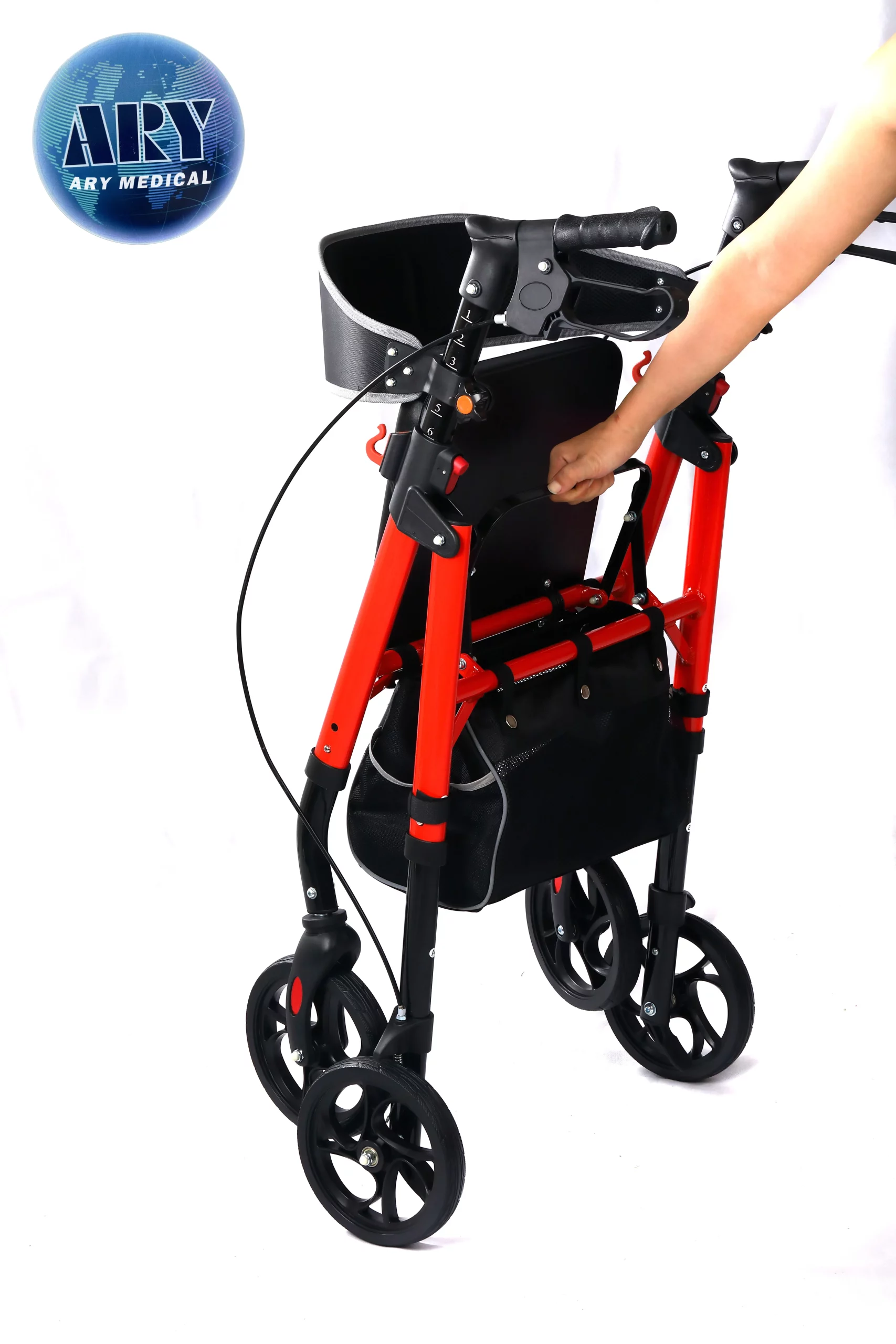
Folding may solve a narrow rollator storage problem only when the model’s approved folded package fits the actual space. Measure the full stored assembly and account for bag or loose parts. The partly collapsed photo does not teach the folding sequence.
What should be checked twice?
Measure open use and folded storage separately. Follow current instructions for closing and reopening. The product range can help narrow options, but each candidate needs its own measured sample.
- Record open dimensions for use.
- Record folded dimensions and permitted parts.
- Check reopening before the next walk.
| State | Purpose |
|---|---|
| Open | Walking and doorway route |
| Folded | Storage or vehicle space |
A chair that stores well may still be too wide in use. Key Takeaway: You can avoid buying from a folded photo alone.
Which floor details affect a narrow rollator route?
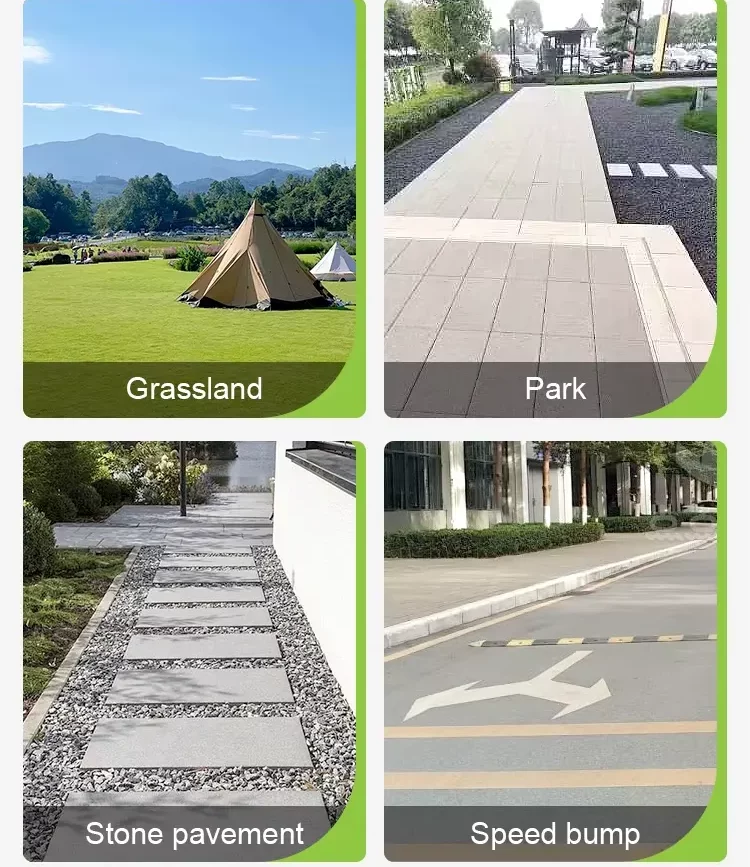
Floor details affect a narrow rollator route through thresholds, clutter and surface changes. Review the actual path with a suitable user and adviser, not a marketing terrain collage. Do not assume the pictured device is approved for every pictured surface.
What belongs in a route note?
Describe the ground beneath each wheel. Record indoor flooring, doorway lips and places where the person will stop or turn. Ask the AryMD team for model-specific intended-use information when a surface is uncertain.
- List route surfaces and transitions.
- Remove or flag avoidable obstacles.
- Keep observations tied to the tested setup.
| Route feature | Review question |
|---|---|
| Threshold | Can it be approached as planned? |
| Stop area | Is it suitable for the intended pause? |
The same width can feel different on another floor. Key Takeaway: You can identify route limits without making a blanket terrain claim.
What should a narrow rollator route chart show?
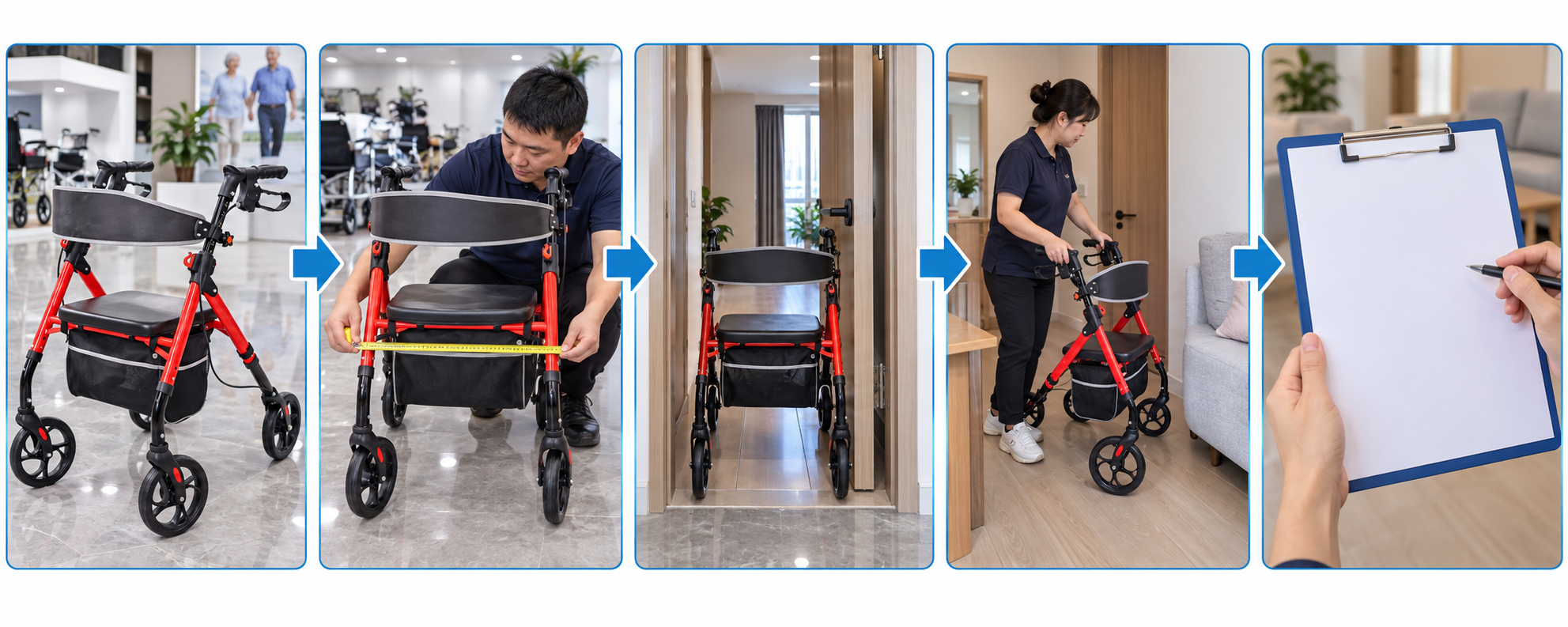
A narrow rollator route chart should show the opened model, outer measurement, doorway, turn and a blank review record. Every stage needs the real site dimensions and user setup attached. The illustration is a checklist prompt, not a passed route test.
How do you keep the decision honest?
Leave unresolved boxes empty. Use the chart to ask what still needs measuring. Record the source of each figure and the person who reviewed the practical route.
- Attach model dimensions.
- Attach the actual route notes.
- Flag each untested turn or stop.
| Chart stage | Evidence |
|---|---|
| Device and route | Measurements and sample |
| Decision | Named reviewer and open issues |
A blank record signals work still to do. Key Takeaway: Your team can see which route question remains open.
How can you order a narrow rollator for Singapore?
Order a narrow rollator for a Singapore setting by sending the measured route and individual use brief for an exact model review. Do not substitute an assumed national width rule for the real doorway. Confirm the accepted setup before ordering.
Ready to review a small-room route?
Send the plan with the product question. Ary Medical can provide available model information once you identify the route, user needs and intended use. A trained local adviser should review the individual fit and real-world use.
- Share door, turn and storage measurements.
- Ask for current dimensions and instructions.
- Record who checks the final user setup.
| Your brief | Supplier information to request |
|---|---|
| Route and user needs | Relevant product options |
| Chosen model | Current dimensions and handling guide |
The useful answer is specific to one product and one route. Key Takeaway: For that model review, contact us. Ary Medical supports choices measured in real spaces, not guessed from photos.
Frequently asked questions
Q1: Can I assume a compact-looking rollator fits my flat?
No. Measure the open device and the narrowest real route, including turns.
Q2: What’s the best way to compare two narrow models?
Use the same doorway, turn, storage and personal-fit checklist for both.
Q3: How do I know if the handles clear furniture?
Check the approved handle setup on the exact product, then measure the route again.
Q4: Can a folded width tell me whether the device fits a doorway?
No. Use the opened width for walking routes and folded dimensions for storage.
Q5: Do I need a Singapore legal width number to choose?
Use current applicable local guidance if relevant, but start with measured site clearance and the exact product.