
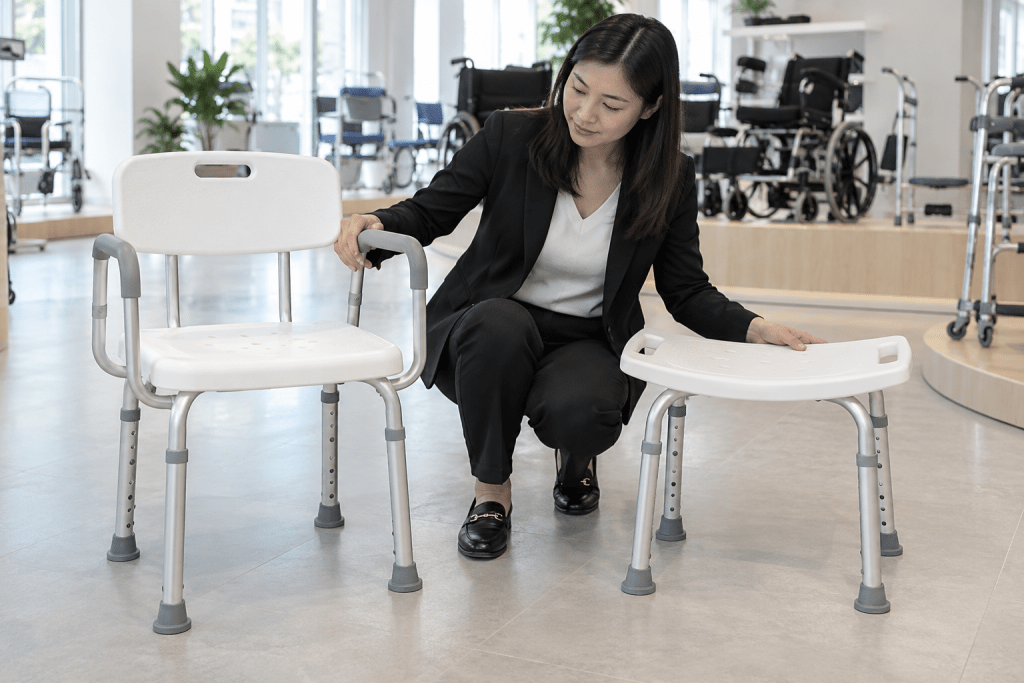
Neither product wins every use case: a shower chair vs shower stool decision depends on support needs, bathroom space, transfers, handling, and service. A distributor may see two similar bathing seats and treat one as a cheaper version of the other. That shortcut causes poor fit, returns, and muddled sales guidance. This guide gives you a B2B method for defining both categories, testing samples, and building a range around real buyer tasks.
1. What Does Shower Chair vs Shower Stool Mean?
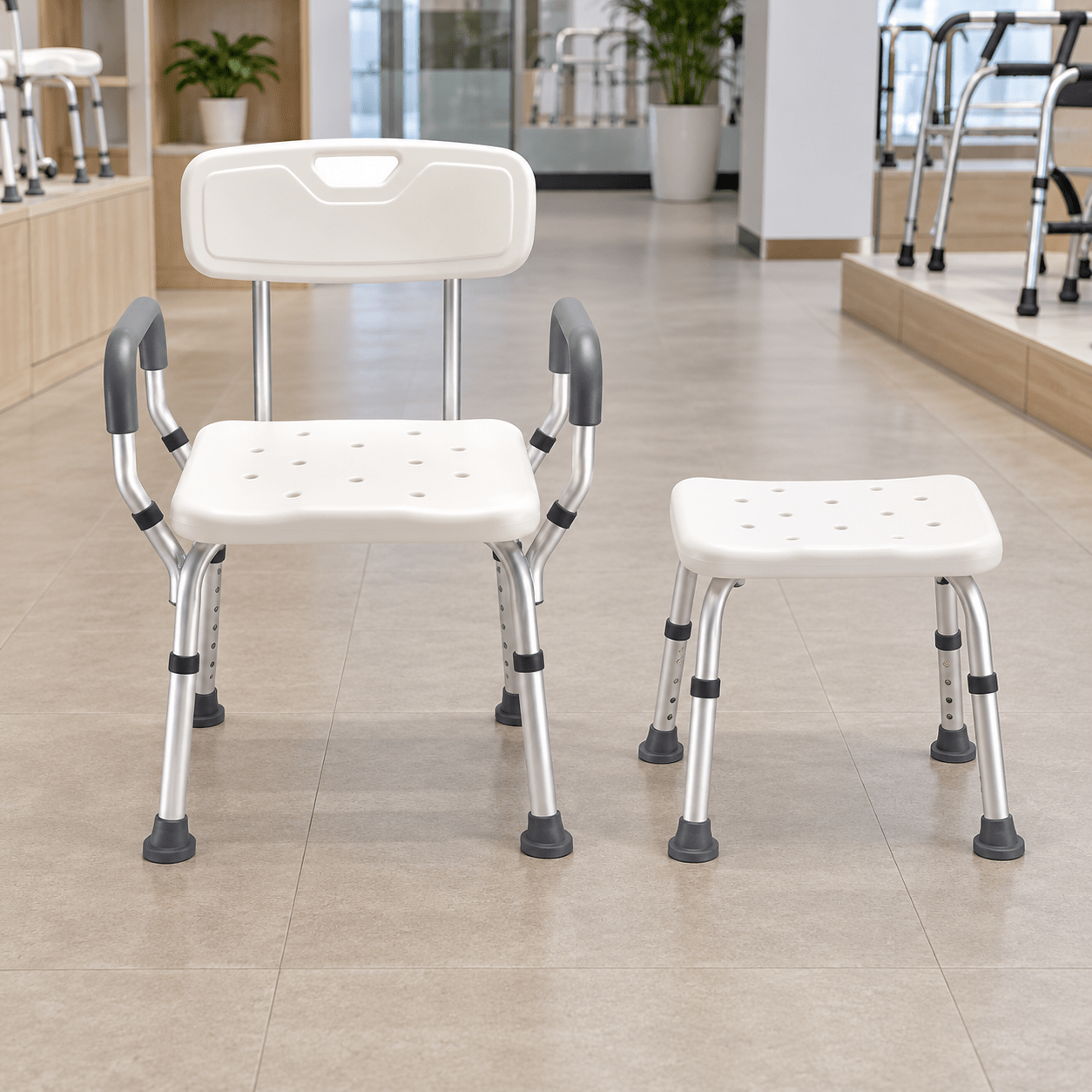
A shower chair vs shower stool comparison separates a supported bathing chair from a compact backless seat. A chair usually includes a back and may include arms, while a stool provides a seat with fewer supports and a smaller footprint.
Which Product Features Define Each Category?
Product identity comes from the complete structure, not the sales name. Record what supports, adjustments, drainage features, and floor contacts are included on the quoted unit.
- Seat shape, width, depth, and drainage.
- Backrest and armrest presence or absence.
- Leg layout, height adjustment, and feet.
Which Category Boundaries Must Buyers Confirm?
Keep transfer benches, commode chairs, rolling shower chairs, and wall-mounted seats outside a basic chair-versus-stool comparison. Start with the task boundary: similar materials do not make two products interchangeable.
- Name the primary bathing or transfer task.
- Identify whether installation or an attendant is required.
- Ask the supplier to state excluded uses.
| Category | Typical support | Footprint | Primary task | Buying boundary |
|---|---|---|---|---|
| Shower stool | Seat only | Compact | Short seated rest or bathing | Requires adequate unsupported sitting |
| Shower chair | Seat plus back; arms optional | Larger | Supported seated bathing | Must fit user and room |
| Transfer bench | Extended seat across tub edge | Long | Seated tub entry | Not a compact shower chair |
The table prevents price from becoming the category definition. Key Takeaway: define product type through intended task and included supports before comparing offers.
2. Who Needs Shower Chair vs Shower Stool Guidance?

A shower chair vs shower stool guide serves buyers who must match support and space to a known user task. Retailers, facilities, rehabilitation teams, and distributors need different evidence because their responsibilities do not end at the same point.
Which User Tasks Change the Product Choice?
Observe how long the person sits, whether the trunk needs support, how standing begins, and where hands or caregivers work. Keep individual suitability with a qualified assessor.
- Seated bathing duration and fatigue.
- Need for back or arm support.
- Sit-to-stand and side-access route.
Which Buyers Need Different Evidence?
Retail buyers need clear range positioning, while facilities also need cleaning, storage, training, and inspection processes. Here is the practical split: user fit and channel readiness are separate approvals.
- Distributors verify configuration and service support.
- Facilities verify rooms, workflows, and staff competence.
- Assessors verify individual tasks and restrictions.
| Buyer | Main question | Evidence need | Decision owner |
|---|---|---|---|
| Retailer | Which customer problem does it address? | Product boundary and dimensions | Category manager |
| Care facility | Can staff use and maintain it? | Workflow and sample trial | Facility lead |
| Rehabilitation team | Does the setup match the task? | Fit and access review | Qualified assessor |
This division creates a clean handoff between sales and use. Key Takeaway: approve the person, product, and operating workflow through distinct decision owners.
3. How Does Shower Chair vs Shower Stool Affect Support?
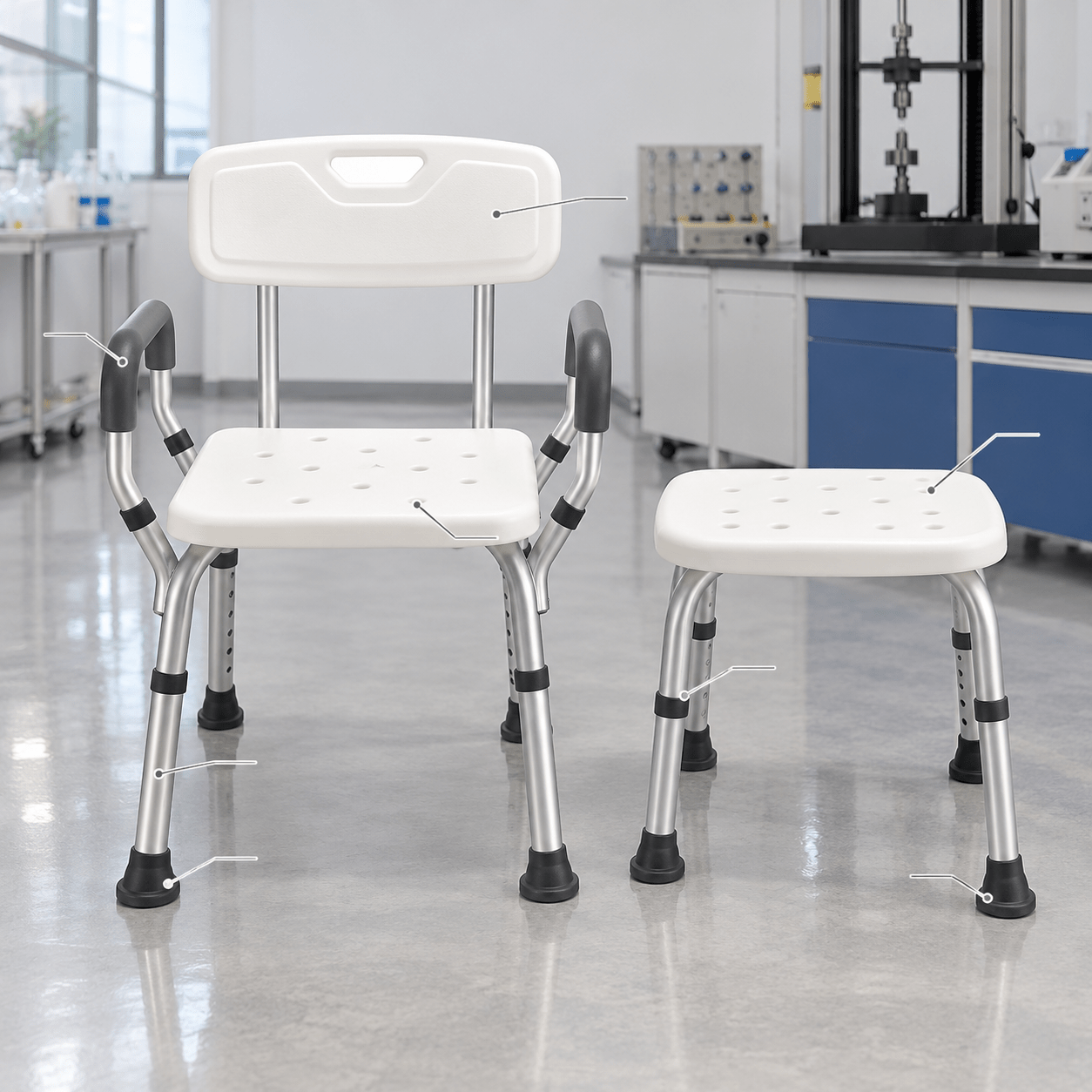
A shower chair vs shower stool decision changes the amount and location of seated support. Backrests and arms may help specific tasks, but they also occupy space and can obstruct washing or lateral access.
Which Supports Change Seated Positioning?
Review each support as a functional component. Seat width, back height, arm spacing, contour, and padding all change contact and available movement.
- Backrest height, width, angle, and attachment.
- Armrest height, spacing, grip, and mount.
- Seat contour, padding, drainage, and usable width.
When Can Added Support Create a New Constraint?
Fixed arms can block side transfers, while a wide back may reduce access near a wall or control. More support has a cost: test every added component against approach and cleaning tasks.
- Check side clearance and washing access.
- Observe how supports affect caregiver position.
- Confirm removable parts lock after refitting.
| Support | Possible benefit | Possible conflict | Buyer check |
|---|---|---|---|
| Backrest | Trunk rest | Wall or washing access | Position and cleaning trial |
| Armrests | Push-off and hand support | Side-transfer obstruction | Access trial |
| Padding | Contact comfort | Drying and damage inspection | Cleaning review |
The best configuration solves a named task without creating a larger problem. Key Takeaway: buy support functions only after verifying their effect on access, transfers, and maintenance.
4. How Does Shower Chair vs Shower Stool Affect Space?
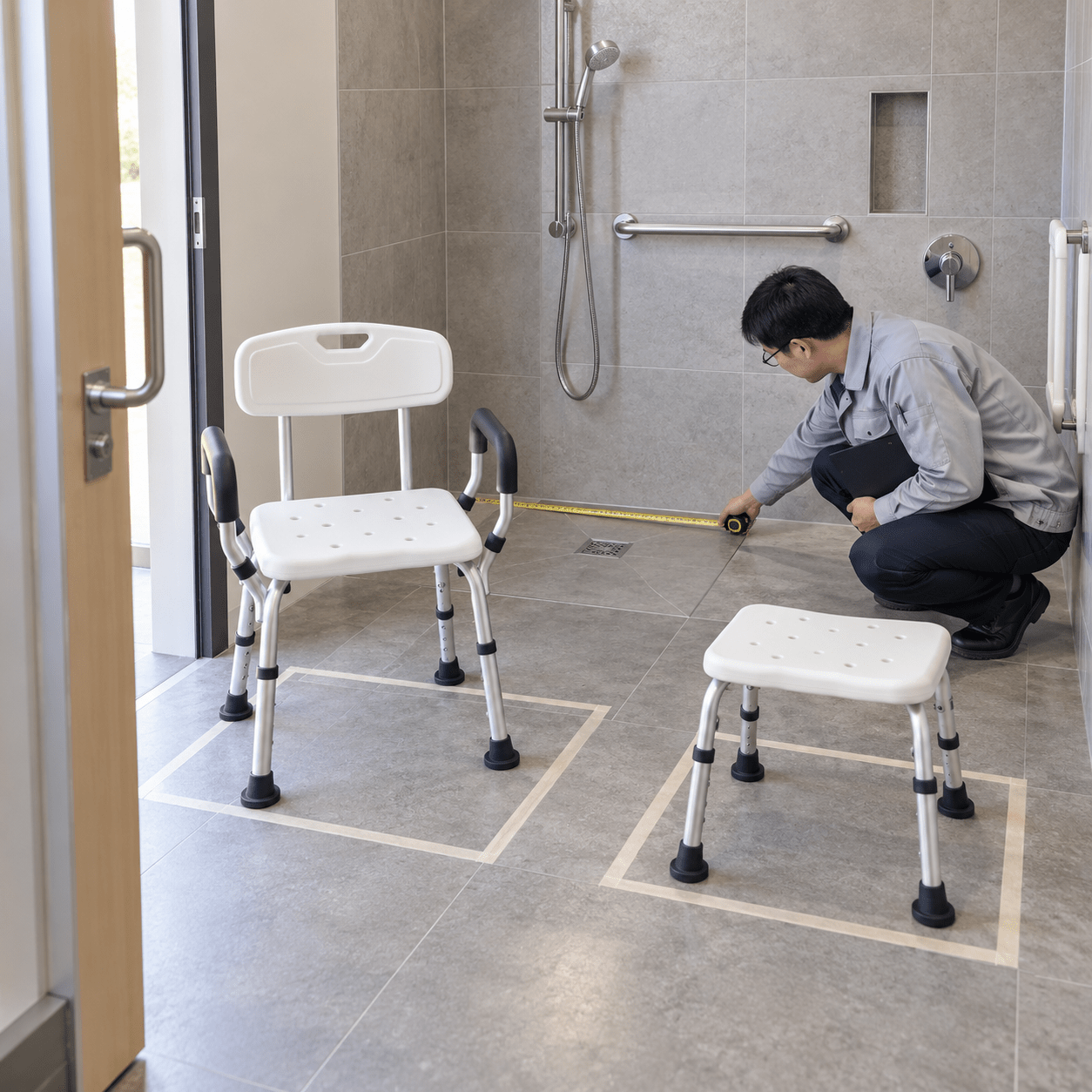
A shower chair vs shower stool comparison affects floor footprint, doorway clearance, placement, and storage. A stool may occupy less space, but dimensions alone do not prove full foot contact or usable access.
Which Bathroom Measurements Matter?
Measure the narrowest points and moving fixtures rather than relying on room area. Include the complete route from storage to final bathing position.
- Doorway, threshold, tub base, and shower floor.
- Wall, controls, drain, curtain, and door swing.
- User approach and caregiver working space.
How Should Buyers Test the Real Footprint?
Set the sample on the target surface or a controlled mock-up. Watch every foot: curved tubs and drain slopes can defeat a favorable width figure.
- Confirm all feet contact the approved surface.
- Check arms and back against walls and controls.
- Leave room for safe entry and exit.
| Measurement | Chair concern | Stool concern | Pass rule |
|---|---|---|---|
| Base width | Larger footprint | Narrower contact polygon | Every foot sits flat |
| Overall width | Arms may project | Seat may remain compact | Clears route and controls |
| Storage depth | Back increases volume | Easier stacking possible | Approved dry storage fits |
A usable footprint includes the product and the people around it. Key Takeaway: confirm room fit through measured placement, not catalog width alone.
5. How Does Shower Chair vs Shower Stool Affect Transfers?
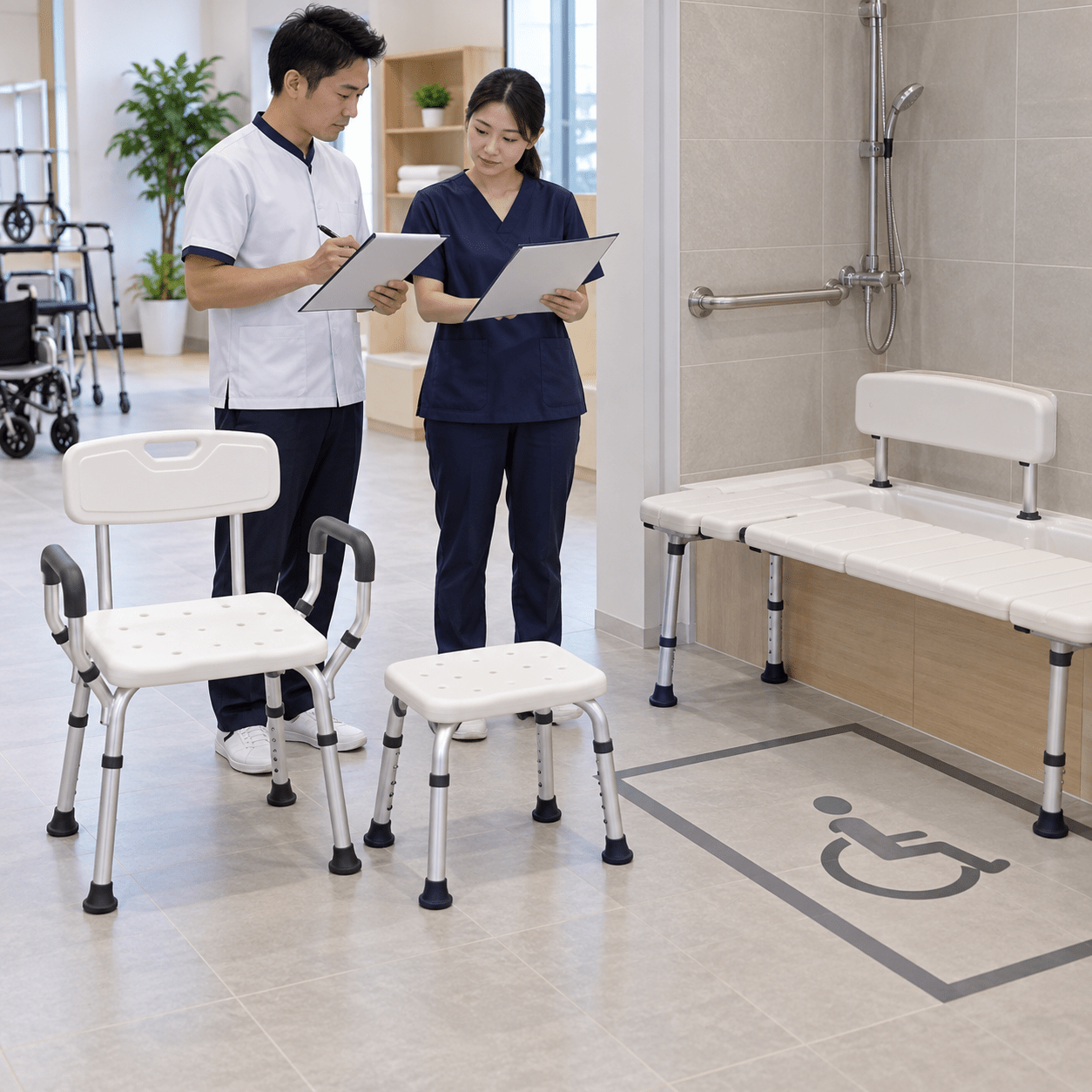
A shower chair vs shower stool decision changes push-off support, side access, seat alignment, and approach space. Neither product makes a transfer safe without an individual plan and a suitable environment.
Which Sit-to-Stand Tasks Need Review?
Seat height, foot position, forward movement, and hand placement affect the complete motion. Arms may provide a push surface, but their height and strength need verification.
- Align seat height with the assessed task.
- Keep both feet on the approved surface.
- Confirm supports stay locked during use.
Which Side-Transfer Tasks Need Clear Space?
A backless stool may allow more directions, while a chair with fixed arms can narrow the route. Trace the whole approach: include the source seat, destination, wall, and caregiver stance.
- Record front, side, and diagonal access.
- Check removable support sequences.
- Keep transfer approval with qualified staff.
| Transfer task | Chair factor | Stool factor | Review need |
|---|---|---|---|
| Sit-to-stand | Arms and back may assist | No arm support | Height and push-off assessment |
| Side access | Fixed arm may obstruct | Open side often available | Route clearance |
| Caregiver support | More structure occupies space | Compact base may leave space | Staff trial |
The product should fit an approved transfer method rather than define one. Key Takeaway: assess the route, supports, and clearances together before selecting a category.
6. How Does Shower Chair vs Shower Stool Affect Stability?
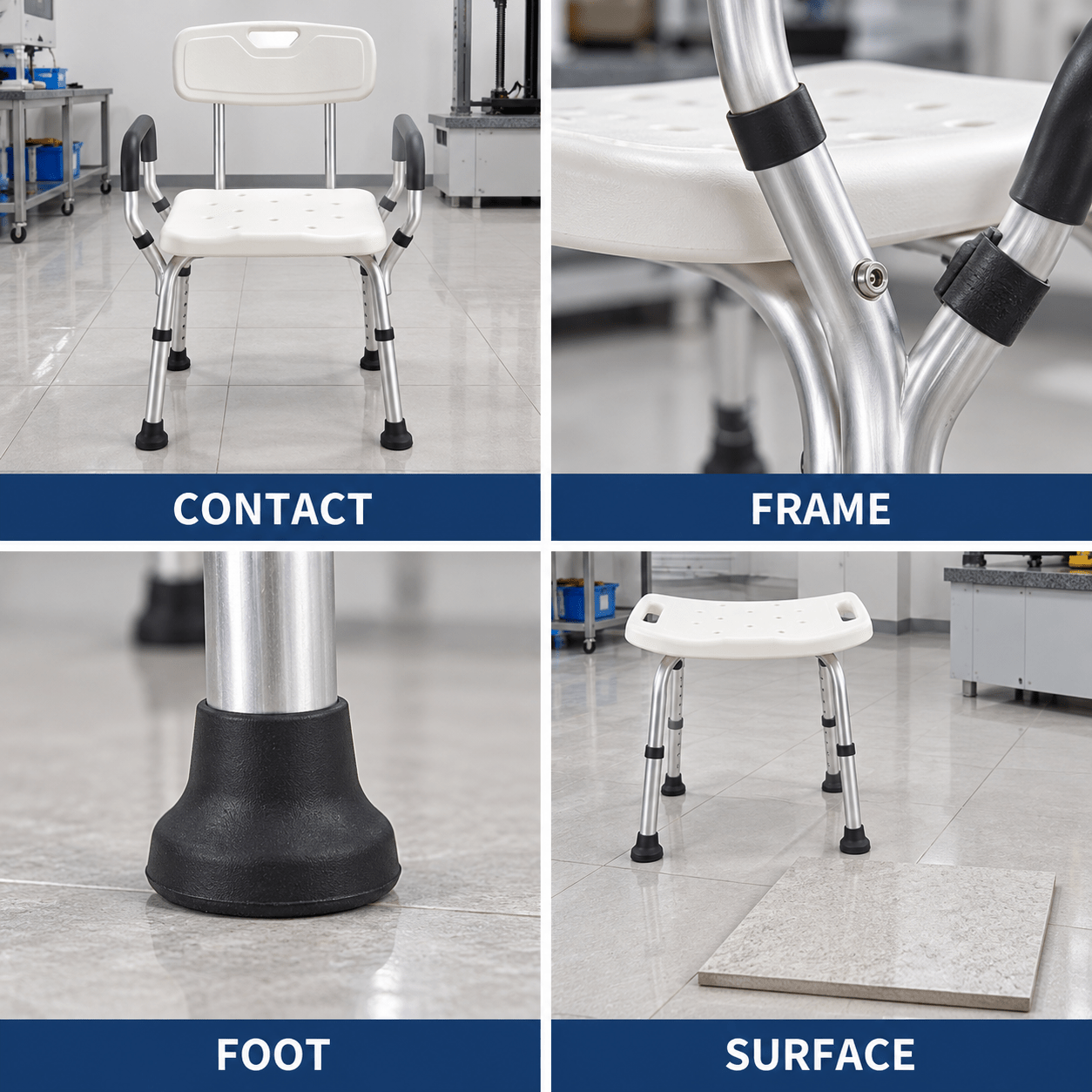
A shower chair vs shower stool decision affects contact geometry, frame stiffness, support loading, and operator behavior. A compact footprint can improve fit yet reduce the margin for some off-center actions.
Which Structural Features Influence Stability?
Review leg spread, cross-bracing, joint play, height settings, feet, and frame twist. Stability belongs to a complete configuration on a defined surface.
- Inspect every joint and adjustment lock.
- Verify matching feet and full floor contact.
- Observe rocking before any user trial.
Which Wet-Area Conditions Need Testing?
Tile texture, grout, floor slope, soap residue, and water can change contact. Dry-floor confidence is not enough: define controlled wet-area limits without unsafe demonstrations.
- Test approved surfaces one variable at a time.
- Stop when a foot lifts or movement becomes unpredictable.
- Link findings to the simple bathing-seat range where relevant.
| Condition | Observation | Evidence need | Decision |
|---|---|---|---|
| Flat dry floor | Baseline rocking and contact | Repeatable check | Reference only |
| Approved wet surface | Movement and grip | Controlled protocol | Approve with limits |
| Curved tub floor | Partial contact risk | Direct placement trial | Exclude if unstable |
The surface is part of the product decision. Key Takeaway: approve stability only for the tested configuration, height setting, floor, and task.
7. How Portable Is Shower Chair vs Shower Stool Equipment?
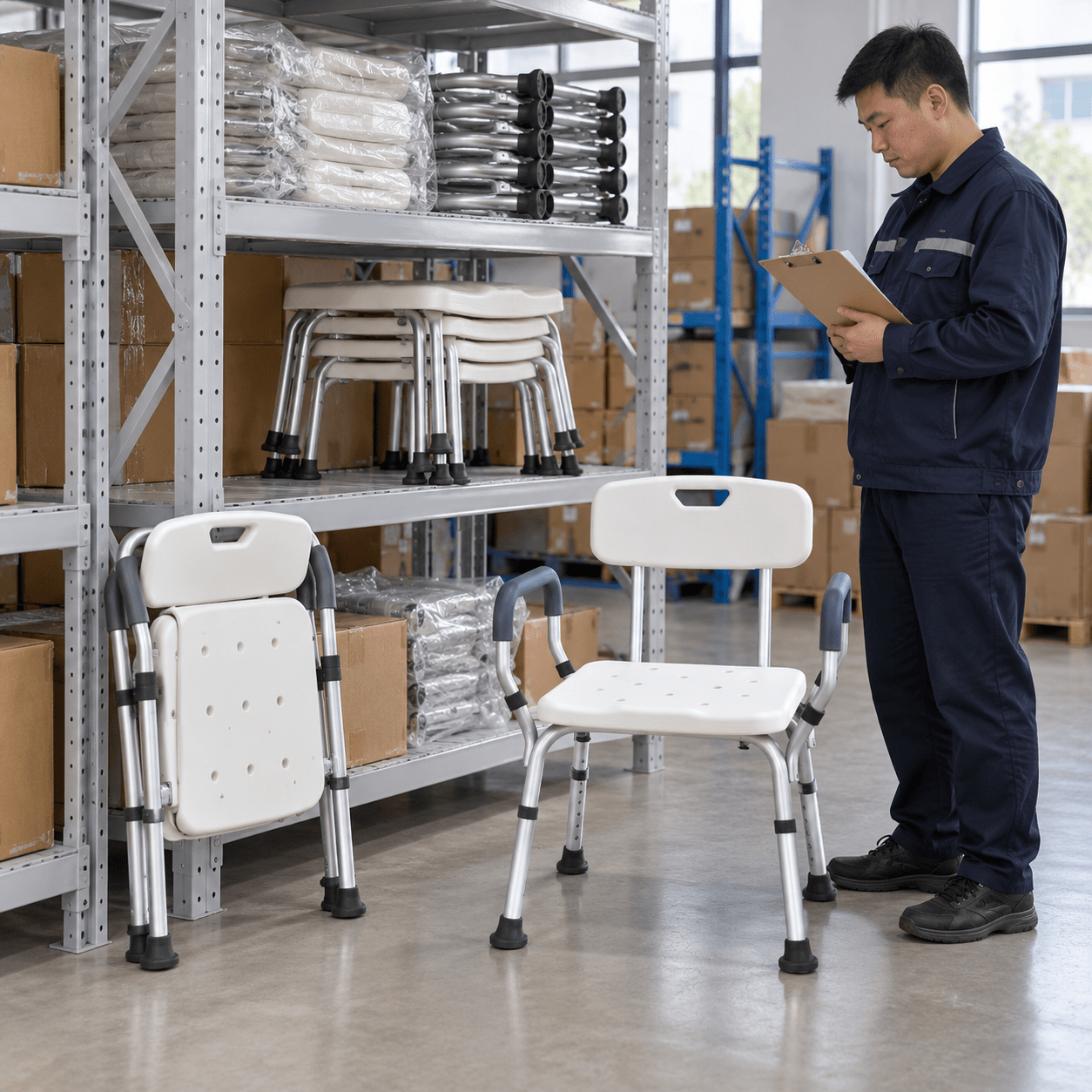
A shower chair vs shower stool comparison changes carrying, folding, stacking, drying, and storage work. A lighter item is not automatically easier if it lacks good grips or traps loose parts.
Which Handling Tasks Matter to Buyers?
Observe the full route from bathroom to drying or storage. Use the people who will actually lift, fold, move, and restore the product.
- Carry through the narrowest doorway.
- Place without damaging feet or supports.
- Dry before folding, stacking, or storing.
Which Portability Claims Need Verification?
Check total mass, folded size, grip points, locks, loose supports, and required tools. Run the return path: a compact fold fails if staff cannot restore it correctly.
- Record the heaviest required lift.
- Protect pins, latches, and padding.
- Finish with a function check.
| Handling task | Chair process | Stool process | Main risk |
|---|---|---|---|
| Carrying | Larger structure or fold | Compact body | Poor grip or drop |
| Drying | More joints and supports | Fewer surfaces | Trapped moisture |
| Storage | Folded or assembled | Stacked or separate | Damage or contamination |
Portability includes safe restoration and storage. Key Takeaway: validate the complete handling cycle with real staff and real spaces.
8. How Do You Test Shower Chair vs Shower Stool Samples?

A shower chair vs shower stool sample test should use common conditions where comparison is fair and product-specific checks where structures differ. The goal is a documented range decision, not a single demonstration.
Which Sample Checks Should Use Common Conditions?
Inspect identity, dimensions, height settings, floor contact, finish, drainage, cleaning, handling, packaging, and instructions for both samples.
- Use the same room mock-up and surface.
- Record configuration before testing.
- Keep pass and stop rules visible.
Which Checks Must Remain Product-Specific?
Back and arm loading apply to the chair, while unsupported sitting and open access may matter more for the stool. Compare like with like: use a bath-lift boundary review when powered tub entry is the real need.
- Test supports only when included.
- Record product-specific restrictions.
- Close every critical exception.
| Test area | Common check | Chair-specific check | Stool-specific check |
|---|---|---|---|
| Fit | Room and seat dimensions | Back and arm clearance | Compact placement |
| Stability | Feet and frame | Support loading | Unsupported sitting boundary |
| Handling | Carry and storage | Fold or removable supports | Stack and grip |
The protocol should respect structural differences. Key Takeaway: use one decision framework without forcing identical tests onto different products.
9. How Do Suppliers Position Shower Chair vs Shower Stool Options?

A shower chair vs shower stool supplier should define configurations, evidence, parts, packaging, instructions, and channel role for each product. Generic brochures make range planning difficult when components or claims overlap.
Which Configuration Records Should Match the Offer?
Model identity, materials, dimensions, safe working load evidence, supports, feet, adjustment, packing, and manual should describe one saleable unit.
- Use a signed configuration schedule.
- Separate standard and optional parts.
- Require notice before substitution.
Which Support Questions Affect Channel Readiness?
Ask how the supplier handles setup, missing parts, damaged feet, returns, cleaning questions, and warranty evidence. Test the support path early: submit a realistic sample issue.
- Identify the technical owner.
- Request illustrated spare-part records.
- Define escalation and closure evidence.
| Supplier area | Required evidence | Common gap | Approval gate |
|---|---|---|---|
| Configuration | Matched product file | Mixed family claims | Correct before sample |
| Parts | Compatibility map | Visual guesswork | Close before scale |
| Support | Mock case response | No named owner | Hold approval |
Support quality determines whether the range remains usable after sale. Key Takeaway: approve the exact products and service scope your team has reviewed.
10. How Should Buyers Decide Shower Chair vs Shower Stool?

A shower chair vs shower stool decision should pass mandatory gates for user task, room fit, support, transfer, stability, handling, evidence, and service before commercial scoring. Many distributors will stock both, but each needs a clear customer boundary.
Which Criteria Belong in the Decision Matrix?
Separate pass-or-fail requirements from preferences such as color, packing style, or range breadth. Do not let a high score override a failed critical gate.
- User task and bathroom fit.
- Support, transfer, and stability evidence.
- Supplier documents, parts, and service.
How Should the Final Choice Be Confirmed?
Confirm the range through sample trials, exception closure, staff guidance, and later bathroom product receiving checks. Preserve the decision: attach approved configurations and positioning rules to your purchasing file.
- Define who each product is for.
- Record exclusions and referral points.
- Recheck production units against the sample.
| Stage | Output | Owner | Release rule |
|---|---|---|---|
| Need definition | User and room segments | Product team | Boundaries agreed |
| Sample review | Test and exception record | Evaluation team | Critical issues closed |
| Range release | Positioning and support plan | Category manager | Production identity fixed |
The final file should make future buying consistent. Key Takeaway: stock both categories only when your team can explain, fit, test, and support their different roles.
Conclusion
Chair-versus-stool selection becomes manageable when support, space, transfers, stability, handling, and supplier readiness are reviewed separately. This method helps distributors build a range without treating a stool as a stripped-down chair or a chair as a universal answer. For help matching bathroom-safety products to your market and procurement process, contact us today. Good B2B mobility equipment starts with honest product boundaries and evidence that survives beyond the showroom.
FAQ
Can a shower stool replace every shower chair?
No. A stool lacks the back and arm support some tasks require, while a chair may occupy more space or obstruct side access. Match the product to an assessed user and bathroom.
What’s the best option for a narrow shower?
The best option is the product that fits the measured floor with every foot flat and enough room for entry, controls, and assistance. A compact stool may fit, but support needs still govern selection.
How do I know whether armrests are needed?
Review sit-to-stand, hand support, side access, and transfer tasks with a qualified assessor. Arms help only when their height, spacing, strength, and position suit the task.
Can both products use the same stability test?
They can share baseline checks, but product-specific structures require different observations. Chair backs and arms need checks that do not apply to a basic stool.
How should a distributor stock both categories?
Define distinct customer profiles, room limits, product evidence, sales questions, sample checks, spare parts, and escalation paths. Keep those boundaries in the range file and staff training.
