
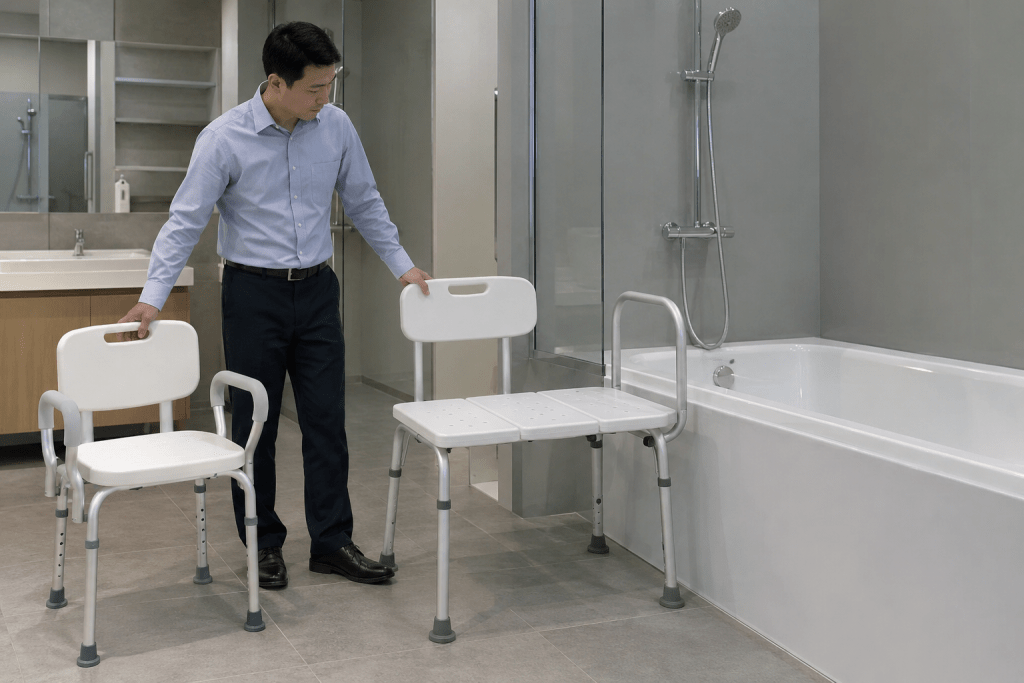
A shower chair vs transfer bench decision depends on the entry barrier: a shower chair supports seated bathing inside an accessible area, while a transfer bench helps a person cross a tub edge while seated. Buyers often focus on seat style and miss the route into the bathing space. That mistake can leave a suitable-looking product unusable in the target bathroom. This guide connects product boundaries, measurements, supports, stability, cleaning, samples, and supplier evidence to a defensible B2B choice.
1. What Does Shower Chair vs Transfer Bench Mean?
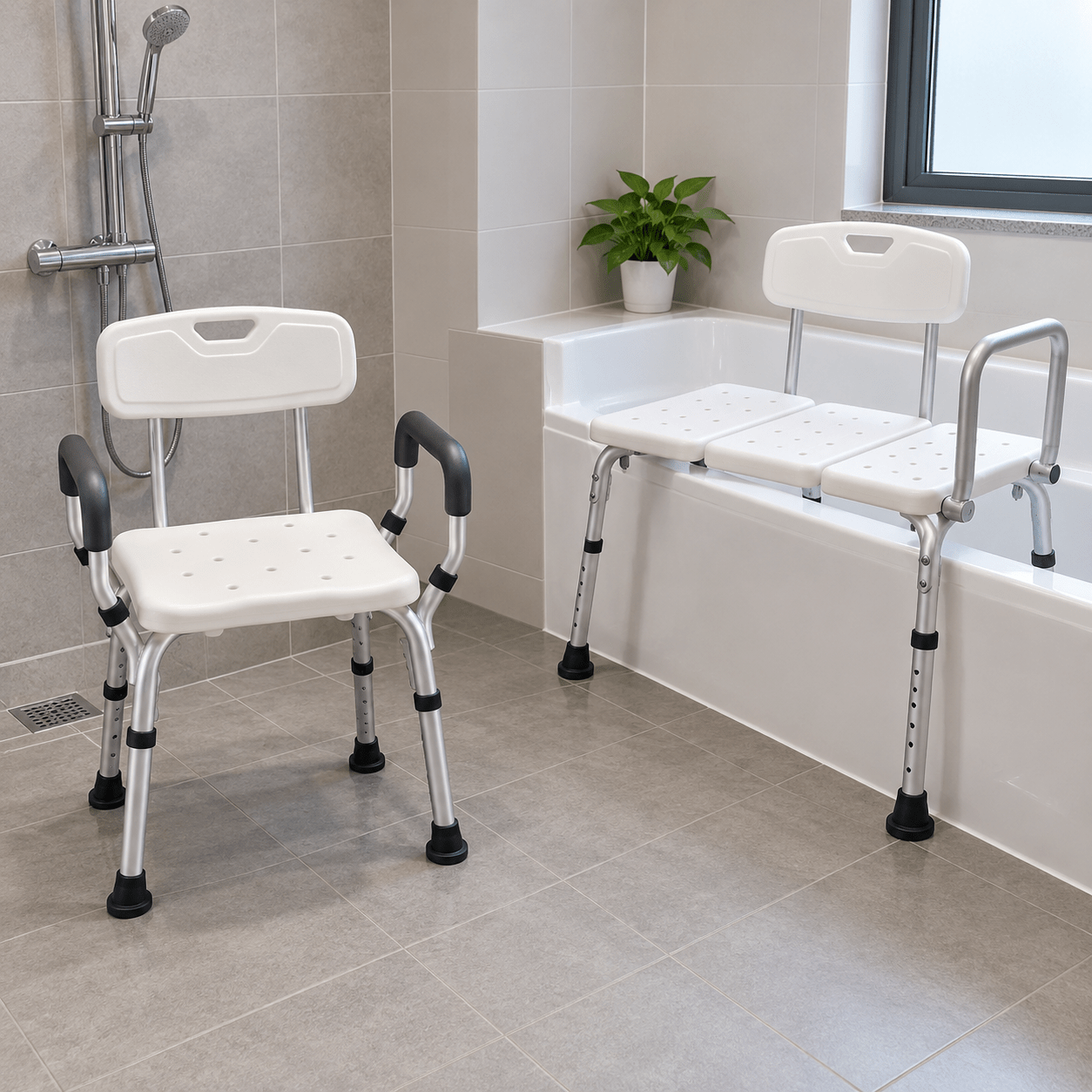
A shower chair vs transfer bench comparison separates seated bathing support from seated tub entry. A chair normally sits inside the bathing area, while a bench spans or crosses a tub edge with legs on both sides.
Which Task Defines Each Product?
Start with the problem the product must solve. A user who can enter a walk-in shower but cannot remain standing has a different need from someone who cannot step over a tub wall.
- Shower chair: seated bathing after entry.
- Transfer bench: seated movement across a tub edge.
- Bath lift: powered movement into a bathtub.
Which Products Should Stay Outside the Comparison?
Wall seats, rolling shower chairs, commodes, and powered bath lifts require separate evidence and workflows. Name the route before the product: category labels should follow the task rather than lead it.
- Identify the bathing-area entry method.
- Record whether installation or an attendant is involved.
- Define excluded uses in the buyer brief.
| Product | Primary task | Bathroom type | Operator need | Boundary |
|---|---|---|---|---|
| Shower chair | Supported seated bathing | Walk-in or accessible tub floor | User or caregiver | Does not bridge a tub edge |
| Transfer bench | Seated tub entry | Bathtub with suitable clearances | User or caregiver | Extends outside the tub |
| Bath lift | Powered lowering and raising | Compatible bathtub | Assessed user or caregiver | Powered product category |
The category boundary prevents a purchase from solving the wrong problem. Key Takeaway: define entry and bathing tasks before comparing product features or prices.
2. Who Needs Shower Chair vs Transfer Bench Guidance?
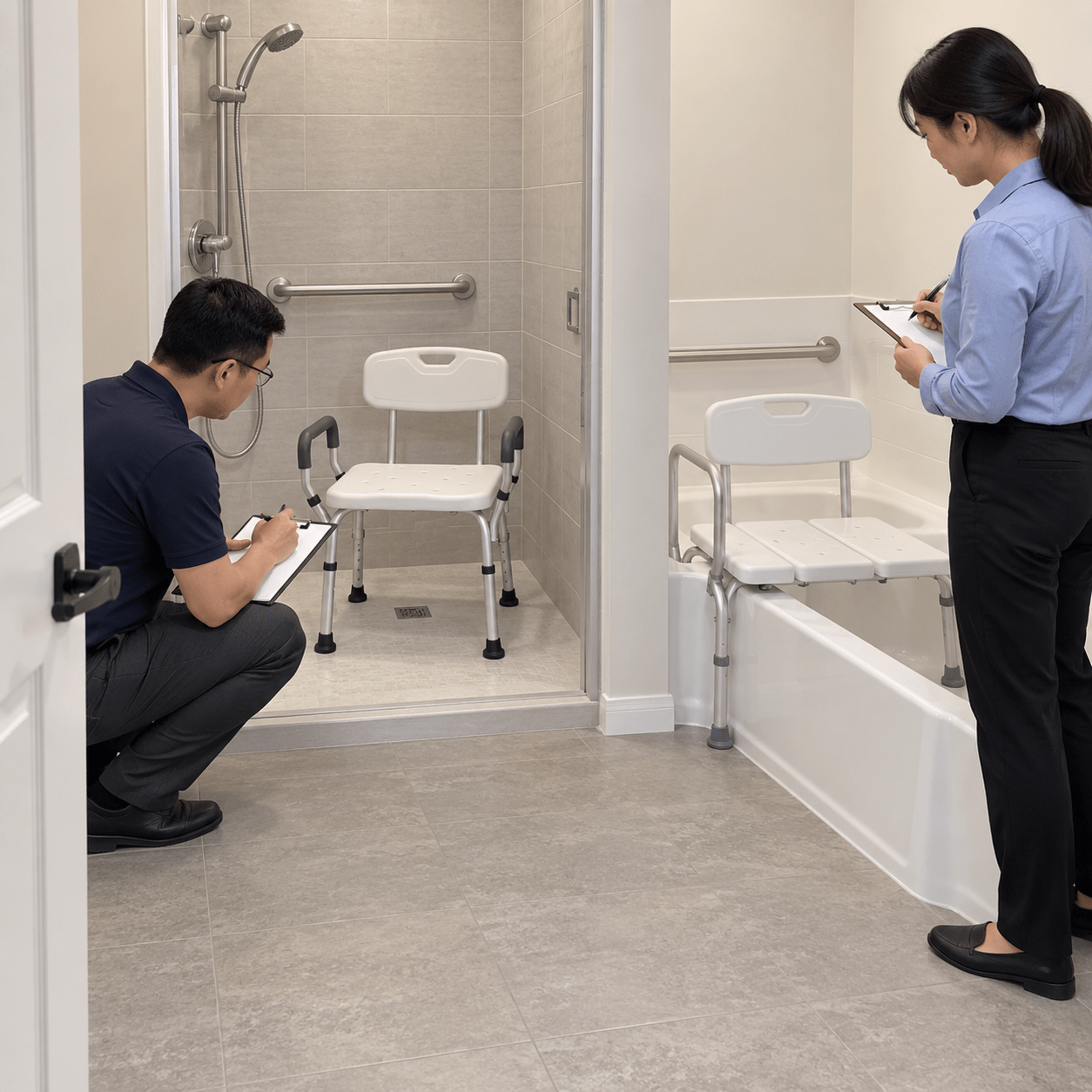
A shower chair vs transfer bench guide serves buyers who must connect user ability, bathroom layout, caregiver work, and procurement evidence. The final choice may involve an assessor, facility lead, installer, and distributor rather than one shopper.
Which Entry Barriers Change the Choice?
Observe the complete route from outside the bathroom to the final seated position. Thresholds, doors, tub walls, narrow approaches, and control locations can change product suitability.
- Walk-in shower entry and turning space.
- Tub-edge height and seated crossing route.
- Caregiver stance and equipment approach.
Which Stakeholders Need Separate Approval?
Product fit, installation, user transfer, and operational readiness belong to different owners. One approval cannot cover every layer: record who is responsible for each decision.
- Qualified staff approve individual transfer tasks.
- Facilities approve rooms, cleaning, and staff workflow.
- Procurement approves configuration and contract evidence.
| Stakeholder | Main question | Evidence | Approval output |
|---|---|---|---|
| Assessor | Does the route suit the user? | Task observation | Fit and limits |
| Facility | Can staff operate and maintain it? | Workflow trial | Operating approval |
| Buyer | Does the offer match the need? | Configuration file | Purchase approval |
Clear ownership reduces gaps between assessment and supply. Key Takeaway: keep user, room, installation, and procurement approvals distinct.
3. How Does Shower Chair vs Transfer Bench Change Entry?
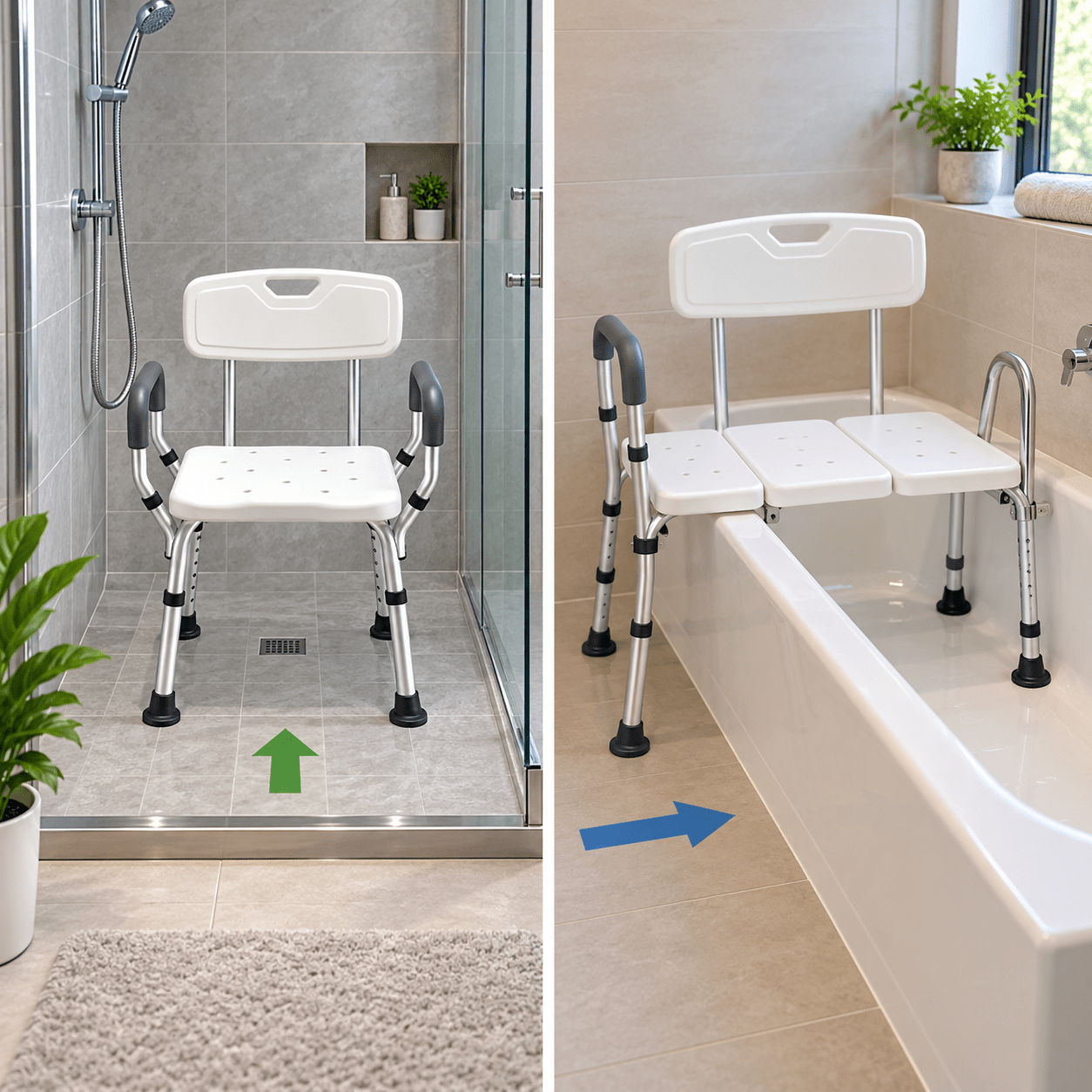
A shower chair vs transfer bench comparison changes how the seated person reaches the bathing position. A chair requires an accessible placement route, while a bench creates a seated path across the tub edge.
How Does a Shower Chair Enter the Bathing Area?
The chair may be carried into place before use or remain stored in an approved location. Every foot must sit on a suitable surface without blocking the drain, controls, or entry path.
- Move through the narrowest doorway or enclosure.
- Place all feet on the approved floor.
- Preserve user and caregiver approach space.
How Does a Transfer Bench Cross a Tub Edge?
Two legs typically remain outside and two inside, depending on the approved design and bathroom. Follow the seated route: bench length, tub rim, curtain, and wall clearance must work together.
- Align the seat with the intended approach.
- Confirm inside and outside floor contact.
- Test curtain or water-control arrangements.
| Entry step | Chair method | Bench method | Buyer check |
|---|---|---|---|
| Product placement | Entire unit inside bathing area | Unit spans tub edge | Floor and rim compatibility |
| User approach | Enter then sit, or transfer inside | Sit outside then move across | Qualified route plan |
| Exit | Stand or transfer from inside | Return across bench | Clear dry-side area |
Entry method is the central difference between categories. Key Takeaway: buy a bench when tub-edge crossing is the barrier, not simply because it offers a larger seat.
4. How Does Shower Chair vs Transfer Bench Affect Space?
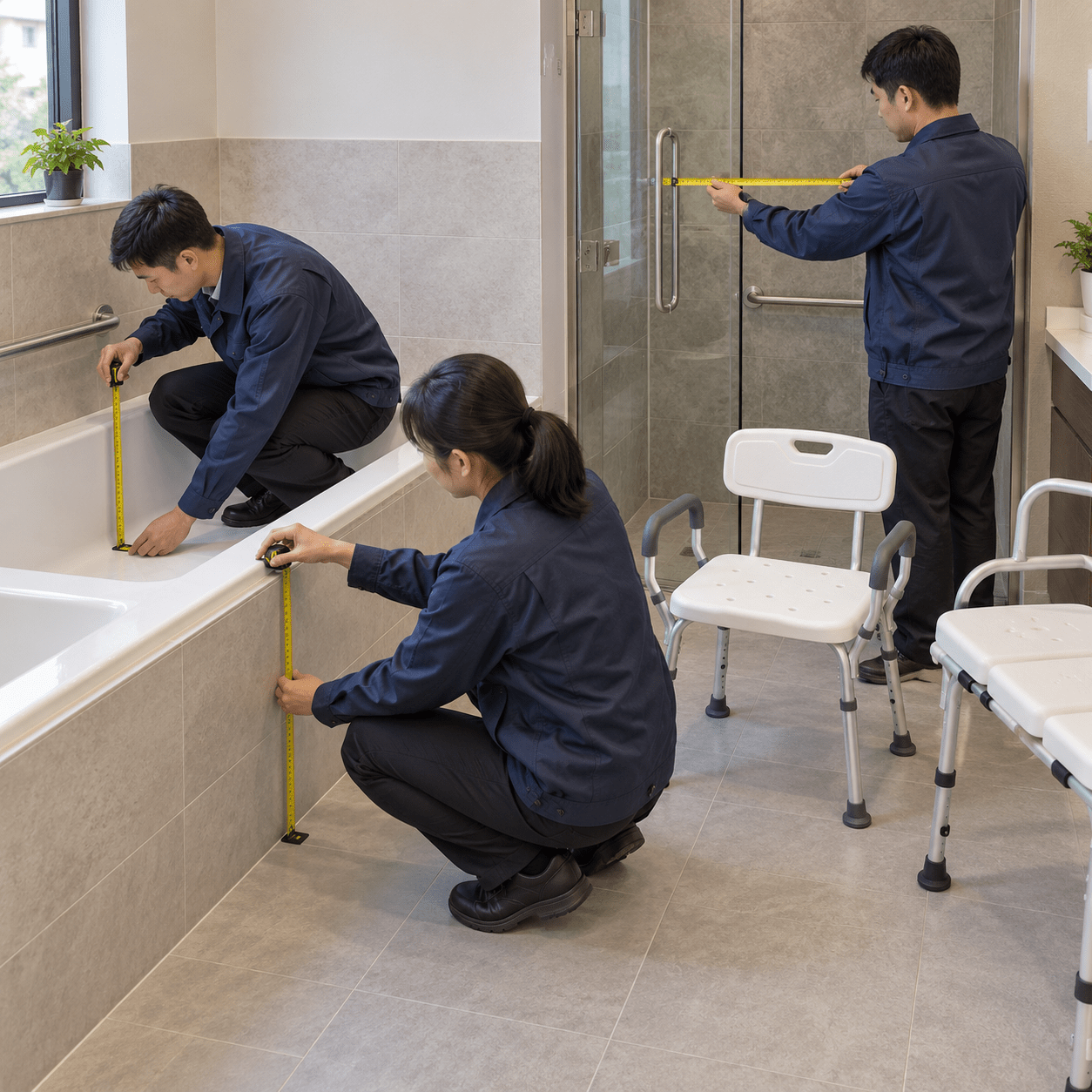
A shower chair vs transfer bench comparison changes the footprint inside and outside the bathing area. A bench may require more lateral room, while a chair requires a complete stable footprint inside the enclosure.
Which Measurements Define Product Fit?
Record fixed and moving clearances using consistent reference points. Measure the route, not only the final location.
- Tub interior, rim, exterior floor, and wall gap.
- Doorway, enclosure track, curtain, and controls.
- Seat, base, overall width, and approach space.
Which Fixtures Can Interfere With Use?
Toilets, vanities, sliding doors, grab bars, and controls can block approach or movement. Draw the real room: a generic bathroom diagram often misses the tightest point.
- Mark every fixed obstruction.
- Include door and curtain movement.
- Check caregiver posture and escape route.
| Space field | Chair concern | Bench concern | Test |
|---|---|---|---|
| Inside floor | All legs must sit flat | Inside legs need stable contact | Placement trial |
| Dry-side floor | Approach space | Outside legs and seat extension | Route trial |
| Enclosure | Chair must clear opening | Bench may cross track or curtain | Full setup |
Usable space includes product, user route, and staff work. Key Takeaway: confirm the complete operating footprint in the target bathroom.
5. How Does Shower Chair vs Transfer Bench Affect Support?
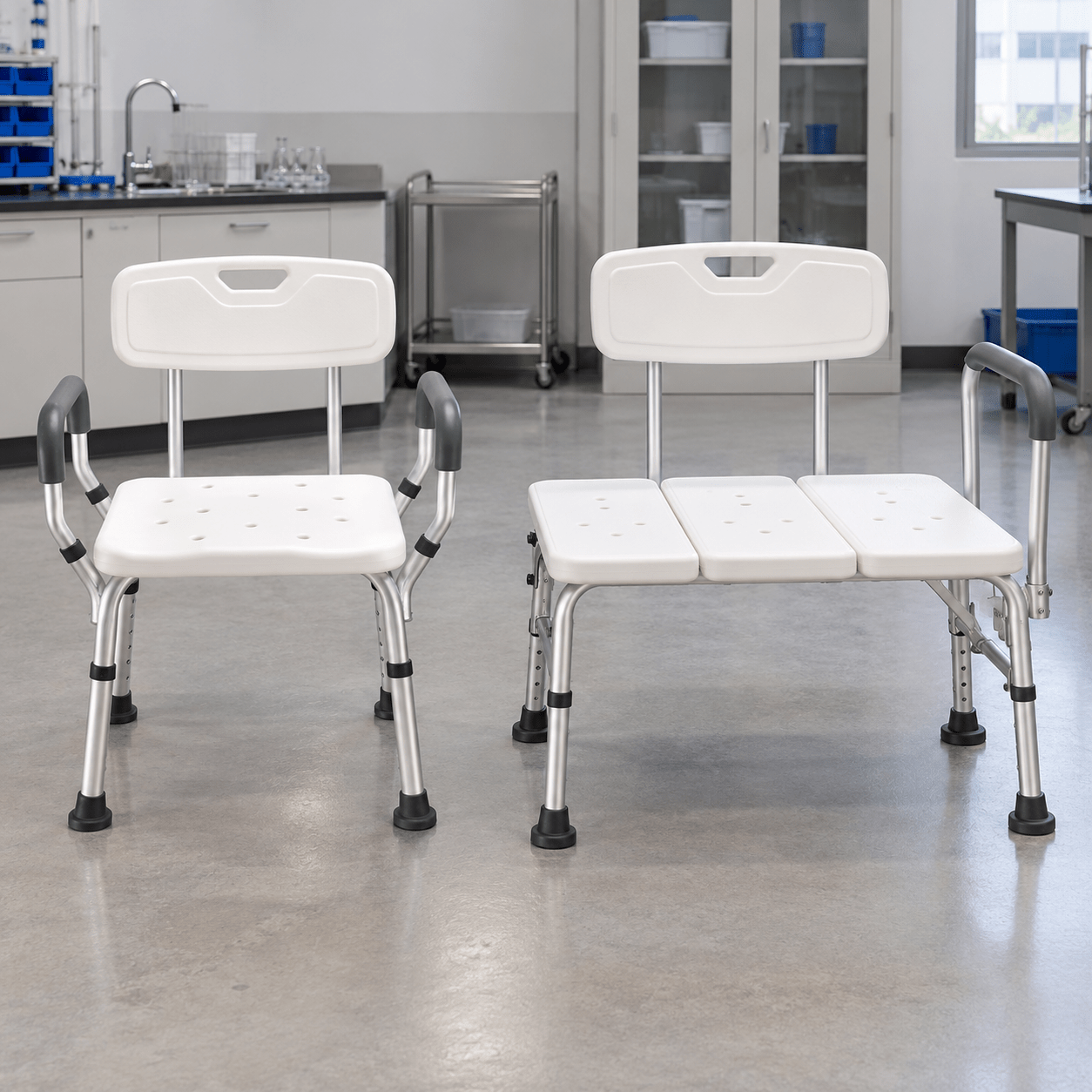
A shower chair vs transfer bench decision affects back, arm, seat, and lateral support options. Added components may improve a specific task while blocking movement across a bench or access beside a chair.
Which Seating Supports Need Review?
Review usable width, depth, height, back position, arms, padding, drainage, and contact surfaces. Do not assume every option fits every frame or bathroom.
- Backrest height and attachment.
- Armrest position and removal method.
- Seat surface, openings, and drainage.
Which Supports Can Block Movement?
Fixed arms can obstruct sliding or side transfers, while back position can conflict with walls or controls. Configuration matters more than category: test the offered options together.
- Check the complete seated route.
- Observe caregiver hand and body access.
- Verify locks after removable parts return.
| Support | Chair effect | Bench effect | Decision question |
|---|---|---|---|
| Backrest | Adds rear support | May affect sliding or wall fit | Does the task require it? |
| Armrest | May support push-off | May interrupt lateral movement | Fixed or removable? |
| Padding | Changes contact and cleaning | May affect sliding surface | Can it be cleaned and dried? |
The selected support must work through the entire entry and bathing task. Key Takeaway: approve the exact support configuration, not a generic chair or bench label.
6. How Does Shower Chair vs Transfer Bench Affect Stability?
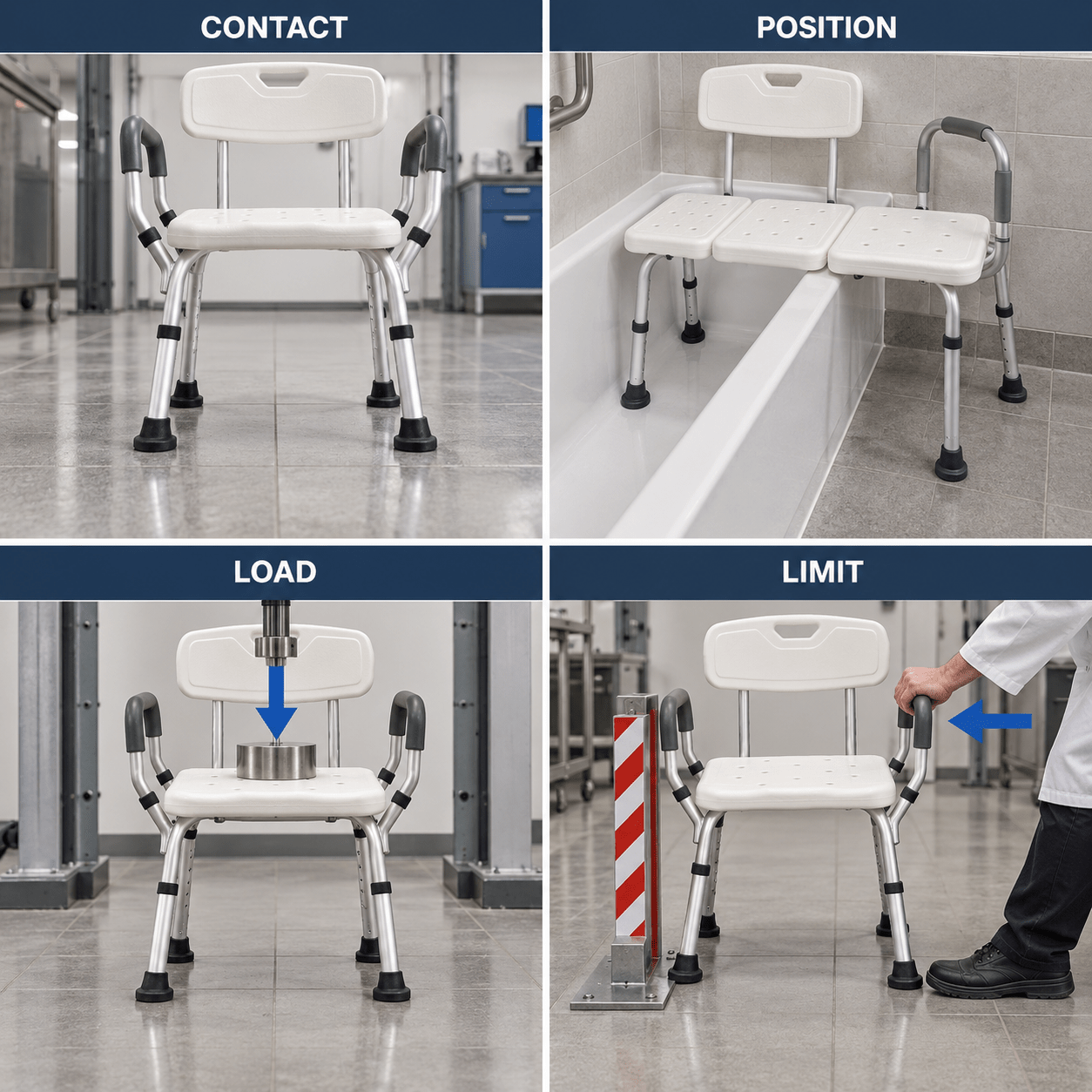
A shower chair vs transfer bench comparison changes floor contact, load distribution, and movement during transfers. Both products require configuration-specific stability evidence and correct placement.
Which Floor Contacts Need Inspection?
Check every foot on the surfaces it will use. Mixed wet and dry floors, curved tubs, grout, and unequal levels can create partial contact.
- Inspect foot material and attachment.
- Verify permitted height settings.
- Observe rocking before task trials.
Which Loads Need Controlled Review?
Seated load, arm push-off, sliding, side transfer, and caregiver contact may act in different directions. Separate the cases: one vertical-load record cannot answer every stability question.
- Use an approved no-user technical protocol first.
- Record product state and floor condition.
- Link baseline checks to the simple chair configuration where relevant.
| Load condition | Chair concern | Bench concern | Evidence need |
|---|---|---|---|
| Seated load | Frame and feet | Frame across two surfaces | Configuration test |
| Push-off | Arms and rear movement | Outside-leg movement | Task-specific review |
| Lateral movement | Side loading | Sliding or scooting path | Controlled trial |
Stability is a product-and-environment property. Key Takeaway: approve the intended load directions and floor setup, not only a capacity number.
7. How Does Shower Chair vs Transfer Bench Affect Cleaning?
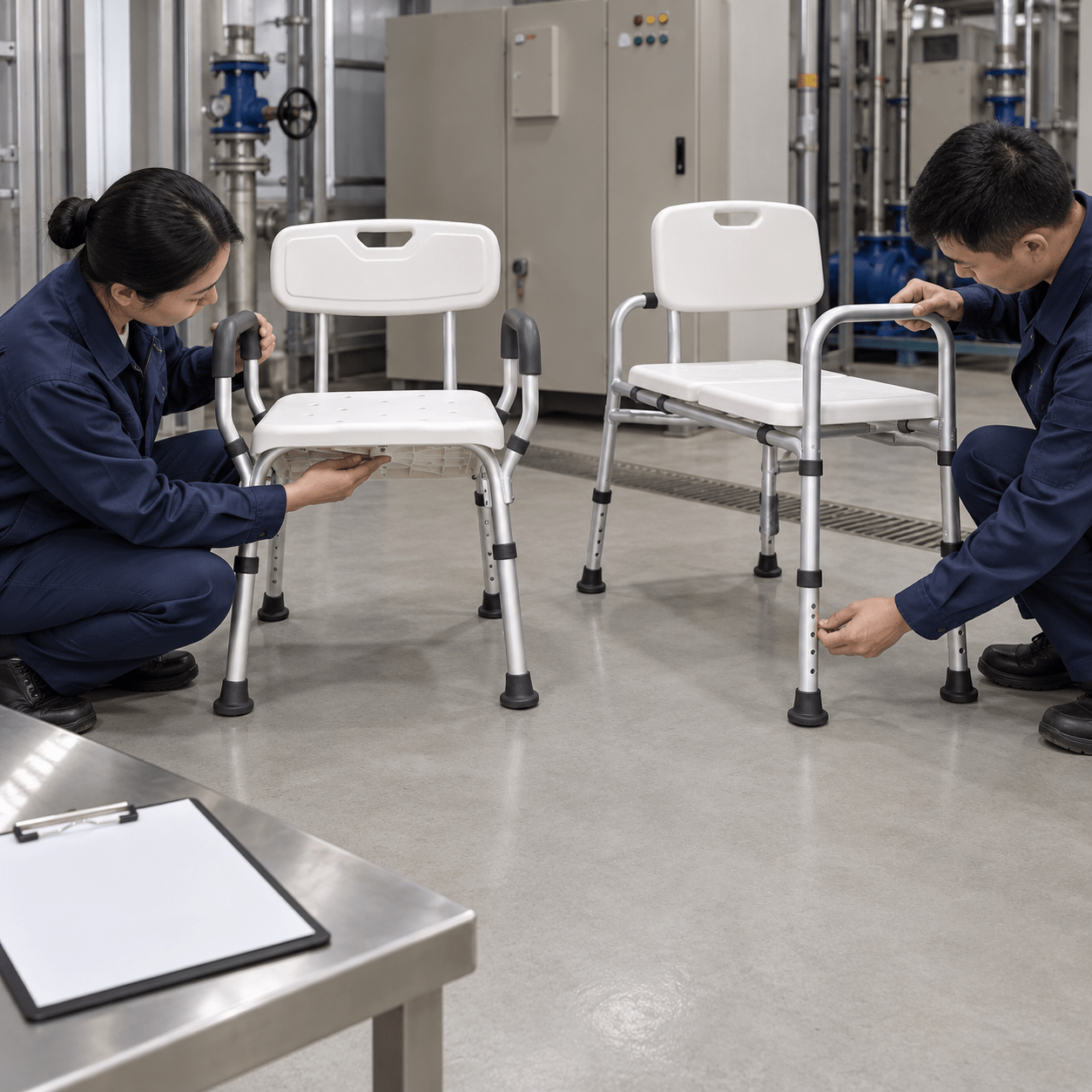
A shower chair vs transfer bench comparison changes cleaning access, water retention, drying time, and storage needs. Longer rails and sliding parts can create more hidden surfaces than a simple chair.
Which Surfaces Collect Water or Residue?
Inspect the seat, back, arms, rails, joints, feet, padding, drainage holes, and undersides. Cleaning instructions should match the exact materials and configuration.
- Identify removable and fixed components.
- Check drainage and trapped-water areas.
- Record surfaces that require inspection after cleaning.
Which Cleaning Tasks Change Between Products?
A bench may need cleaning across both wet and dry sections, while a chair may be lifted or stored after use. Plan the whole turnaround: cleaning ends only after drying, inspection, and release.
- Define who removes or repositions the product.
- Protect locks and sliding interfaces.
- Keep shared-use records where required.
| Cleaning zone | Chair access | Bench access | Control |
|---|---|---|---|
| Seat and back | Compact but layered | Extended seat or track | Approved surface method |
| Feet and legs | Inside bathing area | Mixed wet/dry surfaces | Full-contact inspection |
| Joints | Adjustment or folding points | Rails and cross-tub frame | Dry and function-check |
Cleaning workload belongs in the buying decision. Key Takeaway: test cleaning, drying, and return-to-use before standardizing a product.
8. How Do You Test Shower Chair vs Transfer Bench Samples?
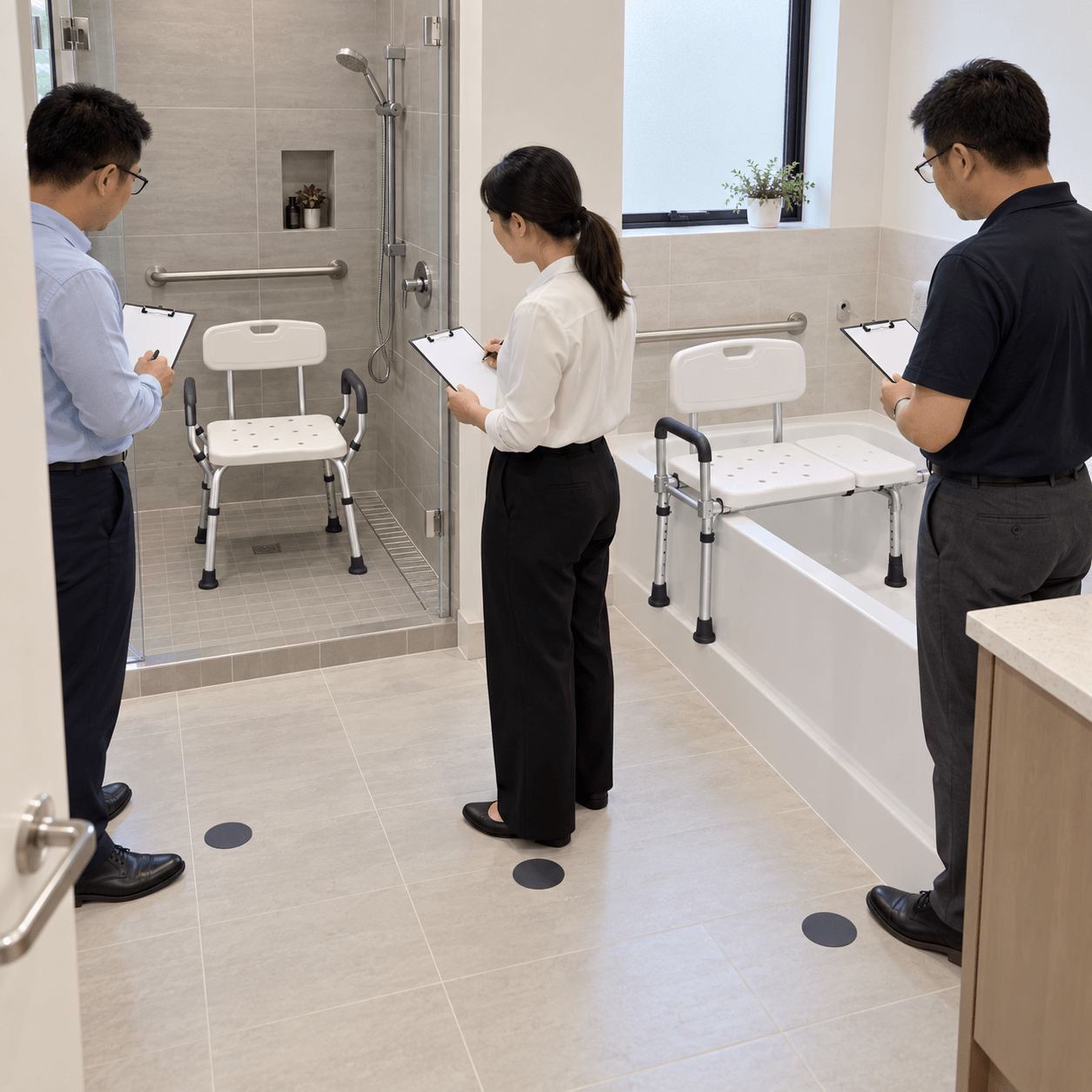
A shower chair vs transfer bench sample test should recreate the target entry, placement, support, transfer, cleaning, and storage workflows. A general showroom demo cannot approve a specific bathroom.
Which Bathroom Simulations Should Be Built?
Use measured mock-ups for walk-in showers, tub walls, doorways, controls, curtains, and caregiver zones. Keep test conditions and stop rules documented.
- Match critical dimensions and surfaces.
- Use the proposed configuration and height.
- Test only approved task sequences.
Which Trial Outcomes Need Documentation?
Record fit, contact, route, support, movement, cleaning, handling, and exceptions. A sample must answer a purchase question: compare with folding bath-chair handling when storage also matters.
- Separate observations from accepted limits.
- Assign an owner to each open finding.
- Retest affected tasks after correction.
| Trial stage | Common check | Chair-specific task | Bench-specific task |
|---|---|---|---|
| Placement | Surface contact | Inside-area fit | Tub-edge span |
| Access | User and staff route | Sit inside area | Seated crossing |
| Turnaround | Clean and store | Carry or fold | Remove or reposition |
The trial should resemble normal work, not a staged product pose. Key Takeaway: approve samples only after the measured bathroom route and operating workflow pass.
9. How Do Suppliers Document Shower Chair vs Transfer Bench?
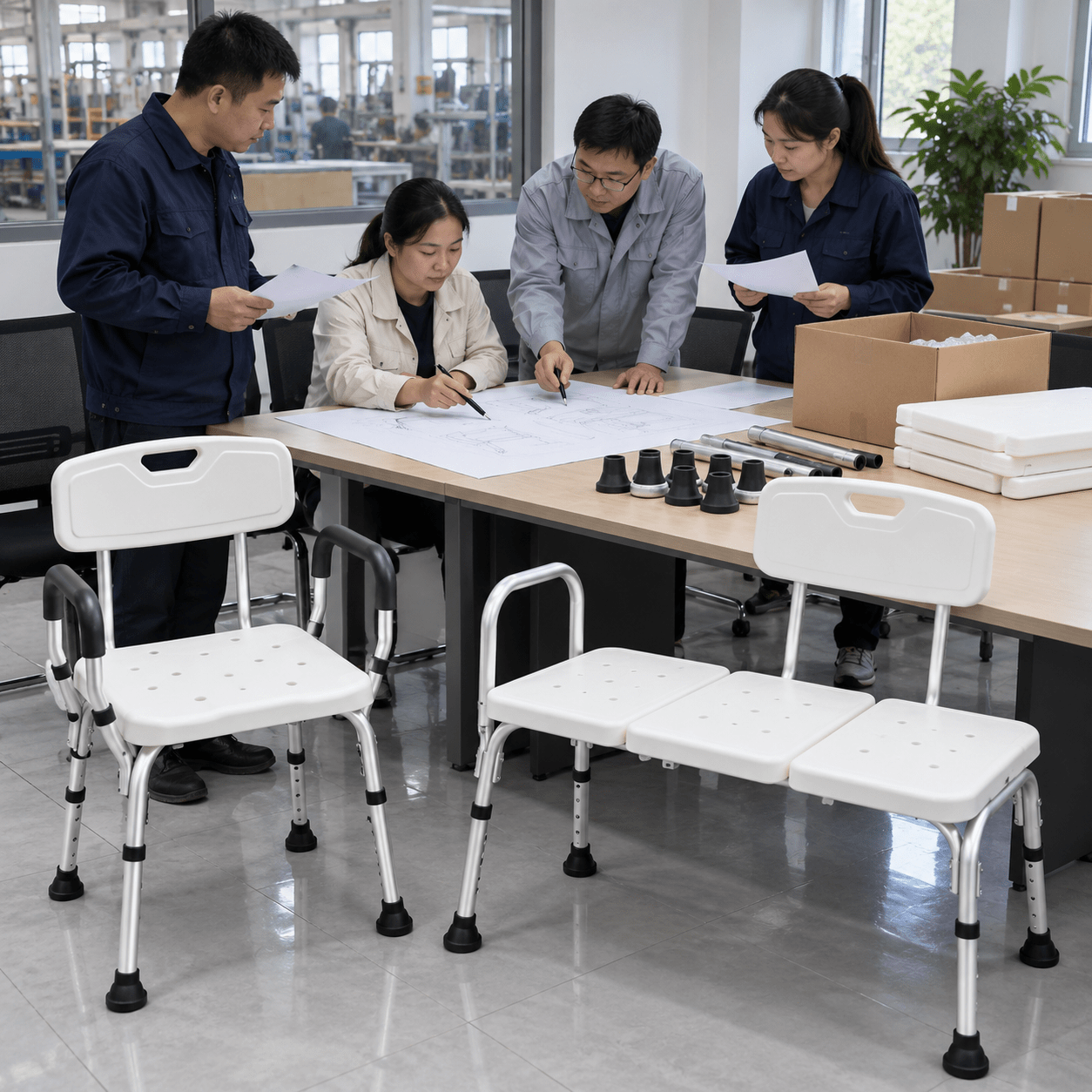
A shower chair vs transfer bench supplier should provide configuration-specific drawings, materials, dimensions, load evidence, manuals, labels, packing, and parts. Family brochures cannot prove that the sampled options match production.
Which Specifications Must Match the Sample?
Model, supports, feet, height range, seat geometry, frame, packaging, and instructions should identify one saleable configuration.
- Cross-reference quotation and sample.
- Record revision and optional components.
- Require notice before substitutions.
Which Instructions Need Product-Specific Detail?
Assembly, placement, transfer sequence, cleaning, inspection, storage, and faults differ between categories. Read for contradictions: instructions must reflect the physical product.
- Compare drawings with delivered parts.
- Run key steps during the sample review.
- Hold approval when limits remain vague.
| Document | Chair field | Bench field | Approval question |
|---|---|---|---|
| Drawing | Footprint and supports | Span and leg positions | Matches sample? |
| Manual | Placement and use | Tub-entry sequence | Task is clear? |
| Parts map | Feet and supports | Rails, legs, and locks | Service is possible? |
Traceable documents keep the approved product reproducible. Key Takeaway: accept only records that match the exact chair or bench configuration offered.
10. How Should Buyers Decide Shower Chair vs Transfer Bench?

A shower chair vs transfer bench decision should begin with the entry barrier and pass gates for room fit, support, transfer, stability, cleaning, evidence, and service. Unit price belongs after these mandatory questions.
Which Gate Comes Before Price Comparison?
Confirm whether the user can enter the bathing area and which seated route is approved. A product that fails entry or floor fit should not proceed to commercial scoring.
- Define the barrier and bathroom type.
- Approve the task and configuration.
- Close critical sample findings.
How Should Procurement Preserve the Choice?
Attach the approved specification, sample record, training, and related bathroom-equipment receiving plan to the order. Keep the reason visible: later substitutions must not erase the task that drove selection.
- Fix configuration and revision.
- Define acceptance checks and change notice.
- Keep support ownership clear.
| Decision gate | Required evidence | Owner | Release rule |
|---|---|---|---|
| Entry route | Measured bathroom and task plan | Assessor/facility | Route is workable |
| Product fit | Sample and configuration record | Evaluation team | Critical checks pass |
| Supply release | Contract and acceptance plan | Procurement | Approved state preserved |
The purchase file should explain why this category was chosen. Key Takeaway: select the product that solves the measured entry task and remains supportable after delivery.
Conclusion
Chair-versus-bench selection becomes clear when buyers start with bathroom entry, then review space, support, stability, cleaning, evidence, and service. A chair supports bathing inside an accessible area; a bench addresses seated movement across a tub edge. To discuss product boundaries and sourcing requirements for your market, contact us today. Sound bathroom-equipment procurement solves the route before comparing the catalog.
FAQ
Can a transfer bench fit every bathtub?
No. Tub width, rim, wall gap, floor levels, enclosure, controls, and outside approach can prevent correct placement. Measure and trial the exact bathroom.
What’s the best option for a walk-in shower?
A shower chair often fits the task when entry is already accessible and the need is seated bathing. User support, floor contact, controls, and caregiver space still require review.
How do I know whether the tub edge is the main barrier?
Observe the complete entry route with qualified input. If stepping over the rim prevents safe access, a seated crossing product may deserve evaluation.
Can one sample approve several bathroom layouts?
Only when critical dimensions, surfaces, routes, supports, and workflows are demonstrably equivalent. Record room groups rather than assuming all bathrooms match.
How should buyers document a product change?
Require a change notice that identifies affected parts, dimensions, evidence, instructions, packaging, and production timing. Retest any task or risk altered by the change.
