

Institutional shower chair procurement should begin with users, bathing tasks, transfer routes, bathroom layouts, staff workflows, cleaning, and service capacity before products are compared. Standardizing one chair across different rooms and care needs can create workarounds, idle stock, or hidden labor. Unit price alone cannot represent that burden. This guide helps hospitals, care homes, rehabilitation centers, group-living facilities, procurement teams, and distributors build a facility-wide process from needs assessment through contract control.
1. What Is Institutional Shower Chair Procurement?

Institutional shower chair procurement is a multi-user, multi-room decision that connects care tasks, staff, shifts, cleaning, maintenance, storage, replacement stock, and supplier support. It may result in several controlled product families rather than one universal model. The goal is a manageable system with clear boundaries.
Which Decisions Make Institutional Buying Different?
Institutions must consider repeated use, different operators, shared equipment, turnover, documentation, service, inventory, and training across locations. A household feature list is too narrow.
- Map users by task rather than diagnosis alone.
- Group rooms by verified constraints.
- Include lifecycle operations before price comparison.
Which Product Families May Be Needed?
Stools, standard chairs, supported chairs, folding chairs, heavy-duty chairs, transfer benches, and commode configurations solve different route and support problems. Keep boundaries clear: one category should not inherit another’s evidence.
- Define inclusion and exclusion criteria.
- Identify shared and dedicated units.
- Avoid unnecessary variety when workflows match.
| Product family | Facility task | Room type | Boundary |
|---|---|---|---|
| Stool/standard chair | Seated bathing with lower support need | Open compatible shower | Limited transfer support |
| Supported chair | Back/arm assistance | Verified floor shower | Support geometry required |
| Transfer or commode type | Route-specific assisted task | Compatible tub/toilet route | Different space and care workflow |
Category discipline reduces both under-specification and needless complexity. Key Takeaway: buy a controlled product family system, not one chair for every situation.
2. Who Owns Institutional Shower Chair Procurement?

Institutional shower chair procurement needs input from procurement, care teams, nursing, therapy where relevant, infection control, facilities, equipment service, finance, users, and distribution partners. Each group sees a different failure mode. Named authority is still necessary so consultation does not become an endless meeting.
Which Stakeholders Need Input?
Care staff understand daily handling, facilities understand rooms and storage, infection control owns hygiene requirements, service teams understand parts, and procurement controls supplier commitments.
- Ask each group a defined question.
- Separate mandatory gates from preferences.
- Record unresolved conflicts and owner.
Which Decisions Need Named Authority?
User fit, room fit, cleaning, maintenance, product release, supplier approval, and design-change acceptance need accountable sign-off. Name the decision, not just the department: shared ownership often means no ownership.
- Set approval and consultation roles.
- Define escalation for blocked gates.
- Preserve decisions with the project file.
| Stakeholder | Main question | Evidence | Approval role |
|---|---|---|---|
| Care/user team | Does the task and support plan work? | Observed sample trial | User-workflow input |
| Facilities/hygiene | Does room and cleaning fit? | Room map and process trial | Environmental gate |
| Procurement/quality | Can supply be controlled? | Documents, sample, contract | Supplier/order release |
Cross-functional input needs disciplined authority. Key Takeaway: assign one owner to every requirement, conflict, and approval gate.
3. How Does Institutional Shower Chair Procurement Segment Users?
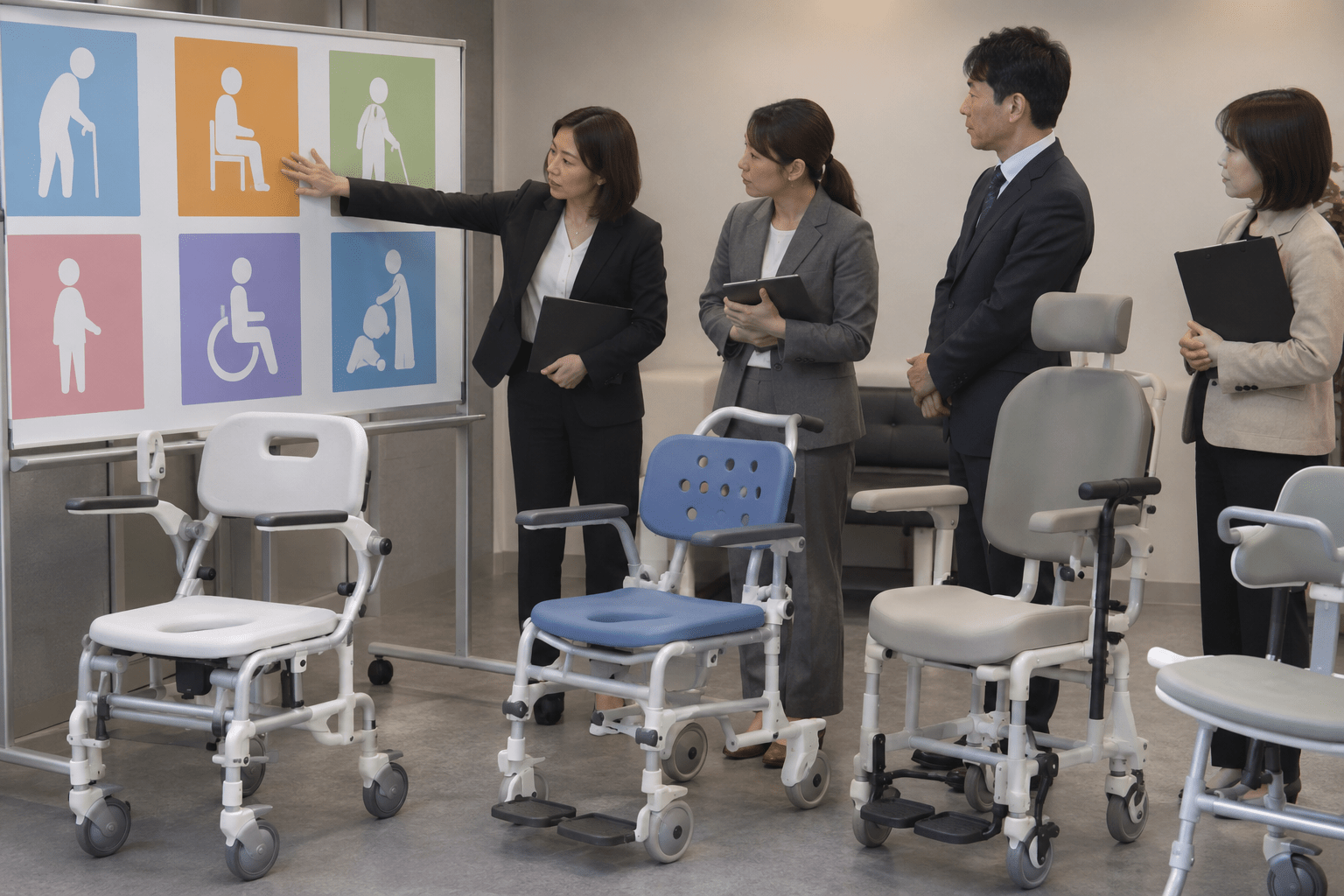
Institutional shower chair procurement should segment people by bathing task, seated balance and support need, transfer route, dimensions, assistance level, environment, and restrictions. It should avoid collecting personal information that is not needed for the equipment decision. The output is a functional group, not a public medical profile.
Which Task Groups Need Separation?
Independent seated bathing, supported sitting, assisted transfer, larger-body fit, temporary use, and shared use can require different geometry, supports, handling, and inspection.
- Describe the task and assistance.
- Record critical dimensions through authorized assessment.
- Identify product categories outside scope.
Which User Information Should Remain Minimal?
Capture only what changes fit, support, route, cleaning, or staff workflow. Protect the purpose: procurement does not need a full clinical history to compare chair configurations.
- Use anonymous group data where possible.
- Keep individual decisions with qualified care staff.
- State uncertainty and reassessment triggers.
| Task group | Product need | Assessment owner | Information limit |
|---|---|---|---|
| Independent seated use | Fit, grip, entry, stability | Qualified facility team | Functional requirements |
| Assisted sitting/transfer | Supports, route, caregiver space | Care/therapy team | Task-specific observations |
| Shared fleet | Range, cleaning, adjustment, records | Program owner | Aggregated group needs |
Task groups create a defensible demand profile. Key Takeaway: collect the minimum functional information needed to choose and manage equipment.
4. How Does Institutional Shower Chair Procurement Map Rooms?
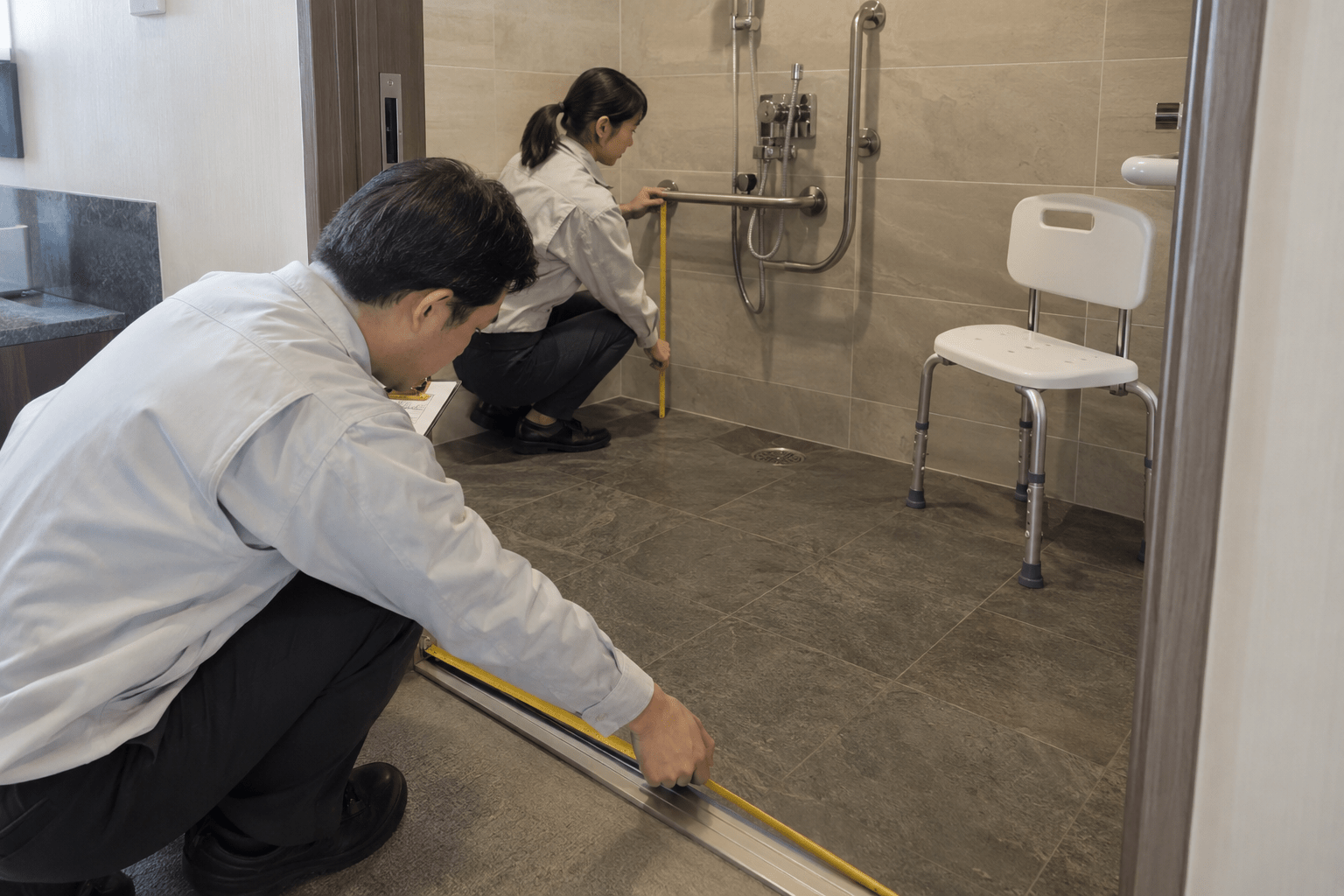
Institutional shower chair procurement should map doorway width, approach route, floor, tub or shower form, threshold, drain, controls, grab bars, storage, turning space, and caregiver position. A seat can fit inside the shower yet fail at the door or block controls. Room measurement should use consistent reference points.
Which Bathroom Variables Need Recording?
Record limiting openings, changes in level, slopes, fixed fixtures, drainage, wet-surface condition, reach zones, and the space needed for normal assistance.
- Measure the complete delivery-to-use route.
- Photograph or diagram approved reference points.
- Note temporary obstacles and shared equipment.
Which Room Groups Can Share a Product?
Rooms can share a product family only when critical clearances, routes, cleaning, storage, and staff tasks remain compatible. Group by constraint: matching room names do not guarantee matching layouts.
- Test the tightest room in each group.
- Record exceptions separately.
- Revalidate after renovations or fixture changes.
| Room group | Critical constraint | Product requirement | Test |
|---|---|---|---|
| Open shower | Floor contact and caregiver space | Base geometry and supports | Placement and task trial |
| Tub environment | Curved floor, rim, route | Compatible category/footprint | Full entry and exit route |
| Compact bathroom | Door, controls, storage | Operating envelope and handling | Measured clearance cycle |
Room groups keep standardization evidence-based. Key Takeaway: approve each product only for verified room constraints and routes.
5. How Does Institutional Shower Chair Procurement Address Hygiene?
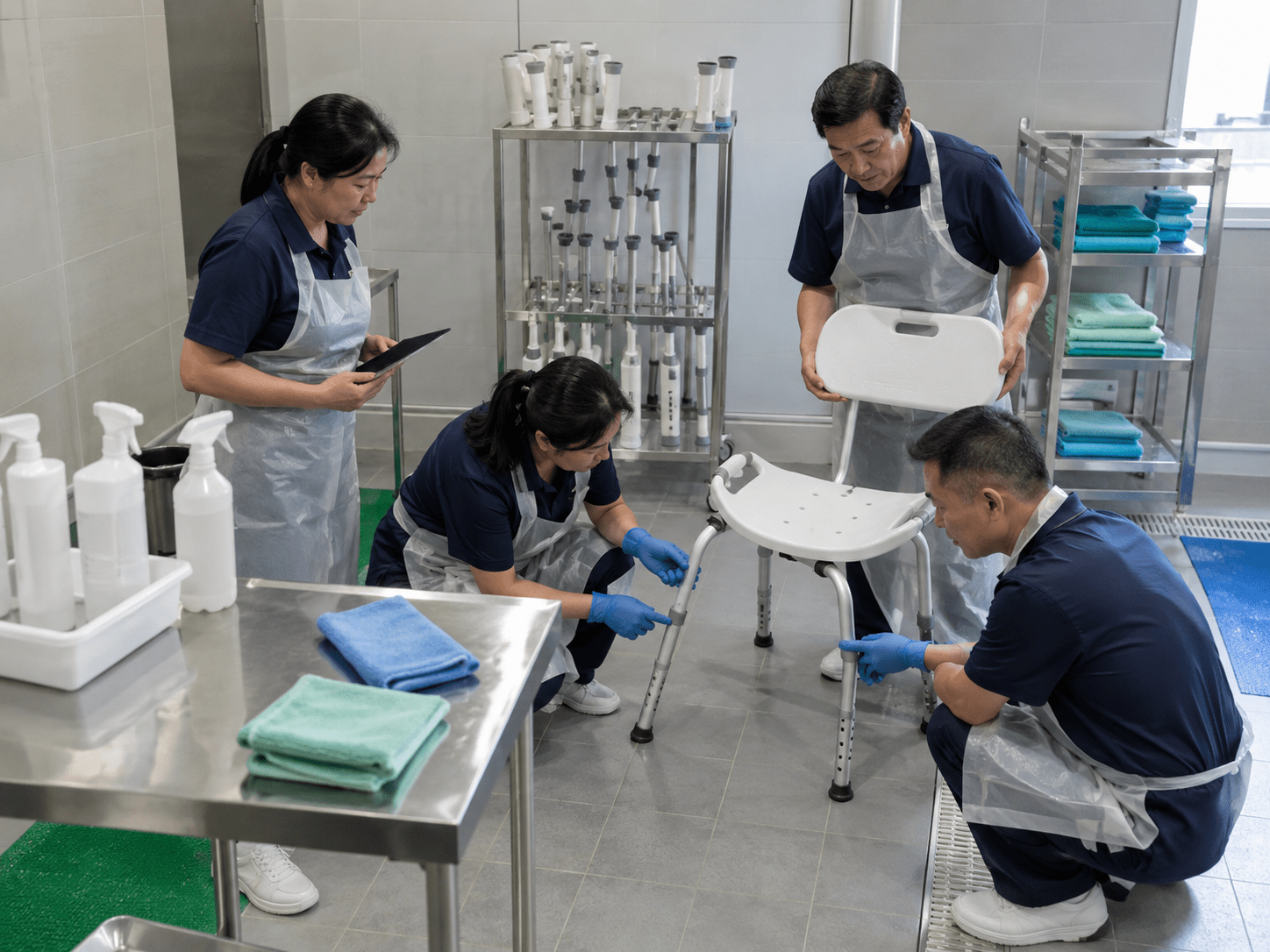
Institutional shower chair procurement should define assigned-use and shared-use collection, isolation, cleaning, disinfection, rinsing, drying, inspection, storage, and release before product approval. Smooth appearance alone does not prove cleanability. Seams, tubes, feet, padding, labels, and removable parts change the work.
Which Cleaning Workflows Need Definition?
Map the dirty-to-clean route, staff roles, compatible methods, area separation, time, drying, technical holds, and records for each product family.
- Use current product and facility instructions.
- Include the complete fitted configuration.
- Trial the process on a sample.
Which Product Features Affect Hygiene Work?
Surface texture, drainage, hidden undersides, seams, removable components, hollow tubes, padding, feet, and label durability influence access and inspection. Measure the labor: a cleanable design must also fit staffing and space.
- Time work without shortcuts.
- Record retained water and hard-to-reach zones.
- Include post-cleaning function checks.
| Hygiene step | Product need | Facility input | Gate |
|---|---|---|---|
| Cleaning/disinfection | Compatible accessible surfaces | Approved process and chemicals | Reconciled method |
| Drying/storage | Drainage and suitable product state | Ventilated clean area | Dryness verified |
| Release | Intact surfaces and functions | Inspection and record | Authorized status |
Hygiene workload belongs in the sourcing decision. Key Takeaway: validate the chair and the facility’s cleaning workflow as one operating system.
6. How Does Institutional Shower Chair Procurement Address Staff?
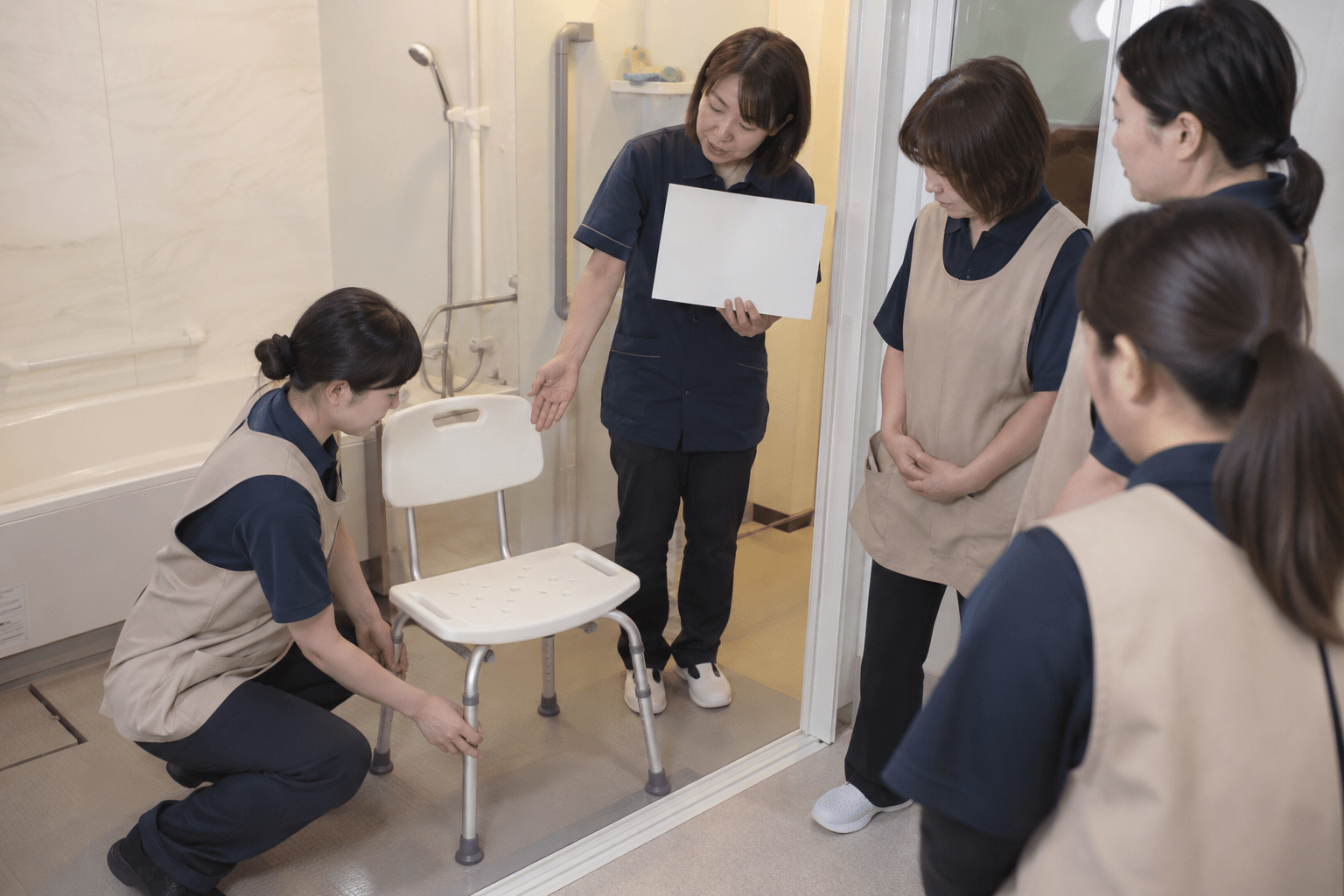
Institutional shower chair procurement should test the staff tasks that place, adjust, support transfers, clean, fold, store, inspect, and report the chair. A configuration that works only with a sales representative’s coaching is not ready for routine use. Training requirements should be proportionate and repeatable across shifts.
Which Staff Tasks Need Trials?
Use empty-chair or approved simulations to observe setup, height adjustment, support placement, room entry, cleaning access, folding, storage, and problem escalation.
- Include different roles and shifts.
- Record awkward reaches and repeated errors.
- State tasks requiring two people or specialist staff.
Which Training Outputs Need Records?
Competence, role limits, refresher triggers, configuration changes, incident learning, and escalation routes should be documented. Train for exceptions: staff need to know when to stop as well as how to proceed.
- Keep materials specific to the product revision.
- Remove obsolete guides.
- Review folding-chair handling when selected.
| Staff role | Task | Assessment | Record |
|---|---|---|---|
| Care team | Setup and supported workflow | Observed correct sequence | Competence/status |
| Cleaning team | Hygiene and drying | Full process trial | Method approval |
| Equipment team | Inspection and service | Technical closeout | Maintenance record |
Staff capability is part of product fit. Key Takeaway: approve configurations only after real operators can complete and stop the workflow correctly.
7. Which Evidence Supports Institutional Shower Chair Procurement?
Institutional shower chair procurement requires evidence that matches the quoted dimensions, materials, supports, intended use, stated load, manuals, labels, parts, and revision. Facility documents must then align with that configuration. A report for another chair or a generic material cannot close the evidence gap.
Which Configuration Documents Need Matching?
Review controlled drawings, specifications, material declarations, applicable test reports, instructions, labels, parts lists, and the physical sample side by side.
- Match model and option identifiers.
- Check report sample and method scope.
- List missing or conflicting fields.
Which Facility Documents Need Alignment?
Risk assessment, cleaning policy, maintenance plan, room map, training materials, and acceptance process should use the same product state. Connect both sides: supplier evidence cannot prove facility workflow, and facility policy cannot prove product performance.
- Assign each gap to an owner.
- Preserve the decision and limitation.
- Reopen approval after material changes.
| Evidence set | Owner | Matching field | Approval gate |
|---|---|---|---|
| Product specification | Supplier/product team | Model, revision, options | Configuration defined |
| Technical evidence | Quality team | Sample and claim scope | Claim supported |
| Facility controls | Facility owner | Room, task, cleaning, service | Workflow approved |
Evidence must meet at the exact configuration. Key Takeaway: close supplier and facility evidence gaps before volume approval.
8. How Should Institutional Shower Chair Procurement Test Samples?
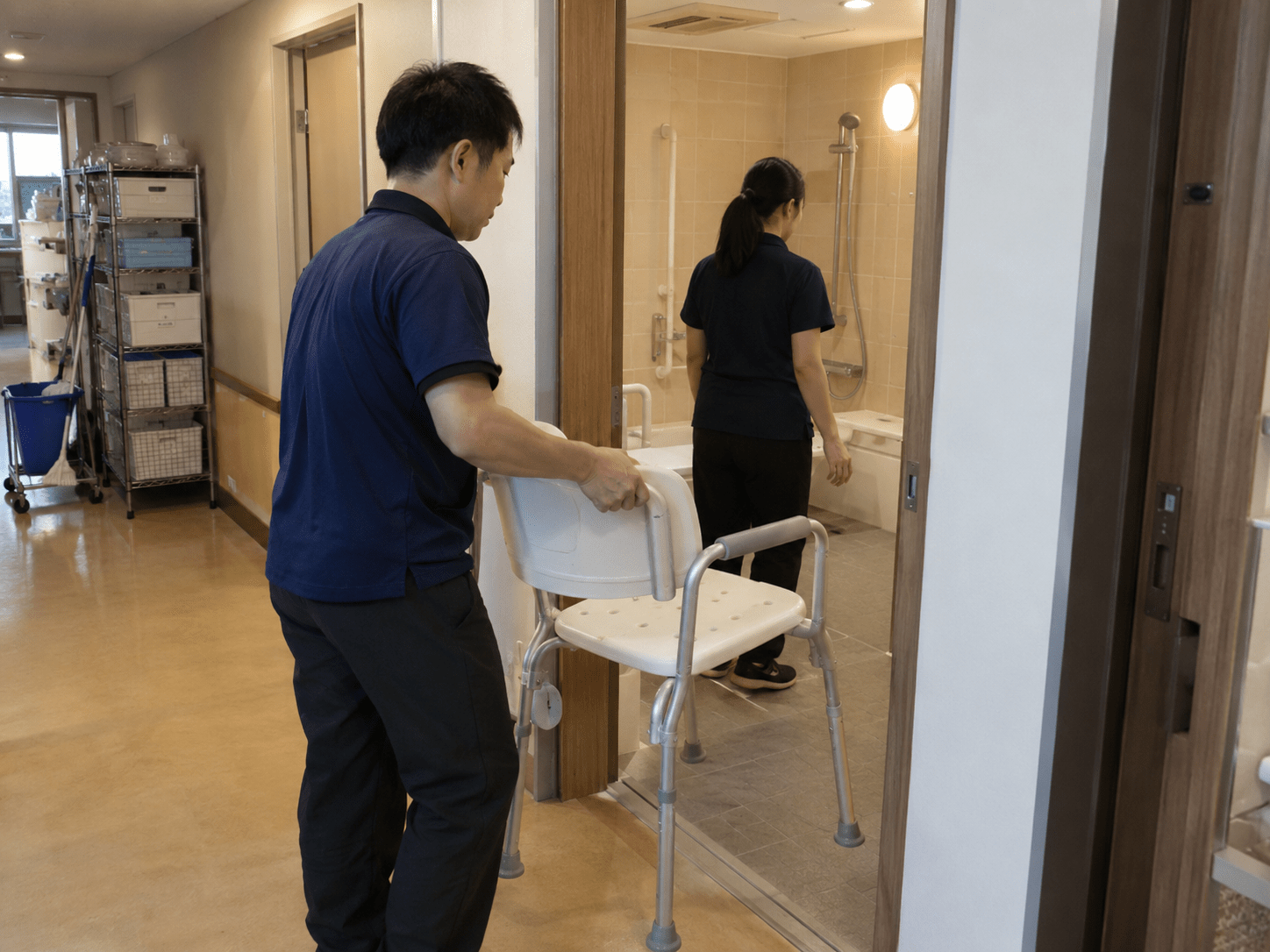
Institutional shower chair procurement should test samples through delivery, storage, bathroom entry, placement, the intended empty-chair or authorized task simulation, cleaning, drying, inspection, repair access, and return to storage. One successful sitting trial is too narrow. Observe normal staff without extra supplier coaching.
Which Facility Routes Need Simulation?
Use representative tight rooms, storage locations, elevators or corridors, cleaning areas, and service benches. Include the route back into clean stock.
- Test each proposed room group.
- Use the offered configuration and packaging.
- Record time, interventions, and failures.
Which Findings Need Closure?
Fit, function, workflow burden, training gaps, document mismatch, damage, retained water, parts access, and supplier response need named owners. Do not average away a failed gate: one critical mismatch can block the configuration.
- Classify mandatory and optional findings.
- Verify corrective changes on a new sample where needed.
- Preserve the final approved state.
| Sample stage | Task | Observation | Gate |
|---|---|---|---|
| Route and room | Deliver, place, retrieve | Clearance and handling | All critical rooms pass |
| Use workflow | Configure and simulate task | Support and staff workload | Approved by owner |
| Turnover/service | Clean, dry, inspect, repair | Labor and access | Lifecycle workflow passes |
Sample trials should mirror institutional reality. Key Takeaway: approve the complete facility route, not a short showroom demonstration.
9. How Does Institutional Shower Chair Procurement Compare Costs?

Institutional shower chair procurement should compare unit price together with freight, storage, setup, cleaning labor, training, spares, repairs, downtime, replacement stock, and disposal. All suppliers need the same period, quantity, use, staffing, service, and currency assumptions. Otherwise, totals are not comparable.
Which Costs Belong Beyond Unit Price?
Include inbound logistics, receiving, assembly, room changes, cleaning materials and time, training, inspections, spare inventory, repair labor, unavailable equipment, and end-of-life handling.
- Distinguish one-time and recurring costs.
- Record who supplied each assumption.
- Avoid invented failure or lifespan rates.
Which Assumptions Need Common Definitions?
Set the comparison period, fleet size, usage, shared-use share, staffing basis, replacement policy, service level, and excluded costs. Normalize before ranking: the cheapest quote may contain less support or a different configuration.
- Compare equal product states and options.
- Run sensitivity checks on uncertain labor.
- Keep non-price gates separate.
| Cost area | Common assumption | Supplier input | Facility input |
|---|---|---|---|
| Acquisition/logistics | Quantity and delivery basis | Unit, freight, packaging | Receiving and storage |
| Operations | Use and cleaning workflow | Instructions and parts | Labor and consumables |
| Service | Support and replacement basis | Spares, lead path, warranty | Downtime and technician work |
Lifecycle cost makes hidden workload visible without inventing certainty. Key Takeaway: compare equivalent configurations under shared, documented operating assumptions.
10. How Should Institutional Shower Chair Procurement Be Contracted?
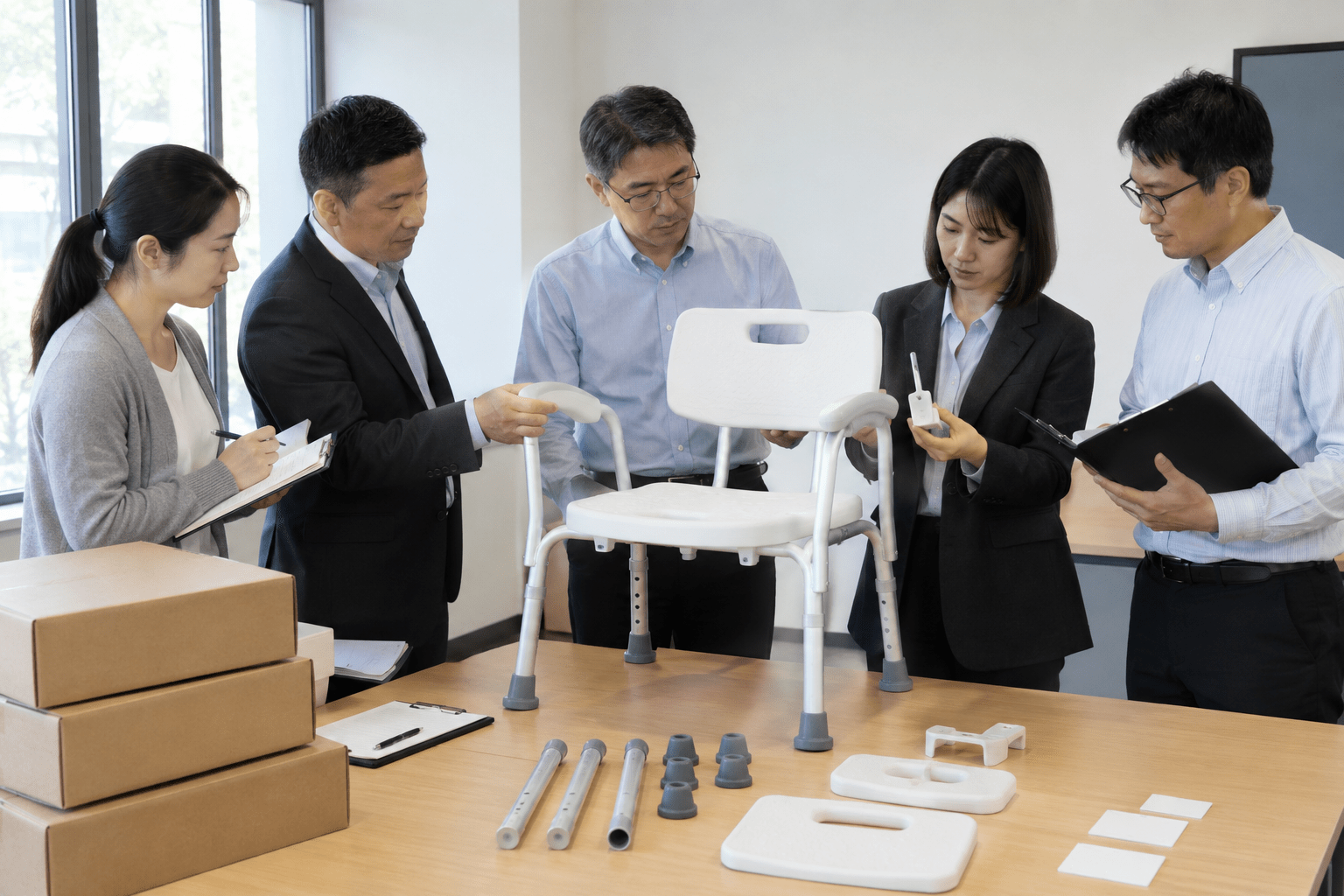
Institutional shower chair procurement should place user groups, room groups, configurations, evidence, samples, cleaning, training, parts, support, acceptance, traceability, and change control into the RFQ and purchase order. Verbal agreement is not enough for a multi-site fleet. The contract should preserve the approved sample through production and service.
Which Requirements Belong in the RFQ?
Describe functional groups and room constraints, required options, evidence fields, sample trial, packaging, training, cleaning information, spares, and supplier-response expectations.
- Separate must-have gates from preferences.
- Request configuration-specific answers.
- State how deviations must be declared.
Which Controls Belong in the Purchase Order?
Fix the approved configuration, references, change notice, acceptance plan, defect handling, traceability, spare parts, service process, and review dates. Preserve the decision: uncontrolled changes can invalidate room, hygiene, or staff approval.
- Reference the final sample and documents.
- Define receiving and supplier controls.
- Require approval before substitutions.
| Contract stage | Output | Owner | Release rule |
|---|---|---|---|
| RFQ | Comparable requirement set | Procurement team | Complete response |
| Sample approval | Recorded facility evidence | Cross-functional owners | Critical gates pass |
| Purchase order | Controlled configuration and changes | Authorized buyer | Production/release terms accepted |
Contract controls keep the approved system intact. Key Takeaway: convert room, user, staff, and service findings into enforceable purchase fields.
Conclusion
Institutional buying works when product categories, users, rooms, hygiene, staff, evidence, sample routes, lifecycle cost, and contract controls are evaluated together. This prevents unit-price selection from shifting costs and risks into daily care. For help developing controlled bath-chair configurations and sourcing documentation, contact us today.
We help B2B buyers turn facility realities into clear RFQs, sample gates, and receiving plans. Better procurement begins with the work people perform, not the catalog page they first see.
FAQ
Can one shower-chair model serve every facility user?
Usually not. User tasks, dimensions, support needs, transfer routes, rooms, cleaning, and staff workflows can require more than one controlled product family.
What’s the best way to group bathrooms for procurement?
Group rooms by verified constraints such as doorway, floor, threshold, fixtures, controls, storage, and caregiver space. Test the most restrictive representative room in each group.
How do I know whether a sample reflects staff workload?
Observe trained everyday staff through setup, route, use simulation, cleaning, drying, storage, and inspection without unusual supplier assistance. Record time, errors, awkward tasks, and two-person needs.
Can a low unit price reduce total facility cost?
Yes, but only when the configuration also meets non-price gates and the comparison includes freight, setup, labor, training, parts, repairs, downtime, and replacement assumptions.
How should facilities control supplier changes?
Require advance written notice, affected fields, updated evidence, sample review where needed, facility-impact assessment, approval authority, and revised receiving checks before shipment.
