

A usable OEM shower chair design brief defines users, tasks, bathrooms, product architecture, dimensions, materials, branding, packaging, evidence, samples, and approval gates. A reference photo plus a color request leaves footprint, supports, interfaces, load basis, and service decisions to factory assumption. The first sample may then look familiar but fail the intended room or workflow. This guide helps private-label brands, distributors, product teams, engineers, and factories convert market needs into a controlled development file.
1. What Is OEM Shower Chair Design?

OEM shower chair design can mean selecting an existing model, combining validated options, changing cosmetics, modifying dimensions, altering structure, or creating a new platform. These levels carry different cost, timing, tooling, evidence, and production risks. The brief should classify the project before quotation.
Which Development Levels Need Separation?
An existing-model private label may need file control, while a new seat width or folding frame can require engineering, tooling, prototypes, and verification. Do not use one approval route for both.
- Name the starting product and revision.
- List every requested difference.
- Assign a risk level and evidence path.
Which Parties Own Which Decisions?
Brand, distributor, factory, engineers, packaging team, test providers, and target-market advisors need defined authority. Name the owner: an unanswered requirement otherwise becomes a manufacturing assumption.
- Separate commercial and technical approval.
- Define who interprets market requirements.
- Record who may accept deviations.
| Development level | Change scope | Main owner | Risk |
|---|---|---|---|
| Existing model/option | Controlled available configuration | Product and sourcing | Lower, still needs matching |
| Cosmetic customization | Color, label, files | Brand and factory | File/process mismatch |
| Engineering/new platform | Geometry, material, structure | Engineering and quality | Tooling and evidence change |
Development classification sets the right process. Key Takeaway: define what is standard, combined, cosmetic, dimensional, structural, or new.
2. Who Uses an OEM Shower Chair Design Brief?

OEM shower chair design needs shared inputs from product, sourcing, quality, market-compliance, sales, service, logistics, finance, and marketing, plus outputs for factory engineering, tooling, purchasing, production, quality, documentation, packing, and support. The brief is the handoff between those groups. One team’s silence should not authorize a design choice.
Which Buyer Teams Need Shared Inputs?
Product defines users and functions; quality defines verification; service defines parts; logistics defines pack constraints; marketing provides controlled brand assets; sourcing manages supplier and cost.
- Use one requirement register.
- Identify mandatory and preferred fields.
- Resolve internal conflicts before release.
Which Factory Teams Need Clear Outputs?
Engineering needs performance and geometry, purchasing needs materials, production needs process files, quality needs inspection points, and documentation needs final claims. Design for the handoff: each output should have an approver and due state.
- Map inputs to deliverables.
- Prevent sales notes from replacing drawings.
- Keep current revisions available to all teams.
| Team | Required input | Required output | Approval |
|---|---|---|---|
| Buyer product/quality | Users, tasks, gates | Controlled requirement set | Buyer owner |
| Factory engineering | Requirement and baseline | Drawings, BOM, samples | Technical sign-off |
| Packaging/documentation | Product state and market files | Pack, manual, labels | Cross-functional release |
A shared brief reduces contradictory instructions. Key Takeaway: connect every requirement with the team that must answer and approve it.
3. Which Users Shape OEM Shower Chair Design?

OEM shower chair design should use body dimensions, seated support needs, transfer routes, bathing tasks, caregiver involvement, reach, posture, and restrictions to define product targets. It should collect only information needed for design. A broad age label cannot replace functional ranges.
Which User Ranges Need Definition?
State the intended range for seat fit, arm spacing, back contact, foot clearance, adjustment, support use, and caregiver access. Assign qualified owners to individual-fit decisions.
- Use task and dimension ranges.
- Identify excluded users or tasks.
- Keep clinical decisions outside factory assumption.
Which Information Should Stay Task-Based?
Describe what the user and caregiver must do, where contact occurs, and what access is required without unnecessary personal data. Design from function: a diagnosis name rarely defines the whole chair.
- Record independent and assisted steps.
- Map support and transfer interfaces.
- State when reassessment is required.
| User factor | Product effect | Evidence | Boundary |
|---|---|---|---|
| Body dimensions | Seat, arms, back, adjustment | Approved range source | Individual fit still required |
| Support task | Arms, back, access, transfer route | Workflow observation | Not a clinical prescription |
| Caregiver involvement | Clearance and grip locations | Simulated task review | Facility training required |
User inputs should become measurable targets. Key Takeaway: write functional ranges and boundaries instead of vague demographic labels.
4. Which Bathrooms Shape OEM Shower Chair Design?
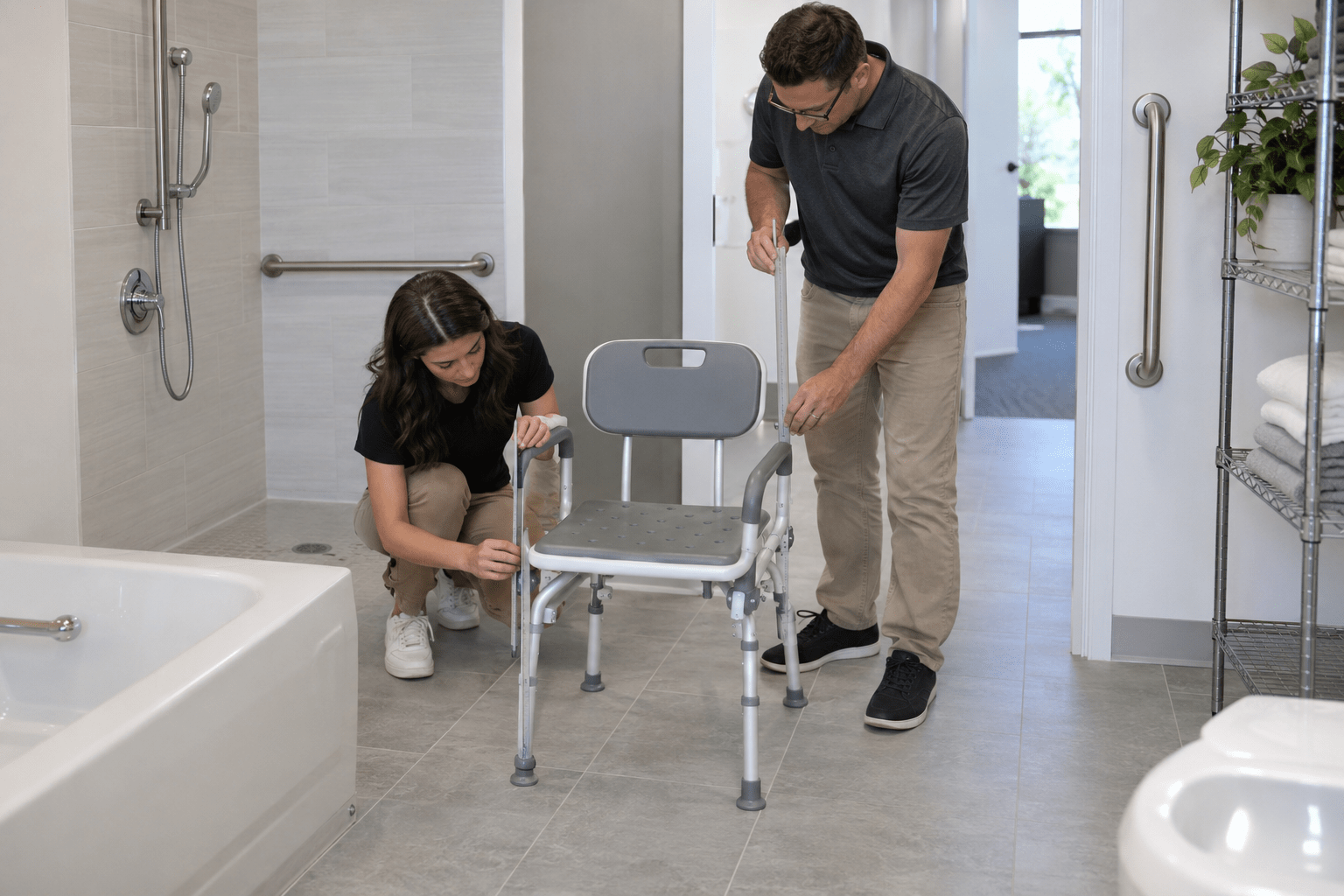
OEM shower chair design should define walk-in showers, tubs, care rooms, hospitals, hotels, homes, rental fleets, storage routes, and other intended environments. Doorways, thresholds, slopes, drains, controls, grab bars, caregiver zones, storage, and vehicles where portable shape the product. One ideal bathroom is not enough.
Which Environment Types Need Definition?
Group environments by constraints rather than marketing category. Record wet exposure, shared use, floor type, cleaning, storage, and handling differences.
- Select representative tight cases.
- State excluded floor or tub conditions.
- Link every environment to a test route.
Which Measurements Need Product Targets?
Translate doorway, floor, tub, threshold, control, drain, caregiver, storage, and vehicle measurements into maximum footprints, minimum clearances, adjustment, and folded-state targets. Measure the route: room entry can be the limiting feature.
- Use consistent reference points.
- Include operating and storage states.
- Record tolerance and measurement owner.
| Environment | Constraint | Product target | Test |
|---|---|---|---|
| Walk-in shower | Floor, drain, controls | Base and operating envelope | Placement/task cycle |
| Tub bathroom | Curvature, threshold, route | Category and footprint boundary | Entry/exit trial |
| Facility/rental | Shared cleaning and storage | Drainage, parts, fold/stack state | Turnover workflow |
Environment data prevents attractive but unusable prototypes. Key Takeaway: design to measured routes, rooms, cleaning, and storage states.
5. Which Architecture Fits OEM Shower Chair Design?
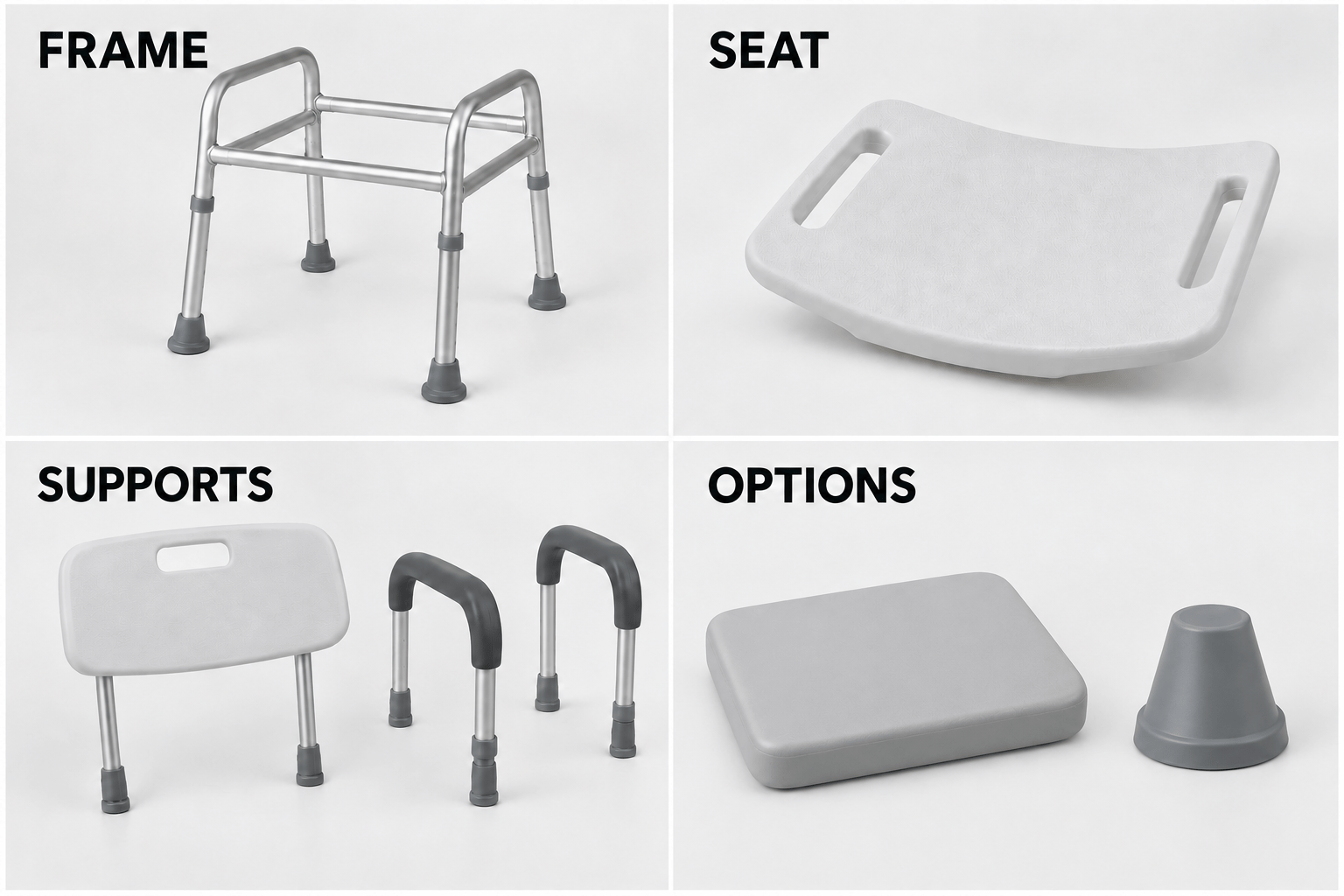
OEM shower chair design should choose a clear product family—stool, standard chair, supported chair, folding chair, reinforced chair, transfer bench, or commode—before modules are combined. Frame, seat, back, arms, legs, feet, padding, bucket, casters, and accessories need controlled interfaces. Categories should not be blended by appearance alone.
Which Product Families Need a Clear Boundary?
Each family changes user task, room fit, handling, cleaning, evidence, and service. Define what the product is intended to do and which adjacent tasks remain out of scope.
- Choose architecture from the requirement map.
- State included and excluded workflows.
- Avoid features with no validated need.
Which Modules Need Configuration Control?
Standard and custom modules need interface drawings, compatibility rules, orientation, materials, fasteners, and option codes. Control the connection: modular choice fails when mounts do not preserve geometry or function.
- Map every allowed combination.
- Prevent incompatible option orders.
- Review changes at shared interfaces.
| Module | Standard option | Custom option | Interface risk |
|---|---|---|---|
| Frame/legs | Existing geometry | New footprint or fold | Strength and locking |
| Seat/supports | Existing shell and mounts | Width, contour, arm/back change | Fit and attachment |
| Feet/accessories | Approved matched set | New compound or module | Contact and compatibility |
Architecture gives customization a controlled base. Key Takeaway: define the family, modules, interfaces, and allowed combinations before styling.
6. Which Dimensions Control OEM Shower Chair Design?

OEM shower chair design should set seat width and depth, height range, arm spacing, back height, foot clearance, base, overall envelope, folded size, carton, pallet, and tolerances from approved user and environment inputs. A single overall dimension cannot protect fit. Measurement methods need reference points.
Which User-Fit Dimensions Need Targets?
Define usable seating area, support clearances, back location, adjustment range, increments, foot space, and caregiver access. Distinguish plastic outline from usable contact area.
- State minimum, maximum, and target where needed.
- Define product state during measurement.
- Assign tolerance and verification method.
Which Product and Package Dimensions Need Targets?
Footprint, operating envelope, folded state, protected module size, carton, pallet pattern, and transport clearance should connect product and logistics decisions. Close the dimensional chain: a product change can alter packaging and freight.
- Review projections and removable parts.
- Include assembly and storage space.
- Preserve measurements in controlled drawings.
| Dimension | Target source | Verification | Owner |
|---|---|---|---|
| Seat/support | User and task range | Prototype measurement | Product/engineering |
| Base/overall | Bathroom and route map | Room-fit trial | Engineering/facility reviewer |
| Folded/package | Handling and logistics plan | Pack-out measurement | Packaging/logistics |
Dimensions link design with real use and supply. Key Takeaway: define reference points, states, tolerances, and owners for every critical measurement.
7. Which Materials Control OEM Shower Chair Design?
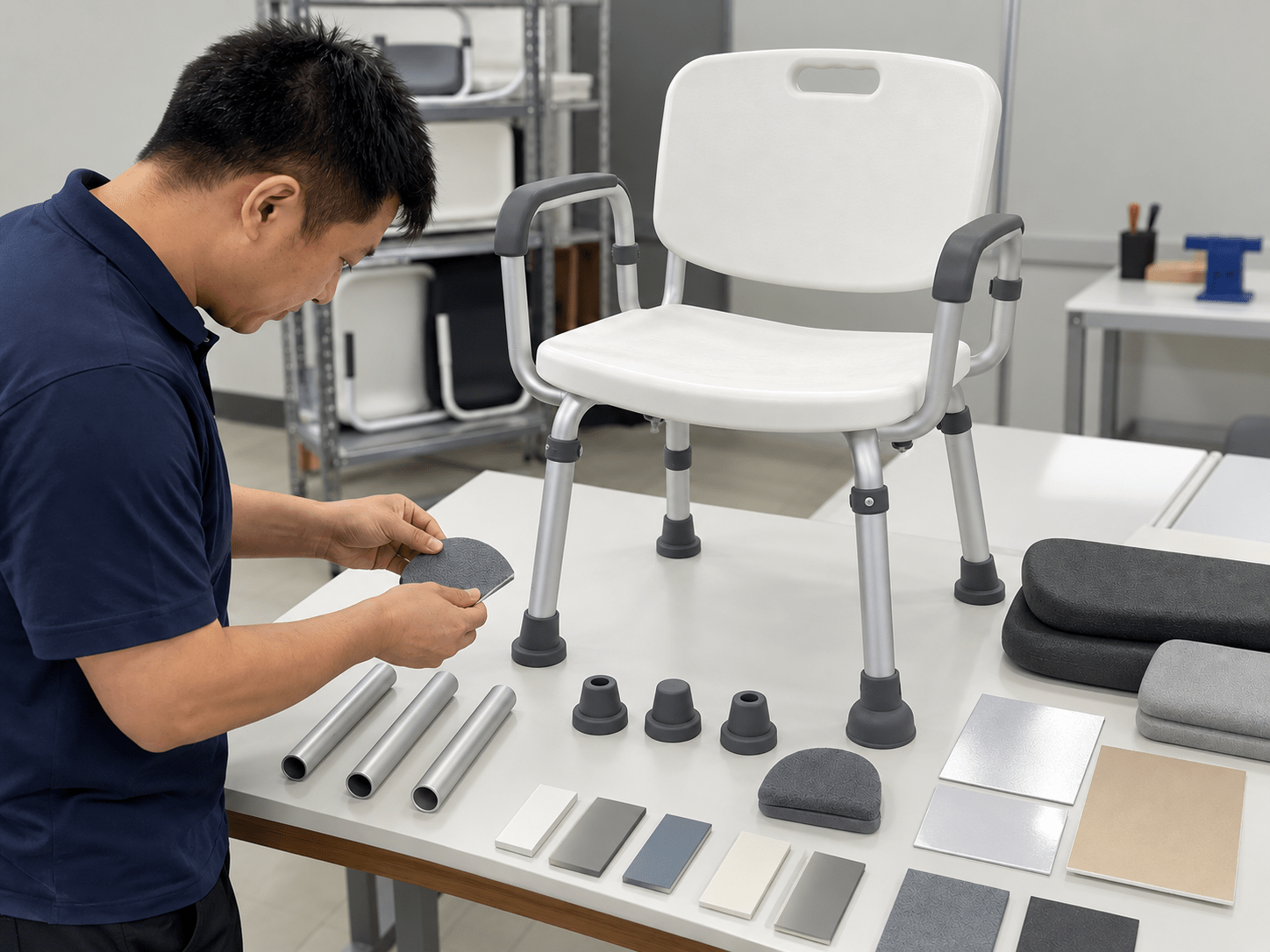
OEM shower chair design should define strength, stiffness, corrosion resistance, water exposure, cleanability, finish, grip, aging, skin-contact condition, and manufacturing needs by component. Frame alloy, coating, seat resin, padding, feet, fasteners, adhesives, and substitutes can change the approved system.
Which Material Properties Need Definition?
Translate the service environment into component properties and inspection points. Avoid using broad names such as “metal” or “plastic” without grade, process, or evidence context where critical.
- Map material to each component.
- Define finish and contact requirements.
- Include cleaning and drying limits.
Which Material Changes Need Evidence Review?
Supplier, grade, compound, coating, texture, hardness, adhesive, or fastener changes may affect performance or production. Treat substitutes as design changes: similar color does not prove equivalence.
- Require advance change notice.
- Assess affected evidence and samples.
- Update parts and receiving controls.
| Component | Material target | Change risk | Release gate |
|---|---|---|---|
| Frame/finish | Structural and wet-area needs | Strength, corrosion, process | Engineering review |
| Seat/padding | Contact, drainage, cleaning | Fit, damage, hygiene | Sample and compatibility |
| Feet/fasteners | Grip and joint compatibility | Contact, wear, corrosion | Interface verification |
Material decisions must remain configuration-specific. Key Takeaway: freeze critical materials and require evidence-based substitute approval.
8. How Do Branding and Packaging Fit OEM Shower Chair Design?

OEM shower chair design should control logo, color, labels, manual, carton artwork, barcode data, language, and market text as approved files, while packaging defines foldability, module separation, protection, carton volume, assembly, parts control, and receiving. Brand decisions can affect technical space and product surfaces.
Which Brand Assets Need Controlled Files?
Set owners, formats, colors, placement, size, language, market responsibility, proof stages, and final revisions. Never recreate a logo or legal field from a low-resolution reference.
- Use one approved artwork package.
- Keep product, manual, and carton fields consistent.
- Separate marketing copy from verified product claims.
Which Packaging Decisions Affect Product Design?
Knock-down state, folding, removable supports, projection protection, assembly sequence, parts bags, and carton limits can drive interfaces and instructions. Design pack and product together: late packaging can force risky changes.
- Review protection at concept stage.
- Run a complete unpack-and-assembly trial.
- Link to folding configuration controls where relevant.
| Brand or pack item | Technical effect | Approval file | Status gate |
|---|---|---|---|
| Label/logo | Surface, location, durability | Controlled artwork | Proof approved |
| Manual/language | Assembly and safe use | Released document | Market review complete |
| Pack architecture | Product state and protection | Layout and instruction | Test and receiving pass |
Branding and packaging belong inside development. Key Takeaway: release controlled files only after their product and logistics effects are checked.
9. Which Evidence Supports OEM Shower Chair Design?
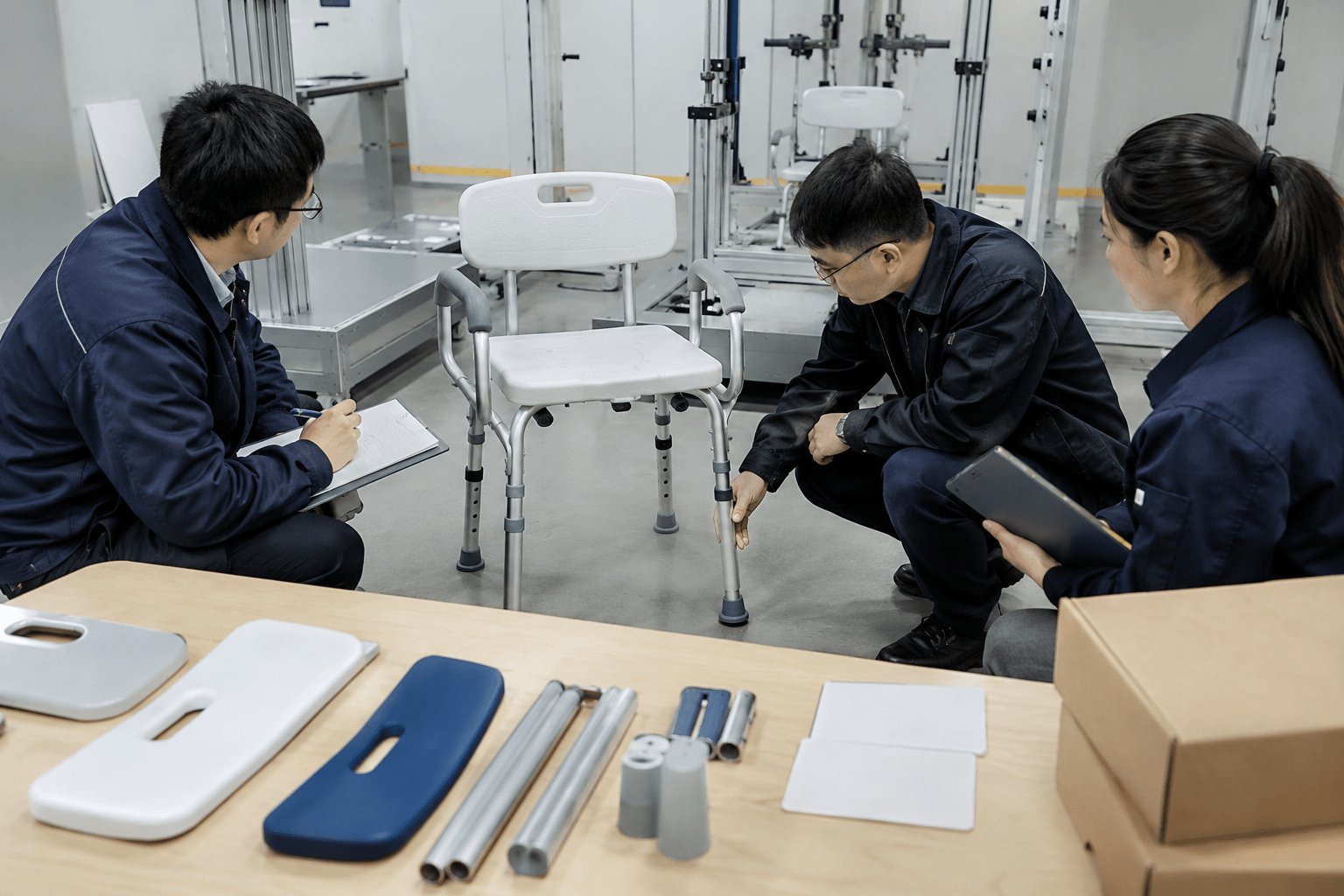
OEM shower chair design needs a verification plan for dimensions, materials, strength, stability, durability, cleaning, usability, packaging, documents, labels, and production inspection. Target-market standards, declarations, languages, traceability, importer duties, and change review need qualified ownership. A certificate image is not a complete evidence plan.
Which Verification Activities Need Planning?
For each requirement, define method, sample state, owner, timing, acceptance source, output, and retest trigger. Match third-party work to the final configuration.
- Start the plan before tooling closes.
- Separate design verification from production inspection.
- Record limits and open evidence.
Which Target-Market Inputs Need Owners?
Applicable rules, labeling, languages, declarations, traceability, importer obligations, and document retention should be reviewed by qualified parties. Keep responsibility explicit: the factory should not guess the buyer’s legal market.
- Name the market and responsible reviewer.
- Confirm configuration changes reopen review.
- Keep unverified claims out of artwork.
| Requirement | Evidence plan | Owner | Release gate |
|---|---|---|---|
| Product dimensions/function | Drawing and controlled tests | Engineering/quality | Prototype passes |
| Material/performance | Applicable records and trials | Quality/technical reviewer | Scope matches |
| Market files | Qualified review and released artwork | Brand/importer advisor | Final files approved |
Evidence planning prevents late redesign. Key Takeaway: link every requirement to a method, sample, owner, and release decision.
10. How Should OEM Shower Chair Design Be Released?

OEM shower chair design should pass concept, engineering sample, appearance sample, packaging sample, pilot, and production-sample gates appropriate to its development level. Final release freezes drawings, bill of materials, samples, artwork, manuals, inspection plans, deviations, packaging, and change routes. Open items must remain visible.
Which Prototype Gates Need Completion?
Each gate should answer a defined question without implying broader approval. Appearance approval cannot close structural evidence, and an engineering prototype may not confirm production finish.
- Define purpose and sample status.
- Record pass, fail, conditions, and retest.
- Keep approved references identifiable.
Which Files Freeze the Production State?
Use signed or controlled drawings, BOM, component specifications, sample record, artwork, manual, packing layout, inspection plan, deviations, and change procedure. Freeze the complete state: a released product is more than a drawing.
- Match all file revisions.
- Define post-release change authority.
- Apply supplier and receiving controls.
| Release stage | Output | Approver | Pass rule |
|---|---|---|---|
| Engineering sample | Fit, function, technical evidence | Product/quality | Critical design gates pass |
| Appearance/pack sample | Brand, finish, protection, assembly | Brand/logistics | Files and workflow pass |
| Pilot/production sample | Repeat process and inspection | Cross-functional team | Approved state reproduced |
Release converts development into a controlled supply state. Key Takeaway: freeze product, evidence, artwork, packaging, inspection, and change authority together.
Conclusion
An effective design brief turns users, rooms, architecture, dimensions, materials, brand files, packaging, evidence, and prototype decisions into one controlled production state. It prevents a reference image from becoming the only specification. For help structuring bath-chair requirements and supplier development files, contact us today.
We help B2B teams translate market needs into measurable samples and release gates. Responsible OEM work starts with explicit decisions and ends with controlled change.
FAQ
Can a reference photo replace a design brief?
No. A photo cannot define user range, environment, dimensions, materials, interfaces, evidence, packaging, service, tolerances, or approval authority. Use it only as a visual input.
What’s the best starting point for a private-label project?
Start with a controlled existing model that fits the user, room, and workflow requirements, then classify each requested change. This exposes cost and evidence needs early.
How do I know whether a change needs new evidence?
Assess whether it alters geometry, material, interface, load path, locking, contact, cleaning, packaging, intended use, or market files. Qualified technical reviewers should decide the verification impact.
Can packaging be decided after product release?
It should not be. Pack state, removable modules, protection, assembly, carton size, labels, and receiving can affect product interfaces and documentation.
How should buyers freeze an approved design?
Approve matched drawings, BOM, material specifications, physical sample, artwork, manual, packaging, inspection plan, deviations, evidence, and change-notice procedure under one revision set.
