

An effective shower chair RFQ defines application, environment, configuration, specifications, evidence, samples, packaging, support, and acceptance before requesting a price. A vague product name invites suppliers to quote different seats, supports, materials, cartons, and documents. The lowest number is then not a like-for-like offer. This guide helps distributors, importers, private-label brands, institutional buyers, and sourcing teams issue a request that produces comparable technical and commercial responses.
1. What Is a Shower Chair RFQ?

A shower chair RFQ is a controlled request that defines the buyer’s need, fixes the configuration basis, asks for evidence, structures commercial responses, plans samples, and supplies inputs for the contract. It should not replace the technical specification, sample plan, purchase order, or acceptance record. Each document has a separate job.
Which Purposes Should the RFQ Serve?
The RFQ should make suppliers answer the same requirements, identify deviations, price the same scope, and state evidence, timing, packaging, support, and change conditions.
- Define mandatory gates before scoring.
- Give suppliers one response format.
- Require explicit exclusions and alternatives.
Which Documents Should Stay Separate?
A request for information explores capability; the RFQ requests a defined offer; specifications define product requirements; sample plans define evaluation; purchase orders create supply controls. Keep the chain clear: one spreadsheet cannot replace all records.
- Reference current linked documents.
- Assign an owner and revision to each.
- Prevent quotation notes from changing the specification.
| Document | Purpose | Timing | Output |
|---|---|---|---|
| Information request | Screen capability | Early sourcing | Shortlist |
| RFQ/specification | Obtain comparable offers | Defined need | Technical and commercial response |
| Sample/PO/acceptance | Verify and contract supply | After shortlist/award | Controlled approval and delivery |
Document separation keeps commitments traceable. Key Takeaway: use the RFQ to compare offers, then carry approved details into formal controls.
2. Who Contributes to a Shower Chair RFQ?

Shower chair RFQ development needs input from product, sales, quality, market-compliance, service, logistics, finance, procurement, and institutional users where relevant. Configuration, target market, evidence, price basis, sample approval, and award still need named decision owners. Supplier questions should return to the responsible function.
Which Internal Teams Need Input?
Product defines users and tasks; quality defines evidence and acceptance; service defines parts; logistics defines packaging; finance defines comparison assumptions; procurement manages process and supplier communication.
- Collect inputs before RFQ release.
- Separate mandatory needs from preferences.
- Resolve contradictions under named authority.
Which Decisions Need Named Ownership?
Architecture, dimensions, materials, market scope, evidence, sample gates, commercial basis, and final award require explicit approval. Name the decision maker: committee input cannot substitute for release authority.
- Record consultation and approval roles.
- Set supplier-question deadlines.
- Freeze the RFQ revision after issue.
| Team | Input | Decision | Handoff |
|---|---|---|---|
| Product/users | Application and configuration | Fit requirements | Quality/sourcing |
| Quality/service/logistics | Evidence, support, pack, acceptance | Technical gates | Procurement |
| Finance/procurement | Commercial basis and process | Comparison and award | Purchase order |
Cross-functional preparation prevents late requirement changes. Key Takeaway: give every RFQ section a knowledgeable owner and final approver.
3. Which Applications Belong in a Shower Chair RFQ?
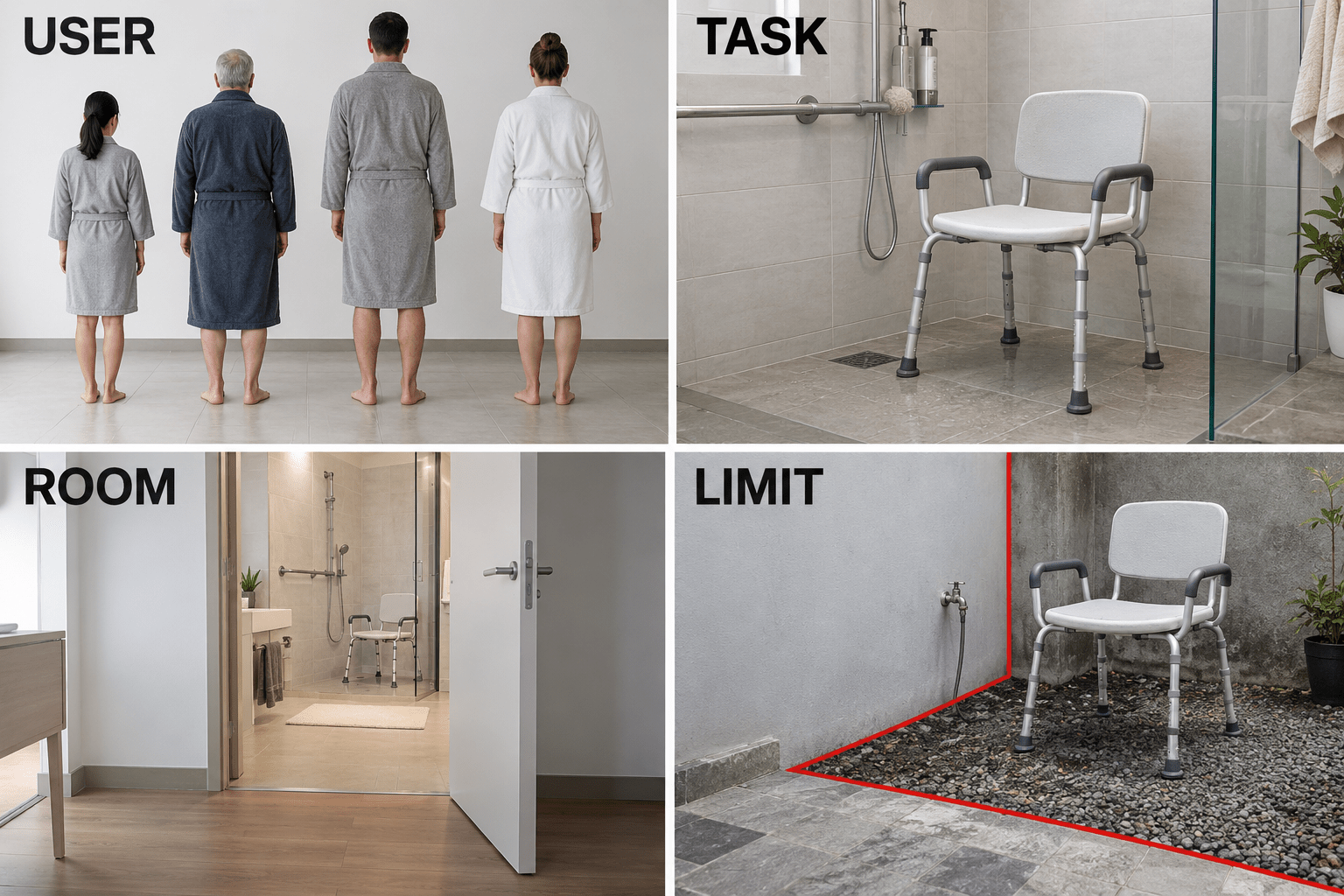
A shower chair RFQ should describe seated bathing, support, transfer access, caregiver involvement, shared use, larger-body requirements, portability, and restrictions, together with home, facility, hospital, hotel, walk-in shower, tub, rental, storage, and transport environments. Product boundaries should be explicit.
Which Users and Tasks Need Definition?
State functional ranges, critical dimensions, assistance, support contact, transfer route, cleaning turnover, and handling needs without unnecessary personal data.
- Describe the task rather than a vague user label.
- Identify excluded uses.
- Assign individual assessment to qualified teams.
Which Environments Need Definition?
Doorways, floors, tubs, thresholds, drains, controls, caregiver zones, storage, vehicles, cleaning areas, and wet exposure can alter product and packaging. Anchor the quote in reality: a generic bathroom image is not a room requirement.
- Provide measured constraints and representative routes.
- Group compatible environments.
- Require suppliers to state limits.
| Application | Task | Environment | Product effect |
|---|---|---|---|
| Independent seated bathing | Position and rise with defined support | Compatible shower | Seat, grip, base, access |
| Assisted use | Caregiver access and support | Facility room | Supports and operating envelope |
| Portable/shared use | Fold, transport, clean, store | Fleet or multi-room route | Locks, drying, parts, records |
Applications give the product specification a purpose. Key Takeaway: define users, tasks, rooms, and exclusions before naming features.
4. Which Configuration Belongs in a Shower Chair RFQ?
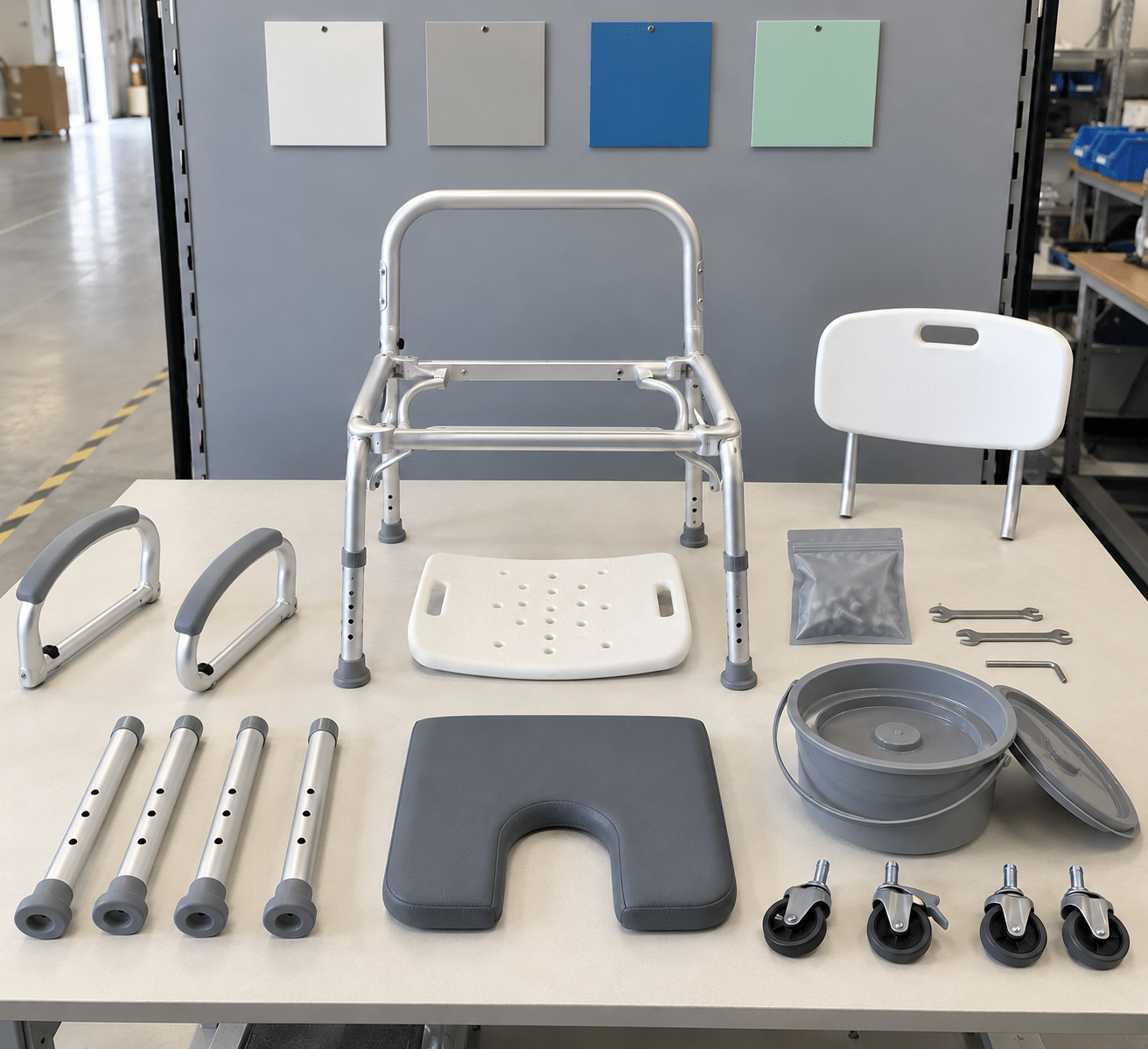
Shower chair RFQ configuration should select frame, seat, back, arms, legs, feet, padding, bucket, casters, accessories, tools, and allowed alternatives. Size, color, supports, folding, packaging, private label, spare packs, manuals, and cartons may require separate pricing. Every option should use a code or controlled description.
Which Product Modules Need Selection?
List required modules, material or interface fields, orientation, quantity, compatibility, and whether components ship fitted or loose. Avoid “standard” without a referenced state.
- Include all supports and accessories.
- Mark incompatible combinations.
- Request a configuration drawing or matrix.
Which Options Need Separate Pricing?
Ask suppliers to price the base requirement and approved alternatives without blending scopes. Keep alternatives visible: a lower quote may omit arms, packaging, evidence, or spare parts.
- Use separate line items and assumptions.
- Require technical differences beside price.
- Reject unrequested silent substitutions.
| Module | Required option | Allowed alternative | Quote field |
|---|---|---|---|
| Frame/seat | Defined architecture and size | Listed approved variant | Unit and evidence |
| Supports/feet | Required fitted set | Explicit optional set | Separate line |
| Brand/pack | Manual, labels, carton, spare pack | Controlled alternatives | One-time and recurring |
Configuration detail makes commercial comparison possible. Key Takeaway: price a named module set and show every alternative separately.
5. Which Specifications Belong in a Shower Chair RFQ?

A shower chair RFQ should define seat, arms, back, base, overall envelope, height range, folded state, package, and tolerances with usable reference points. Performance fields may include stated load basis, stability, strength, durability, corrosion resistance, cleanability, and intended use, but each needs an evidence source and configuration link.
Which Dimensions Need Usable Definitions?
Specify whether dimensions describe usable area, outside surface, floor contact, setting range, product state, or protected package. Provide method and tolerance where critical.
- Avoid copying unverified catalog values.
- Include minimum and maximum states.
- Separate product and package dimensions.
Which Performance Fields Need Evidence?
Ask suppliers to state the claim, applicable method, sample configuration, report identity, limitations, and change impact. Make every claim reviewable: a number without a method is not a comparison field.
- Match evidence to quoted options.
- Keep unsupported claims out of artwork.
- Assign review to qualified staff.
| Specification | Definition | Evidence source | Status |
|---|---|---|---|
| Dimensions | Reference points, state, tolerance | Drawing and sample measurement | Match/open |
| Materials/finish | Component and process | Controlled specification | Match/open |
| Performance/intended use | Claim, condition, configuration | Applicable technical evidence | Supported/open |
Specifications should be measurable and evidence-linked. Key Takeaway: request definitions, methods, configurations, and tolerances—not isolated claims.
6. Which Evidence Belongs in a Shower Chair RFQ?

Shower chair RFQ evidence should request drawings, material records, applicable reports, manuals, labels, parts lists, packaging files, inspection plans, and change history tied to the quoted model and revision. Target-market standards, declarations, languages, traceability, importer duties, and labeling need qualified review. Do not ask for certificates without defining the claim.
Which Product Documents Need Requesting?
Create a matrix of required files, identifiers, configurations, issuers, languages, revisions, and response status. Allow suppliers to mark unavailable fields openly.
- Distinguish mandatory and post-shortlist files.
- Protect confidential records appropriately.
- Review cross-document consistency.
Which Market Documents Need Qualified Review?
State the target countries or channels and assign responsibility for applicable requirements. Do not outsource judgment blindly: supplier files still need buyer-side qualified review.
- Request scope and current revision.
- Check labels and manuals against the market.
- Reopen review after relevant changes.
| Evidence | Configuration link | Review owner | Gate |
|---|---|---|---|
| Drawing/material/parts | Model, revision, options | Product/quality | Technical match |
| Reports/inspection | Sample and method scope | Qualified reviewer | Claim supported |
| Manual/label/market files | Product and destination | Brand/importer advisor | Release complete |
Evidence requests should answer defined risks. Key Takeaway: ask for matched records and name who will judge them.
7. Which Sample Plan Belongs in a Shower Chair RFQ?

A shower chair RFQ should define sample configuration, quantity, cost, timing, packing, documents, deviations, and production-representativeness status, plus receiving, dimensions, assembly, function, stability, cleaning, handling, support, and exception closure. Sample price alone does not define the evaluation.
Which Sample Fields Need Control?
Require sample identity, revision, options, materials, packaging, labels, manuals, build status, inspection record, deviations, and shipment terms.
- Match the sample to the response.
- Declare temporary or prototype parts.
- Define which reference will be retained.
Which Acceptance Tasks Need Agreement?
List methods, owners, pass criteria, stop rules, records, corrections, and retest conditions. Plan before arrival: improvised tests create incomparable results.
- Start with identity and no-user checks.
- Include facility or logistics routes.
- Close all mandatory exceptions.
| Sample stage | Task | Output | Release rule |
|---|---|---|---|
| Receiving | Pack, identity, completeness | Baseline record | Correct sample confirmed |
| Evaluation | Dimensions, assembly, function, workflow | Test findings | Critical gates pass |
| Closure | Corrections, retest, evidence | Approval record | Production state defined |
The sample plan turns shortlisted offers into verifiable products. Key Takeaway: specify what the sample represents and exactly how it will be accepted.
8. Which Packaging Terms Belong in a Shower Chair RFQ?

Shower chair RFQ packaging terms should cover product state, carton dimensions, gross mass, units per carton, pallet arrangement, container or shipment basis, assembly, inserts, restraints, part bags, identity, artwork, manuals, and receiving marks. These fields affect landed cost, damage, labor, and comparison.
Which Pack Fields Affect Landed Cost?
Request protected product state, inside and outside carton size, packed mass, pallet pattern, units per load basis, required assembly, storage, and disposal assumptions.
- Use one freight basis across offers.
- Verify figures on a packed sample.
- Separate estimates from confirmed data.
Which Protection and Identity Fields Matter?
Ask how seats, supports, locks, feet, finishes, fasteners, labels, and documents are restrained and identified. Make receiving possible: a dense pack fails if parts arrive mixed or untraceable.
- Require pack layout and parts list.
- Define damaged-carton escalation.
- Link to folding and handling needs.
| Packaging field | Supplier response | Buyer comparison | Gate |
|---|---|---|---|
| Product/carton state | Folded, separated, protected dimensions | Freight and labor | Sample verification |
| Protection/parts | Materials, layout, containment | Damage and completeness | Pack test |
| Pallet/identity | Load plan and markings | Warehouse/receiving | Logistics approval |
Packaging terms prevent freight and labor from hiding outside the quote. Key Takeaway: compare verified pack states, not carton claims in isolation.
9. Which Commercial Terms Belong in a Shower Chair RFQ?

A shower chair RFQ should define currency, delivery term, quantity tiers, tooling, samples, packaging, documents, spares, quotation validity, order minimum, lead-time basis, capacity basis, payment, warranty, defect handling, changes, support, and forecast assumptions. Every supplier should answer the same field.
Which Price Fields Need Common Definitions?
Separate product, options, private-label files, packaging, tooling, testing, inspection, samples, spare packs, and freight-related charges. Identify recurring and one-time costs.
- Use the same quantity and configuration.
- Record tax or duty exclusions where relevant.
- Require validity and currency basis.
Which Supply Terms Need Clear Responses?
Minimum order, lead time, capacity, payment, warranty route, defect disposition, change notice, spare support, and forecast use should include conditions. Read the exclusions: short answers often assume buyer-provided work.
- Ask who owns delays and rework.
- Define forecast as binding or informational.
- Keep unsupported guarantees out of scoring.
| Commercial field | Required basis | Supplier answer | Comparison rule |
|---|---|---|---|
| Price | Configuration, quantity, currency, term | Included/excluded scope | Like-for-like total |
| Timing/capacity | Order state and assumptions | Lead and constraint basis | Same milestone definition |
| Support/change | Warranty, parts, defects, notice | Process and responsibility | Mandatory completeness |
Commercial structure exposes hidden scope. Key Takeaway: compare total defined offers only after technical gates are met.
10. How Should Buyers Award a Shower Chair RFQ?

Shower chair RFQ award should require product fit, configuration, evidence, sample, quality, packaging, service, and commercial completeness before weighted scoring. A low price cannot compensate for a failed mandatory gate. The award record should state open conditions and the production handoff.
Which Gates Come Before Scoring?
Use pass/fail review for application fit, document scope, sample identity and results, production controls, packaging, parts, support, and change management. Score only compliant offers.
- Record evidence behind each gate.
- Resolve material deviations.
- Keep conditional items time-bound.
Which Files Should Enter the Purchase Order?
Include signed specifications, approved sample, deviations, drawings, artwork, manuals, packing, inspection, change notice, parts, support, and acceptance plan. Carry the decision forward: an award presentation is not a production specification.
- Match all revisions before signature.
- Define receiving and defect disposition.
- Apply institutional purchasing controls.
| Award stage | Record | Owner | Pass rule |
|---|---|---|---|
| Compliance | Requirement and evidence matrix | Cross-functional reviewers | Mandatory gates pass |
| Commercial selection | Normalized offer and risk | Procurement/finance | Complete comparable scope |
| Contract handoff | Frozen product and acceptance files | Authorized buyer/supplier | Terms and changes accepted |
Award closes only when approval becomes contract input. Key Takeaway: select among compliant offers and attach the approved state to the order.
Conclusion
A strong RFQ makes application, configuration, specifications, evidence, samples, packaging, commercial terms, support, and acceptance comparable before price ranking. It prevents suppliers from answering different product questions under one name. For help building controlled bath-chair requirements and supplier response fields, contact us today.
We help B2B buyers turn sourcing intent into clear offers, sample gates, and purchase controls. Better procurement begins with a precise question that every supplier can answer on the same basis.
FAQ
Can an RFQ start with only a product photograph?
No. A photograph can support visual discussion but cannot define users, rooms, dimensions, materials, performance evidence, configuration, packaging, support, or acceptance.
What’s the best way to compare supplier quotations?
Use one response template, fixed configuration, quantity, currency, delivery basis, pack state, document scope, sample plan, support assumptions, and explicit exclusions. Apply technical gates before price scoring.
How do I know whether a response is configuration-specific?
Check that drawings, reports, manual, parts, packaging, sample, and quotation share the same model, revision, materials, supports, and options. Flag generic family documents.
Can a sample be approved before documents are complete?
Only as a limited conditional result when missing documents do not conceal a mandatory gate and their owner, deadline, evidence, and final release condition are explicit. Production approval should wait.
How should buyers control post-award changes?
Require advance written notice, affected files and parts, impact assessment, updated evidence, sample or retest where needed, written approval, revision control, and updated receiving checks.
