
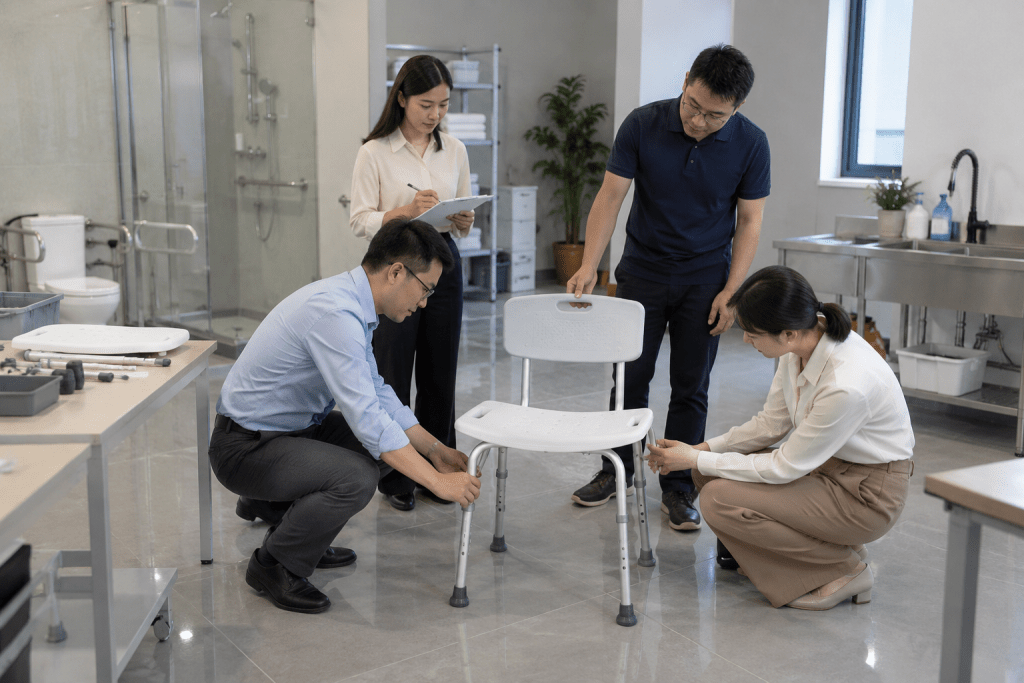
Shower chair sample testing should produce a configuration-specific decision record, not a showroom impression. A chair may feel stable during a short dry-floor demonstration yet fail the target doorway, bathroom route, cleaning workflow, or parts-support test. Approving that impression turns assumptions into a volume order. This guide helps distributors, importers, quality teams, institutional buyers, product managers, and service teams plan, receive, test, and close a sample under controlled conditions.
1. What Is Shower Chair Sample Testing?
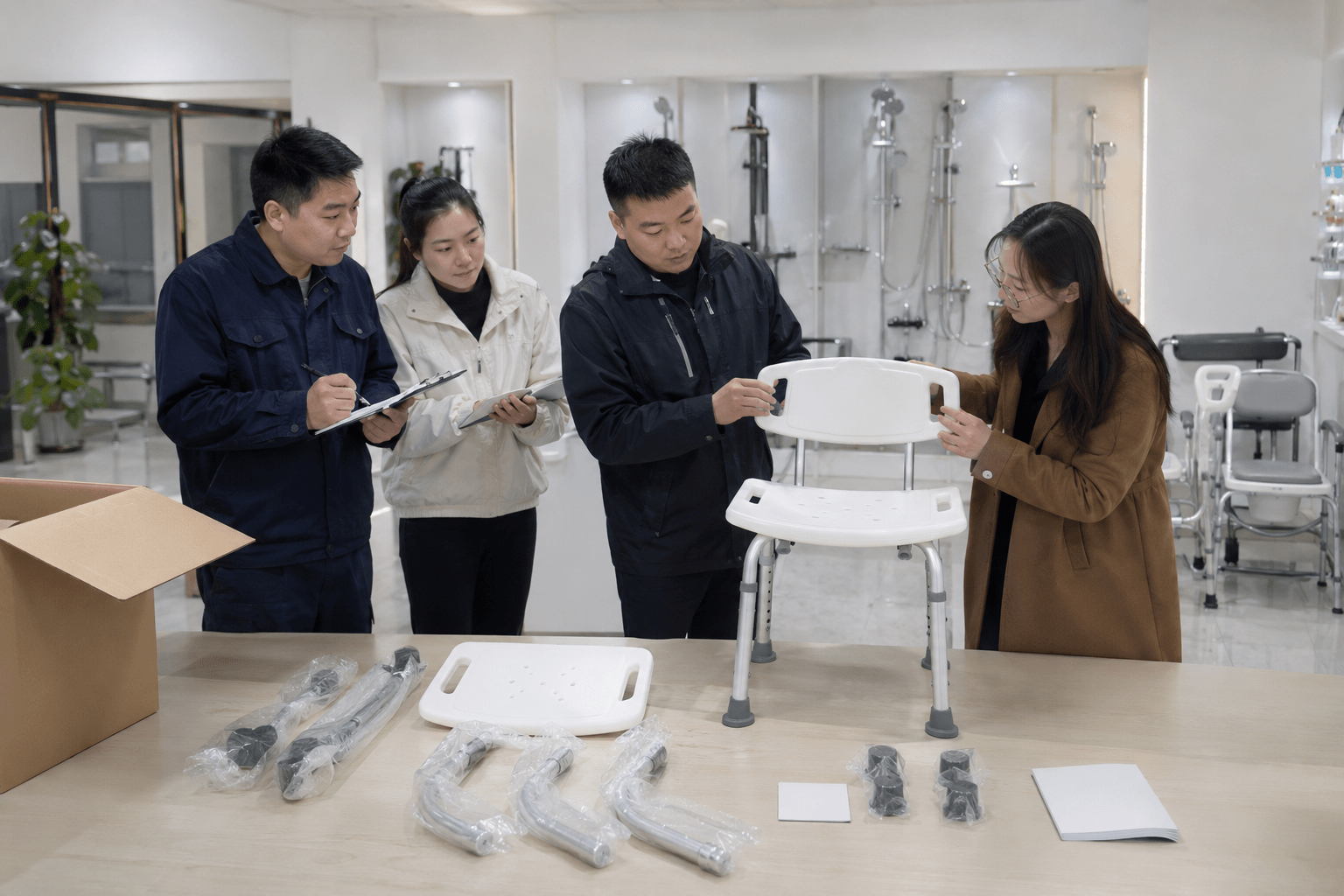
Shower chair sample testing is a planned evaluation of identity, configuration, fit, dimensions, assembly, function, stability, handling, cleaning, documents, packaging, and support. It should answer named sourcing questions and produce pass, conditional pass, fail, limits, exceptions, training needs, and a production acceptance plan.
Which Questions Should the Sample Answer?
Ask whether the exact chair matches the quotation and requirements, fits intended rooms and tasks, functions correctly, survives the approved workflow, and has adequate evidence and support.
- Define each question before delivery.
- Assign method and qualified owner.
- Separate observation from conclusion.
Which Outcomes Should the Test Produce?
Record pass, fail, condition, limit, open issue, retest, training requirement, and production check. Decide what approval means: a color pass cannot authorize structure or function.
- Keep mandatory gates separate from preferences.
- Name owners and closure dates.
- Preserve the approved sample state.
| Sample question | Method | Owner | Gate |
|---|---|---|---|
| Identity/configuration | Record and physical match | Product/quality | Exact state confirmed |
| Fit/function/workflow | Controlled trials | Qualified evaluation team | Critical tasks pass |
| Evidence/support | File review and mock case | Quality/service | Gaps closed |
Sample testing turns a product into a traceable decision. Key Takeaway: define questions, methods, owners, and outputs before the chair arrives.
2. Who Owns Shower Chair Sample Testing?
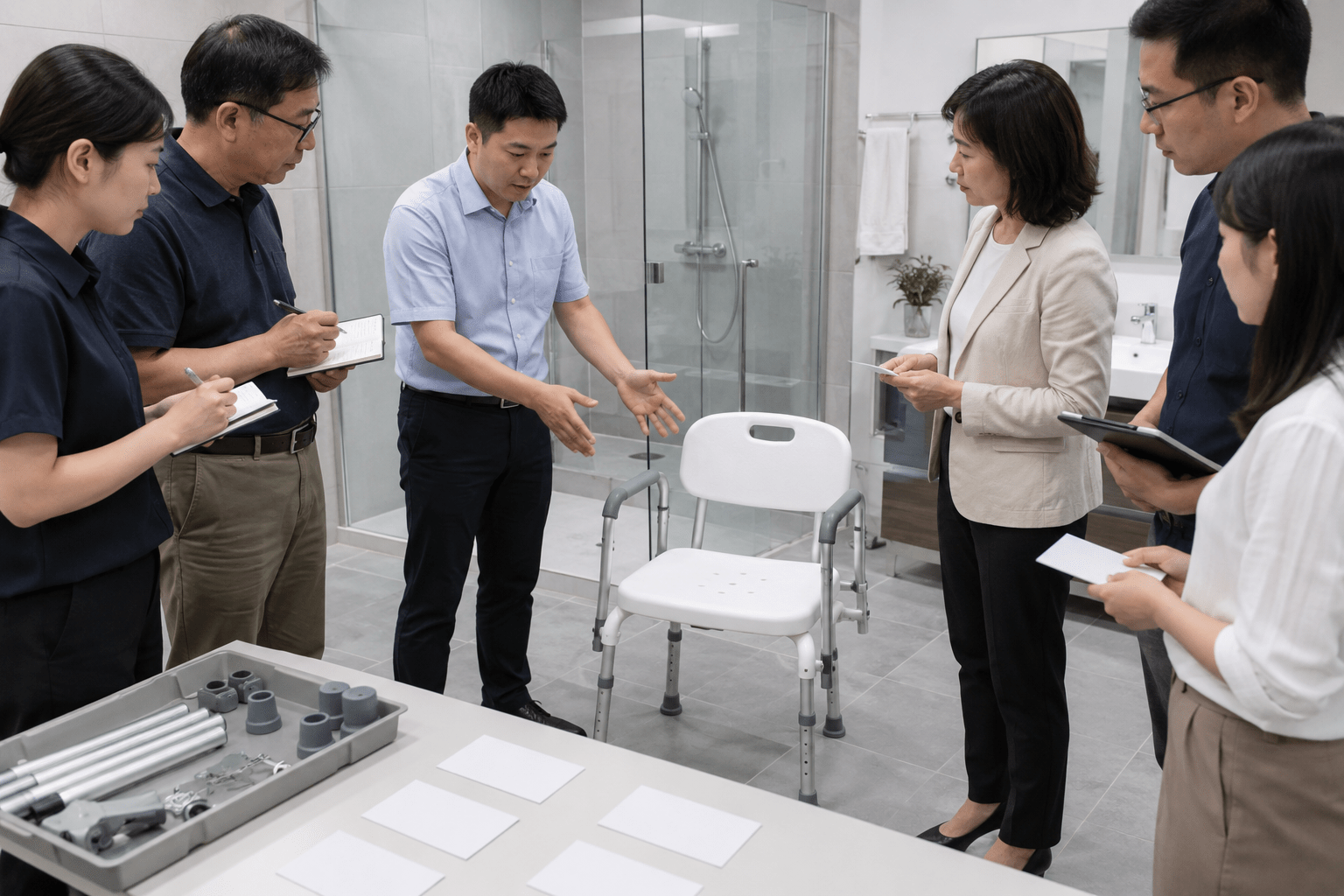
Shower chair sample testing needs assigned tasks for product, quality, clinical or assessment staff where relevant, service, logistics, procurement, and the supplier. User fit, transfer methods, intended use, bathroom routes, cleaning, and target-market requirements need qualified input. No single buyer should silently approve every discipline.
Which Teams Need Assigned Tasks?
Product manages the brief, quality manages records and defects, qualified assessors manage user-task boundaries, logistics manages packing and handling, and service tests parts and support.
- Build a responsibility matrix.
- Define observers and approvers.
- Keep supplier coaching separate from buyer evidence.
Which Decisions Need Qualified Input?
Individual fit, transfer technique, load approach, market requirements, chemical compatibility, and structural disposition should not be guessed by a general sourcing team. Use the right owner: uncertainty is a hold, not a shortcut.
- State role limits in the protocol.
- Escalate decisions beyond competence.
- Record the basis for approval.
| Role | Task | Authority | Handoff |
|---|---|---|---|
| Product/procurement | Scope, quote, commercial follow-up | Project decision | Quality and supplier |
| Quality/technical | Identity, dimensions, function, evidence | Pass/hold recommendation | Approval owner |
| Facility/service/logistics | Workflow, support, pack and route | Domain findings | Project record |
Clear ownership protects the meaning of test results. Key Takeaway: assign every decision to a competent reviewer and documented handoff.
3. How Should Shower Chair Sample Testing Be Planned?
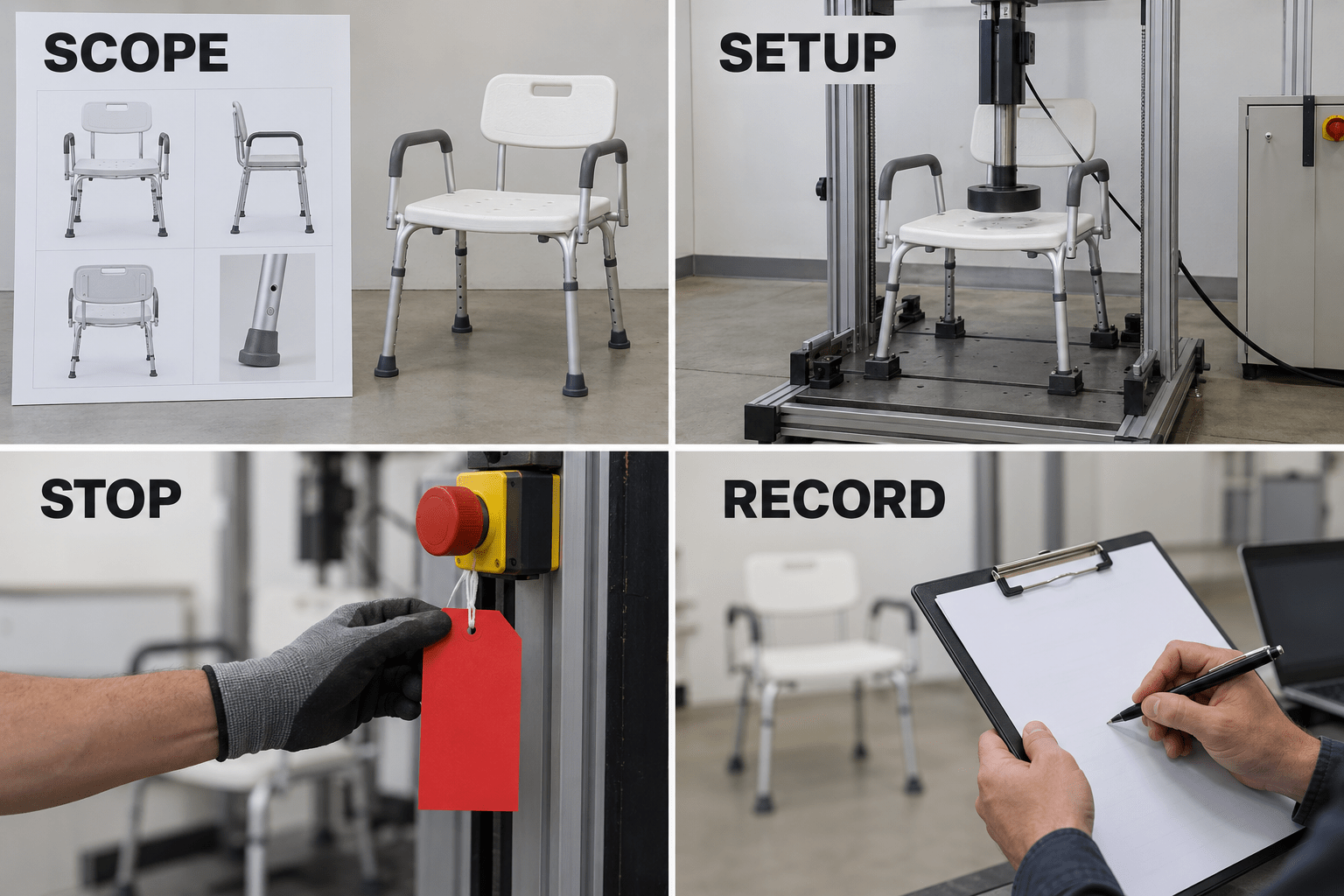
Shower chair sample testing should define bathroom type, floor, configuration, height, supports, handlers, cleaning method, task simulation, measurement points, pass criteria, and stop rules. Critical defects, instability, lock failure, identity mismatch, damage, or missing evidence may stop testing. Conditions should match intended use without unsafe improvisation.
Which Test Conditions Need Definition?
Specify dry and approved wet-area boundaries, product setup, tools, room, sequence, handlers, environmental state, and evidence source. Record any departure from the protocol.
- Use the offered configuration.
- Set no-user checks before task simulation.
- Keep unsupported load tests out of the plan.
Which Pass and Stop Rules Need Agreement?
Define what causes immediate quarantine, corrective action, retest, conditional review, or rejection. Stop rules come first: teams should not negotiate safety after a failure appears.
- List critical defects and mismatches.
- Define who may resume testing.
- Preserve failed-state evidence.
| Test area | Defined condition | Pass rule | Stop rule |
|---|---|---|---|
| Identity/setup | Quoted model and options | Exact match | Unknown or substituted part |
| Function/stability | Approved surface and sequence | Repeatable correct operation | Instability, lock or structural failure |
| Workflow/evidence | Intended route and documents | Requirements supported | Uncontrolled risk or missing critical basis |
Planning keeps test conclusions comparable. Key Takeaway: agree on conditions and stop rules before anyone handles the sample.
4. How Does Receiving Start Shower Chair Sample Testing?
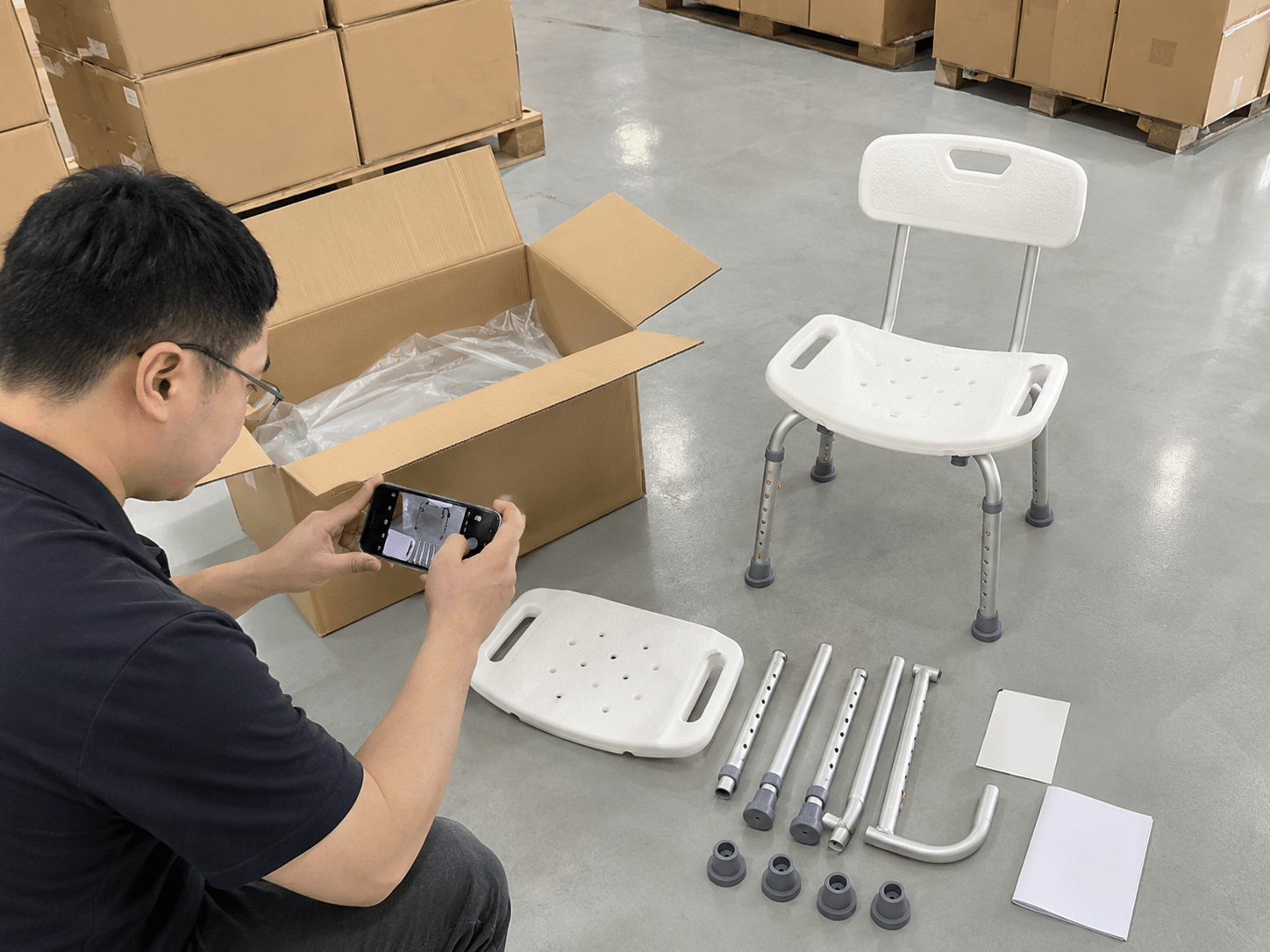
Shower chair sample testing begins with carton, moisture, damage, seal, packing list, components, manuals, labels, and sample-identity checks before assembly. Record model, revision, materials, supports, feet, accessories, packaging, and declared deviations. Hand-built differences should remain visible.
Which Shipment Checks Come First?
Photograph the unopened package, record condition and orientation, verify quantity, and open in a way that preserves part positions and possible damage evidence.
- Link carton and sample identity.
- Keep packing materials until review closes.
- Record missing or loose components.
Which Sample Identity Needs Recording?
Compare quote, sample sheet, labels, drawing, physical configuration, manual, and pack. Test the sample you received: do not mentally substitute what production is expected to become.
- List every deviation and temporary part.
- Confirm which features represent production.
- Hold unknown substitutions.
| Receiving field | Expected state | Finding | Action |
|---|---|---|---|
| Carton/pack | Controlled sample shipment | Intact or damaged | Record and inspect effect |
| Product identity | Model, revision, configuration | Match or mismatch | Continue or hold |
| Documents/parts | Complete current set | Present, missing, obsolete | Log gap |
Receiving establishes the evidence baseline. Key Takeaway: preserve shipment condition and identify the exact sample before assembly.
5. How Do Dimensions Enter Shower Chair Sample Testing?
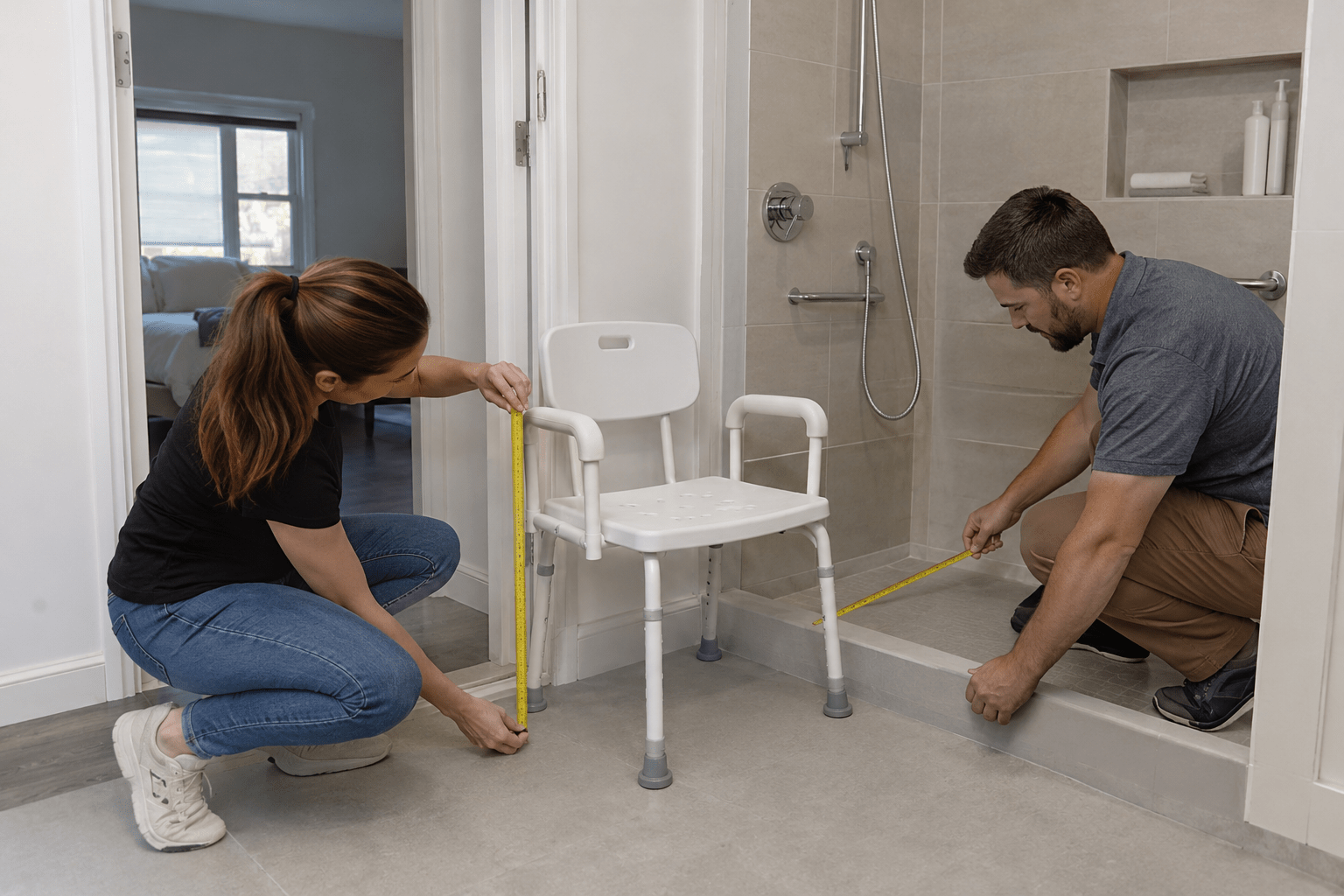
Shower chair sample testing should verify seat, supports, base, height range, overall envelope, folded state, package, and adjustment increments against controlled sources, then match the chair to doorway, floor, tub, threshold, drain, controls, storage, and caregiver zones. Use defined reference points and tolerances.
Which Product Dimensions Need Verification?
Measure usable seat area, arm spacing, back location, base contact, minimum and maximum height, overall projections, folded state, and packed state as applicable.
- Record the product state and tools.
- Check all equal-leg settings.
- Resolve drawing and sample differences.
Which Environment Dimensions Need Matching?
Walk the delivery, storage, bathroom entry, placement, use, removal, and return route. Measure the full path: a correct seat width cannot overcome a blocked doorway.
- Use the tightest approved room group.
- Include caregiver hand and body space.
- Record clearance and interference.
| Dimension | Approved source | Measured result | Decision |
|---|---|---|---|
| Seat/support | Controlled drawing and brief | Actual sample value | Fit gate |
| Base/overall | Room requirement | Sample and route clearance | Environment gate |
| Fold/package | Handling and logistics plan | Actual state | Storage/freight gate |
Dimension checks connect product, room, and logistics. Key Takeaway: verify both the chair and every critical space it must pass through.
6. How Does Assembly Enter Shower Chair Sample Testing?
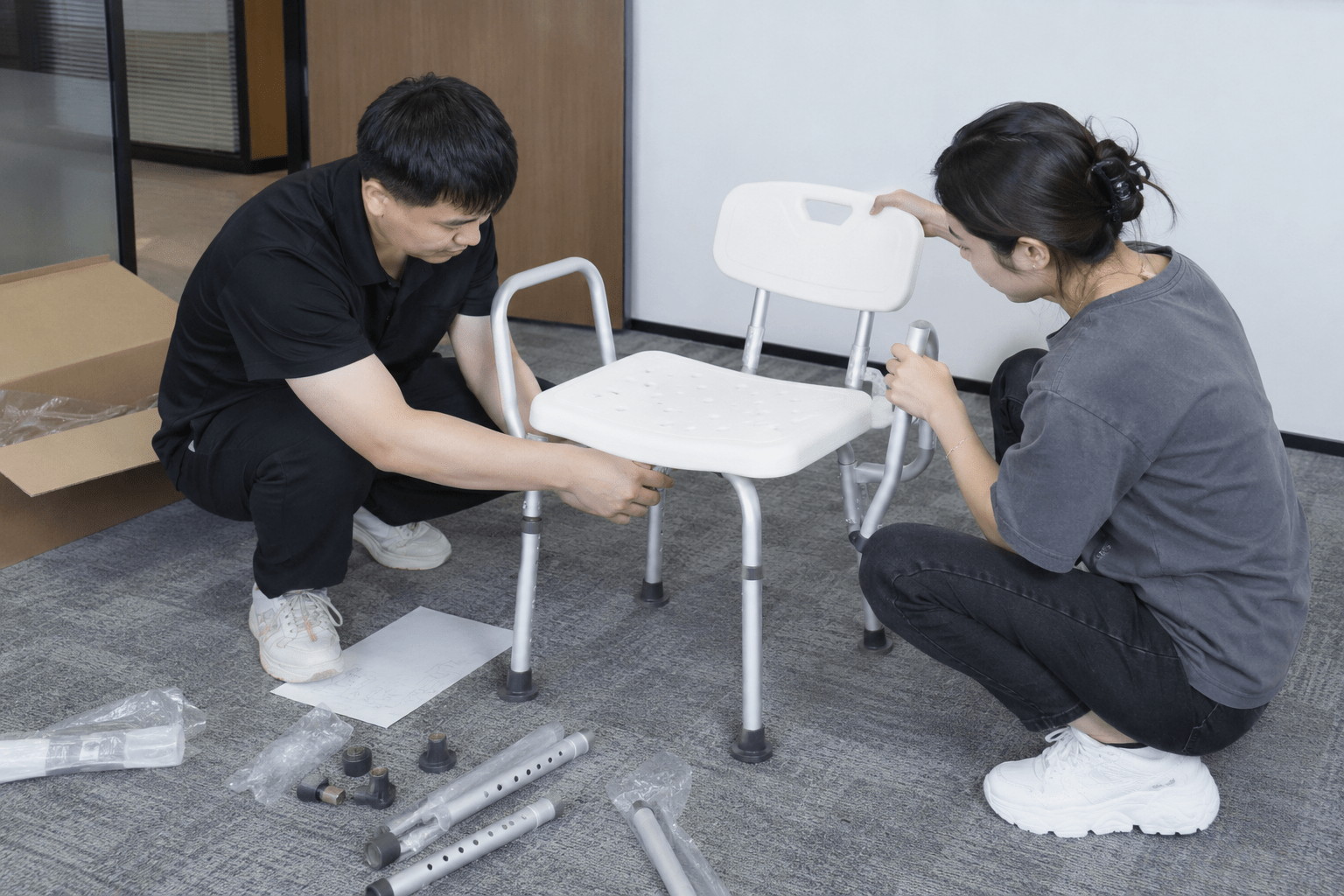
Shower chair sample testing should observe unpacking, part identification, leg orientation, support installation, height setting, lock engagement, tool use, and final checks with representative staff. The current instructions should be available before work begins. Supplier rescue during a confusing step is itself a finding.
Which Assembly Steps Need Observation?
Track unpack order, parts recognition, orientation, fasteners, supports, feet, adjustments, folding interfaces, and final configuration. Record time only with context.
- Note extra tools or two-person work.
- Keep unused parts for reconciliation.
- Inspect surfaces after assembly.
Which Errors Need Documentation?
Missing or wrong hardware, forced fit, reversed parts, partial pins, unclear instructions, trapped padding, or assembly damage need an exception record. Do not coach away the issue: ordinary receivers need the same information.
- Separate instruction, design, and operator factors.
- Photograph the pre-correction state.
- Verify corrective changes on retest.
| Assembly step | Expected instruction | Observation | Action |
|---|---|---|---|
| Part identification | Clear complete set | Match or confusion | Update pack/instruction |
| Fit and fastening | No force, correct interface | Gap, damage, wrong hardware | Hold and investigate |
| Adjustment/lock | Full engagement | Partial or uneven state | Stop test |
Assembly tests product, packaging, and documentation together. Key Takeaway: record every intervention needed to reach the intended configuration.
7. How Does Stability Enter Shower Chair Sample Testing?
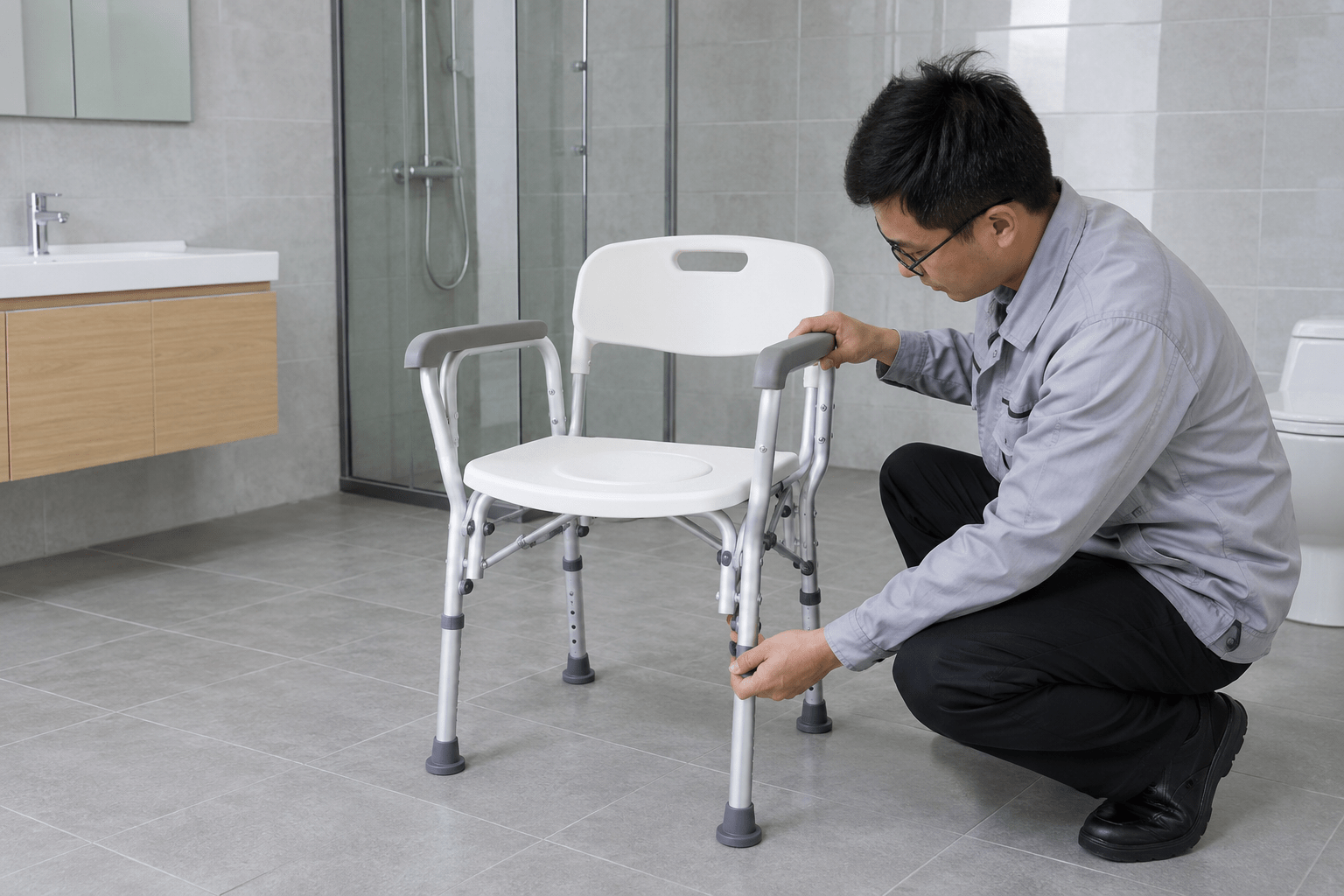
Shower chair sample testing should complete no-user checks for rocking, frame twist, foot contact, locks, supports, folding mechanisms, and surface placement before any approved task-based assessment. Sitting approach, push-off, side access, repositioning, caregiver contact, and wet-floor boundaries need qualified methods and stop rules.
Which No-User Checks Need Completion?
Place the configured chair on the defined surface, inspect all feet, apply only approved controlled forces, cycle mechanisms, and look for movement, noise, deformation, or partial engagement.
- Confirm settings and orientation first.
- Compare dry relevant surfaces.
- Stop for instability or structural change.
Which Task-Based Checks Need Controlled Conditions?
Use authorized simulation or assessment for approach, support contact, transfer access, repositioning, and caregiver movement. Do not improvise a load test: task trials and laboratory evidence serve different purposes.
- Define participant and supervision.
- State surface and assistance conditions.
- Record limits rather than overgeneralizing.
| Stability task | Setup | Failure sign | Limit |
|---|---|---|---|
| Empty-chair contact | Correct configuration and floor | Rocking or incomplete foot contact | No user task |
| Locks/supports | Approved no-user cycle | Movement or partial engagement | Technical hold |
| Task access | Qualified controlled simulation | Tip tendency or blocked support | Configuration/room limit |
Stability findings are configuration- and condition-specific. Key Takeaway: clear no-user gates before any controlled task assessment begins.
8. How Does Cleaning Enter Shower Chair Sample Testing?
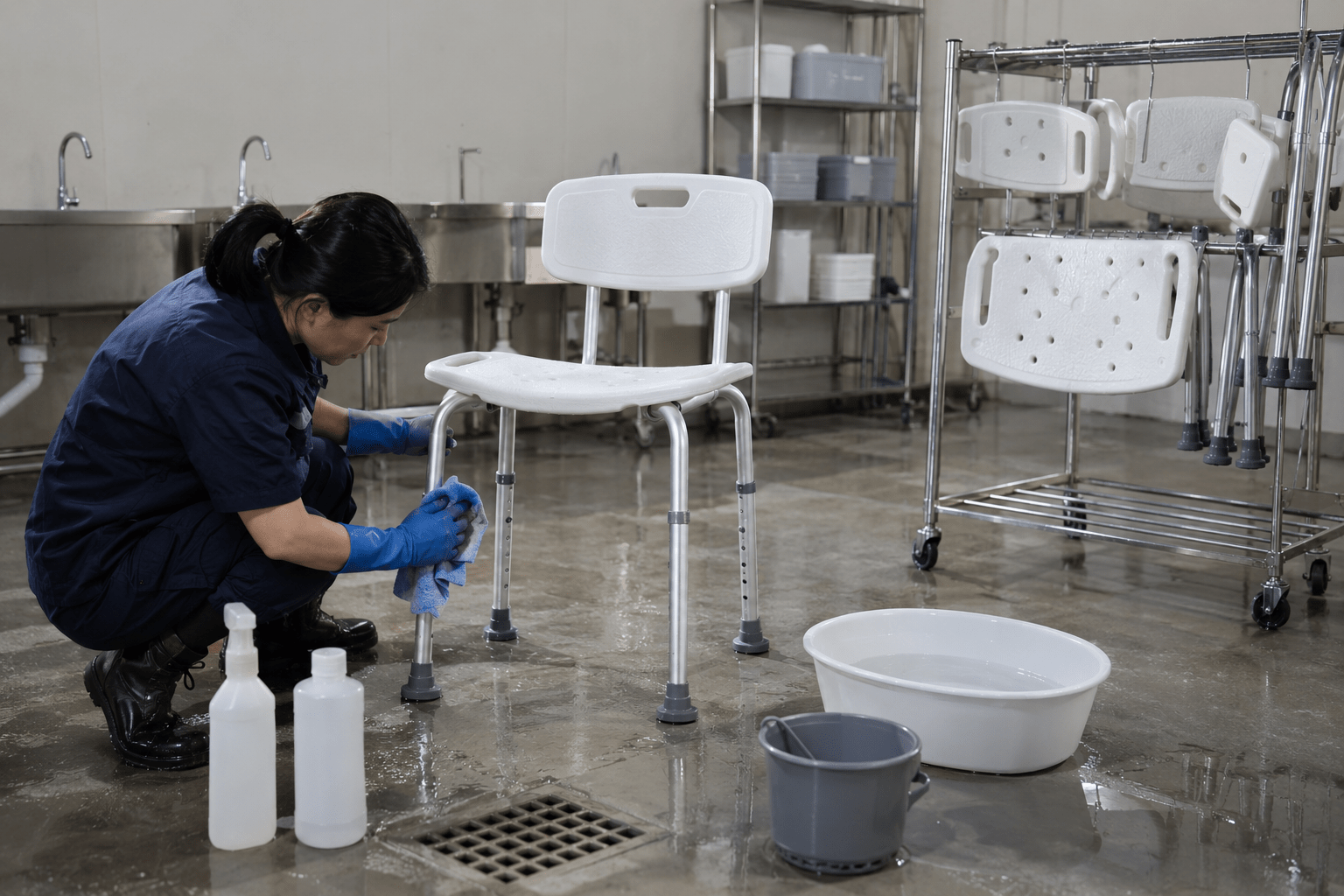
Shower chair sample testing should include soil-removal access, compatible-agent use, rinsing where required, drainage, drying, post-cleaning inspection, storage, and restoration. Observe discoloration, swelling, cracking, residue, corrosion signs, label damage, trapped water, or stuck adjustments. Use the exact configuration and current instructions.
Which Cleaning Steps Need Practical Trials?
Run the facility or channel workflow from collection through release. Record access, tools, time, water retention, removed parts, drying position, and inspection burden.
- Include undersides, joints, feet, and supports.
- Avoid unapproved chemicals or soaking.
- Check function after drying.
Which Material Reactions Need Observation?
Compare surfaces, padding, finish, labels, fasteners, locks, and feet before and after the approved process. Look beyond appearance: swelling or retained water may affect function later.
- Photograph controlled before/after views.
- Hold damaged or uncertain components.
- Link changes to materials and method.
| Cleaning step | Product area | Observation | Release |
|---|---|---|---|
| Access/soil removal | Contact and hidden zones | Reach and residue | Process feasible |
| Rinse/drain/dry | Tubes, seams, padding, feet | Retained water or film | Dryness gate |
| Final check | Finish, labels, locks, supports | Damage or functional change | Pass or hold |
Cleaning trials expose lifecycle workload and material limits. Key Takeaway: test the complete dirty-to-clean process and repeat functional checks afterward.
9. How Does Support Enter Shower Chair Sample Testing?
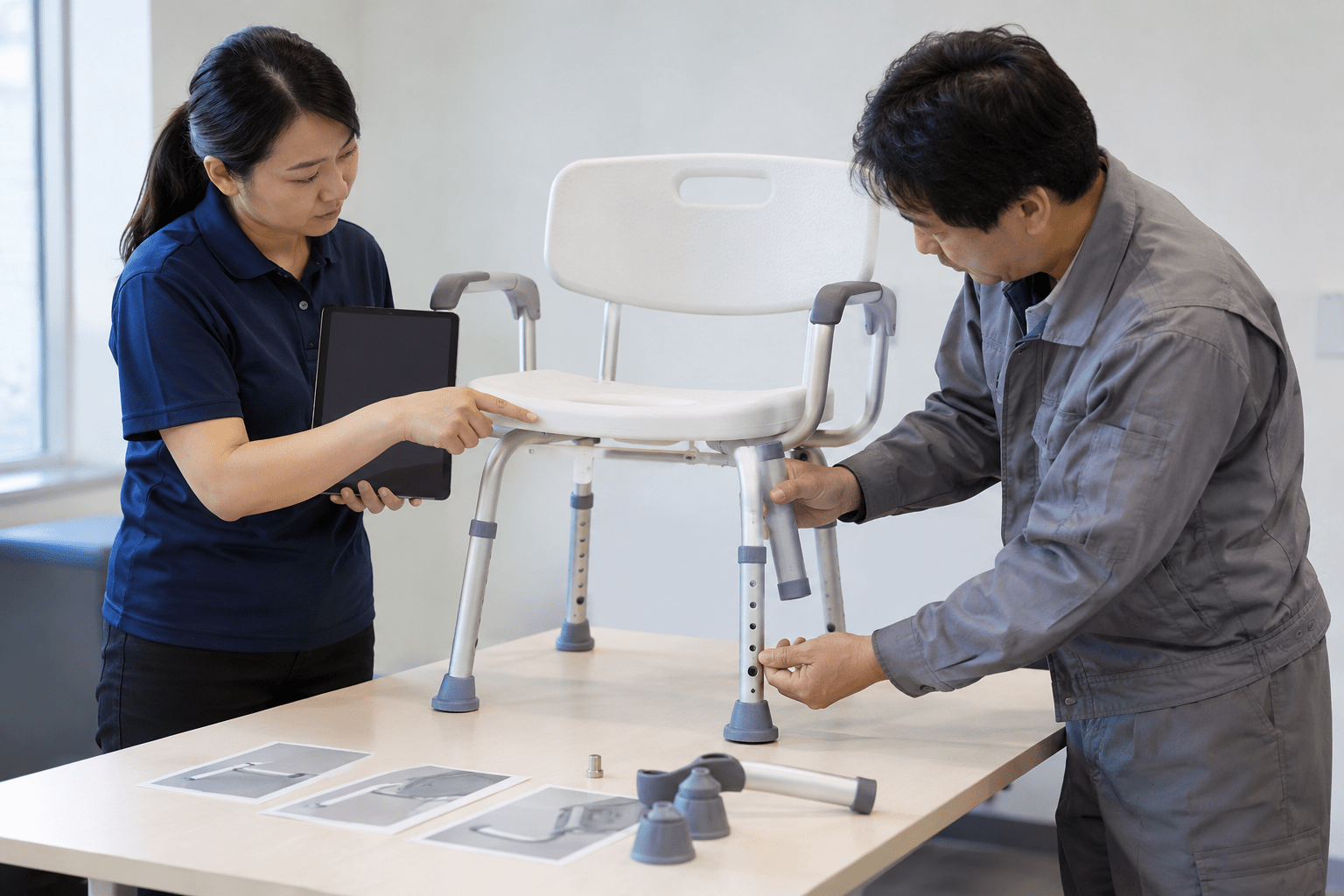
Shower chair sample testing should test operator training and a mock service case, because manuals and warranty statements do not prove support quality. Training should cover assembly, adjustment, placement, cleaning, storage, inspection, defect reporting, and restrictions. Service should identify the unit and close an actionable case.
What Should Operator Training Prove?
Representative staff should complete routine tasks and explain stop conditions without relying on undocumented supplier knowledge. Materials should match the sample revision.
- Observe correct sequence and checks.
- Record confusing terms or images.
- Define refresher and change triggers.
What Should a Mock Service Case Prove?
Submit a realistic identity, photo, condition, and part or defect question, then observe intake, evidence request, triage, technical owner, parts decision, response, and closeout. Test the system now: support gaps become more expensive after distribution.
- Check spare-part compatibility.
- Record response content, not only speed.
- Require a clear final disposition.
| Support stage | Expected action | Evidence | Gate |
|---|---|---|---|
| Training | Staff complete and stop tasks | Observation record | Competence demonstrated |
| Case intake | Unit and issue identified | Model, lot, photos | Correct owner assigned |
| Resolution | Controlled instruction or part | Technical response | Verification closes case |
Support is part of the sample decision. Key Takeaway: approve the training and service workflow alongside the physical chair.
10. How Should Shower Chair Sample Testing Be Approved?
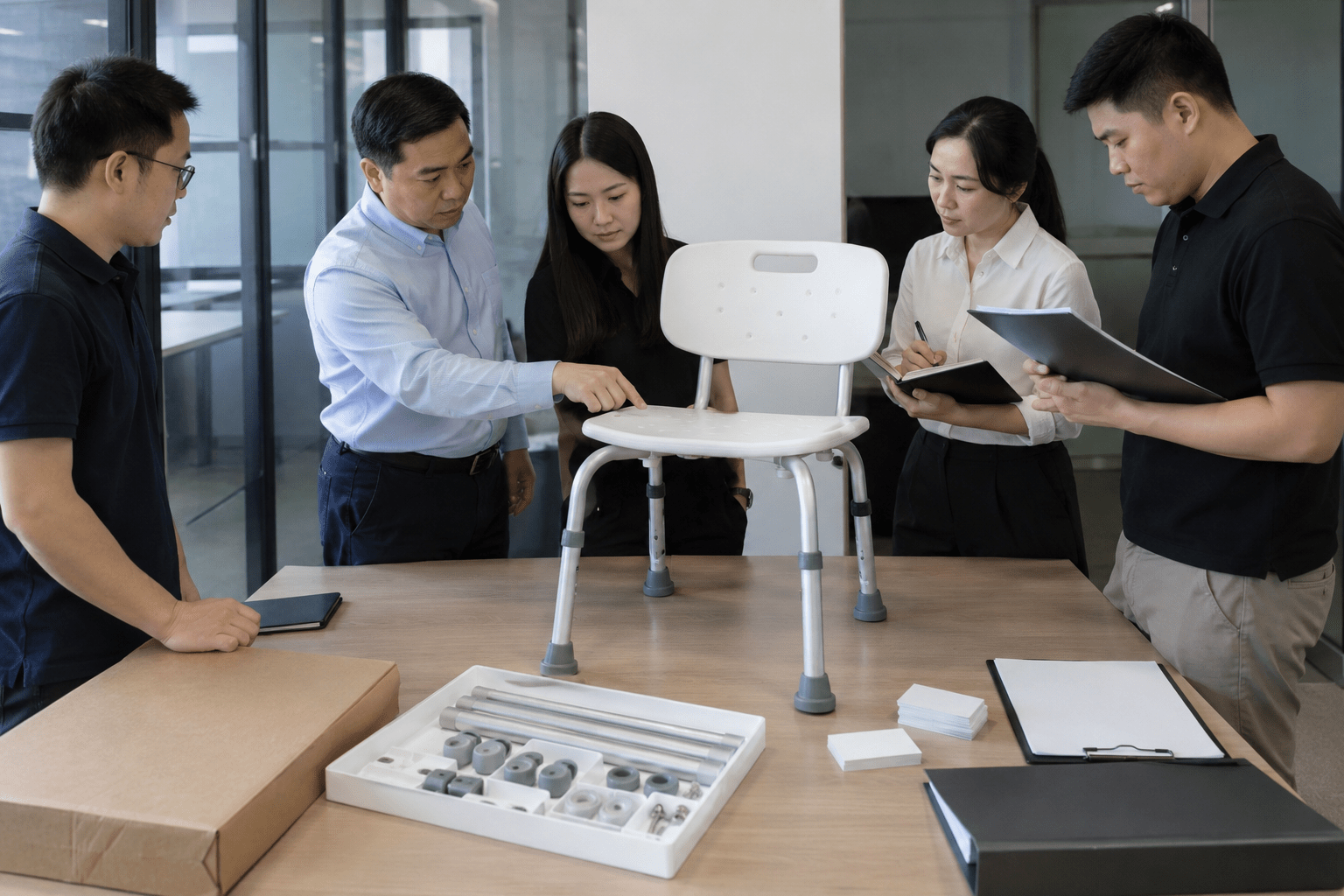
Shower chair sample testing should close critical defects, configuration mismatch, unstable behavior, document gaps, cleaning issues, packaging problems, and support failures before production release. Conditional approval needs explicit conditions, owners, evidence, and retest. The purchase order should preserve the approved state.
Which Findings Must Close Before Production?
Any failed mandatory gate, unknown substitution, structural concern, unclear lock state, critical route failure, or missing performance basis should remain open until verified correction.
- Classify severity and scope.
- Verify the corrected sample where needed.
- Keep rejected configurations identifiable.
Which Conditions Enter the Purchase Order?
Reference the approved configuration, sample, documents, changes, packing, inspection, parts, training, evidence, and acceptance plan. Carry approval forward: otherwise production starts from the quotation, not the tested chair.
- Require advance change notice.
- Define incoming checks and defect handling.
- Link supplier configuration controls.
| Approval layer | Record | Owner | Release rule |
|---|---|---|---|
| Technical/workflow | Completed test and exceptions | Evaluation owners | Mandatory gates pass |
| Corrective/retest | Verified closure evidence | Quality/product | Conditions resolved |
| Production handoff | Frozen files and acceptance plan | Procurement/supplier | Approved state accepted |
Approval should become a production control. Key Takeaway: close findings and attach the tested configuration to the purchase order.
Conclusion
A sample is useful when identity, dimensions, assembly, stability, cleaning, handling, documents, support, exceptions, and production controls are evaluated as one decision. A short demonstration cannot provide that evidence. For help reviewing bath-chair configurations and sample requirements, contact us today.
We help B2B buyers turn observations into measurable gates and supplier actions. Good sourcing treats the sample as the beginning of production control, not the end of evaluation.
FAQ
Can a showroom demonstration replace sample testing?
No. A demonstration rarely covers identity, room routes, dimensions, assembly, cleaning, packaging, support, documents, and controlled stop rules. Use a planned sample protocol.
What’s the best order for sample checks?
Start with receiving and identity, then documents, dimensions, assembly, no-user function, controlled task fit, cleaning, handling, support, and final approval. Stop immediately at critical failures.
How do I know whether a sample represents production?
Review revision, materials, options, manufacturing route, inspection, packaging, deviations, and supplier declaration of production status. Confirm again through pilot or production samples.
Can a failed sample be conditionally approved?
Only when the failure is not a mandatory safety or identity gate and the condition, correction, owner, timing, evidence, and retest are explicit. Never convert uncertainty into acceptance.
How should buyers record retest results?
Link the retest to the original finding, corrected configuration, changed files, method, conditions, evidence, result, reviewer, and remaining limitations. Preserve both records.
