
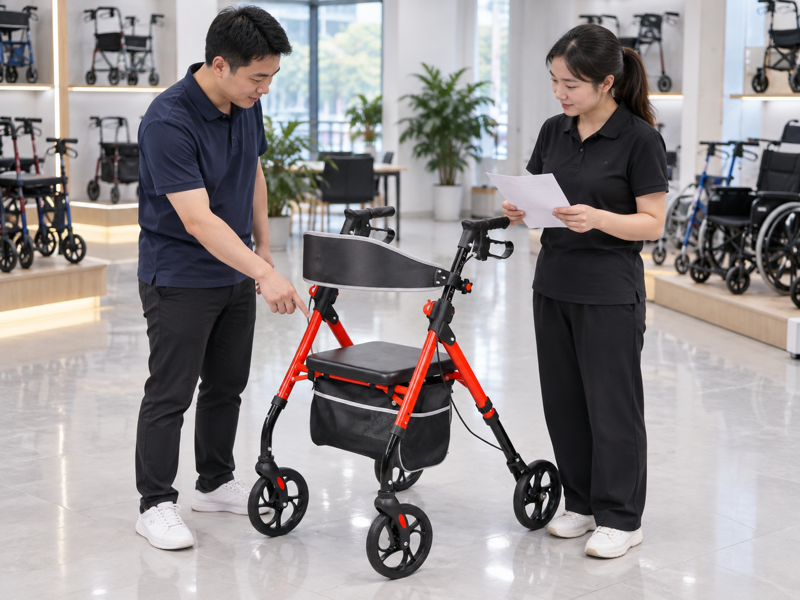
Choose a rollator walker with seat by checking whether the person can use the walking aid and its rest seat under the exact model instructions. A buyer may welcome a padded place to pause, then discover that parking the aid or rising from its seat needs more planning than a product photograph suggests. Review user fit, approved braking, real stop locations and handover training before ordering.
What does a rollator walker with seat offer?
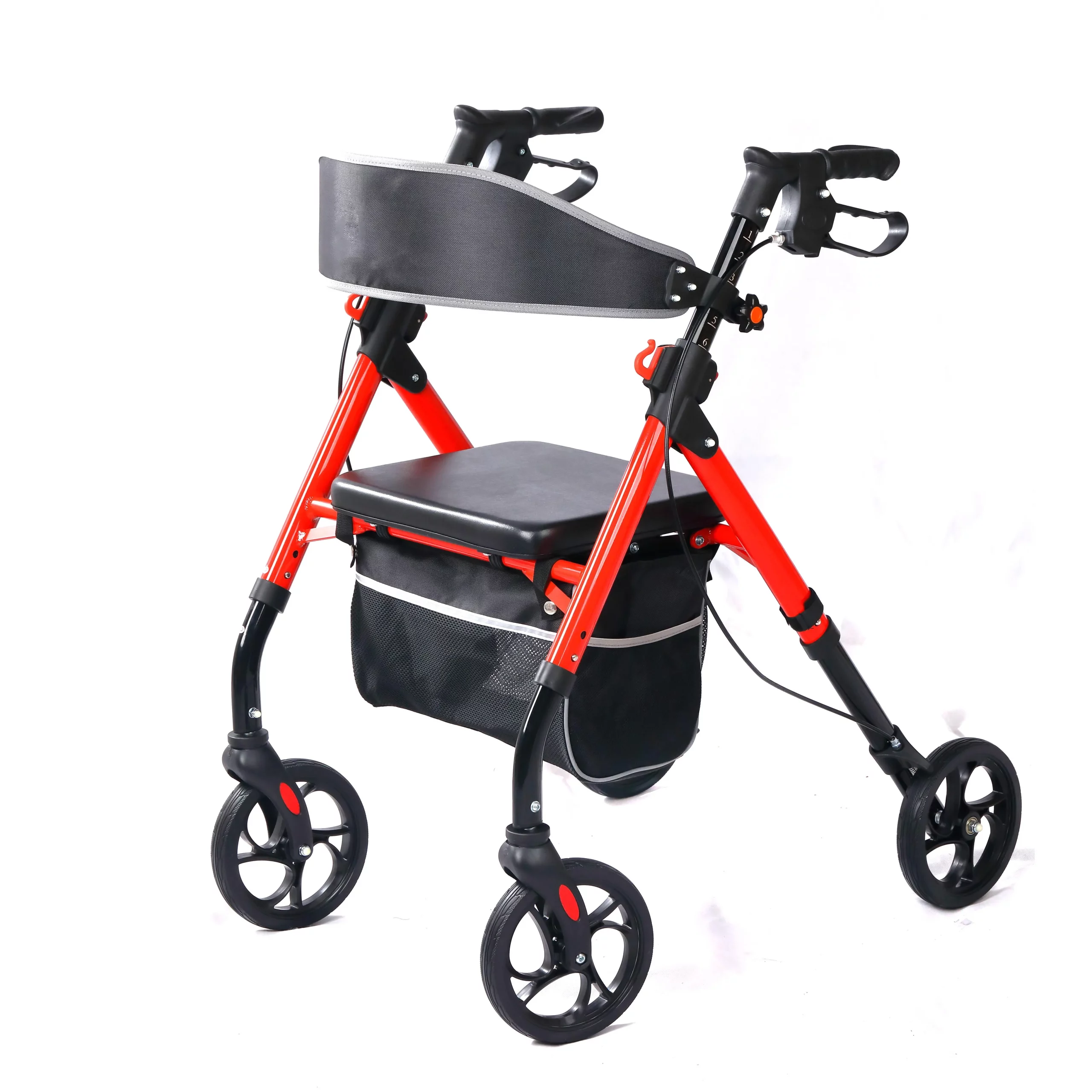
A rollator walker with seat combines a wheeled walking frame with a place to pause when used as its maker permits. The pictured Shopping Walker has four wheels, a padded seat, curved fabric back strap, paired hand levers and a bag. These visible parts do not prove any person's fit or the model's load rating.
Which features belong in a buying brief?
Name each visible part before assigning a benefit. Ask for the exact model description and current instructions. The product range includes different aid types, so a seat on one model does not establish the same use on another.
- Identify seat, back strap, frame and wheels.
- Confirm brake and bag functions from documentation.
- Keep user-fit questions separate from catalogue imagery.
| Visible feature | Document to request |
|---|---|
| Rest seat | Intended use and applicable limits |
| Hand levers | Operating and parking instructions |
A feature list is useful only when paired with the exact product guide. Key Takeaway: Your team can describe the aid without promising unsupported performance.
Who should try a rollator walker with seat?
A rollator walker with seat should be tried by the intended user within an appropriate assessment and training process. Walking, braking, sitting and rising are different tasks. A person who manages one may still need help or another device for another.
What should the trial record?
Follow the person's full sequence. WHO describes trained assessment, fitting and follow-up as core parts of assistive-product provision. Record the specific aid and tasks reviewed, not a generic claim of suitability.
- Identify the user's walking and rest needs.
- Include grip, braking and sit-and-rise review.
- Note the assessor and any unresolved concern.
| Task | Review focus |
|---|---|
| Walking | Control of the moving aid |
| Resting | Parking, seat fit and rising |
A single successful showroom turn cannot cover the rest stop. Key Takeaway: You can organize a trial around what the user will actually do.
How should a rollator walker with seat seat be checked?
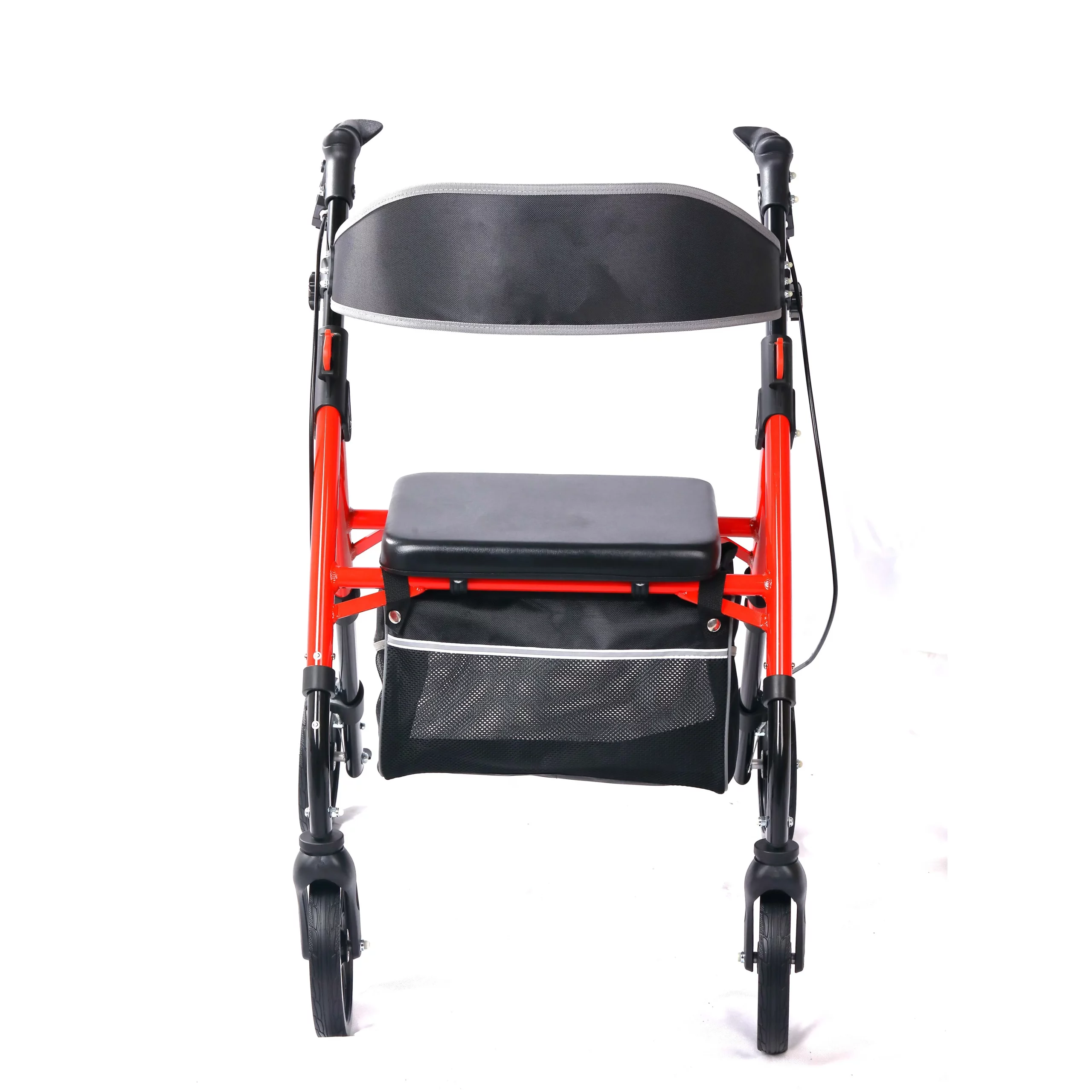
A rollator walker with seat needs an individual review of seat position, back-strap role and the person's ability to sit and rise. The front product view shows these parts clearly but gives no verified seat dimension. Do not assume the seat height changes with the adjustable handles.
What should fit staff ask for?
Compare measured product facts with the person. Request the actual seat dimensions and intended-use limits for the chosen model. Keep the person's seating observations with the complete walking-aid record.
- Confirm seat dimensions and configuration.
- Review the rest task with trained personnel.
- Record the approved setup and follow-up contact.
| Input | Purpose |
|---|---|
| Seat specification | Defines the product being tried |
| Personal review | Shows whether it suits the user |
The measurement and the individual trial answer different questions. Key Takeaway: Buying can move beyond the padded-seat photograph.
Why verify rollator walker with seat brakes before sitting?
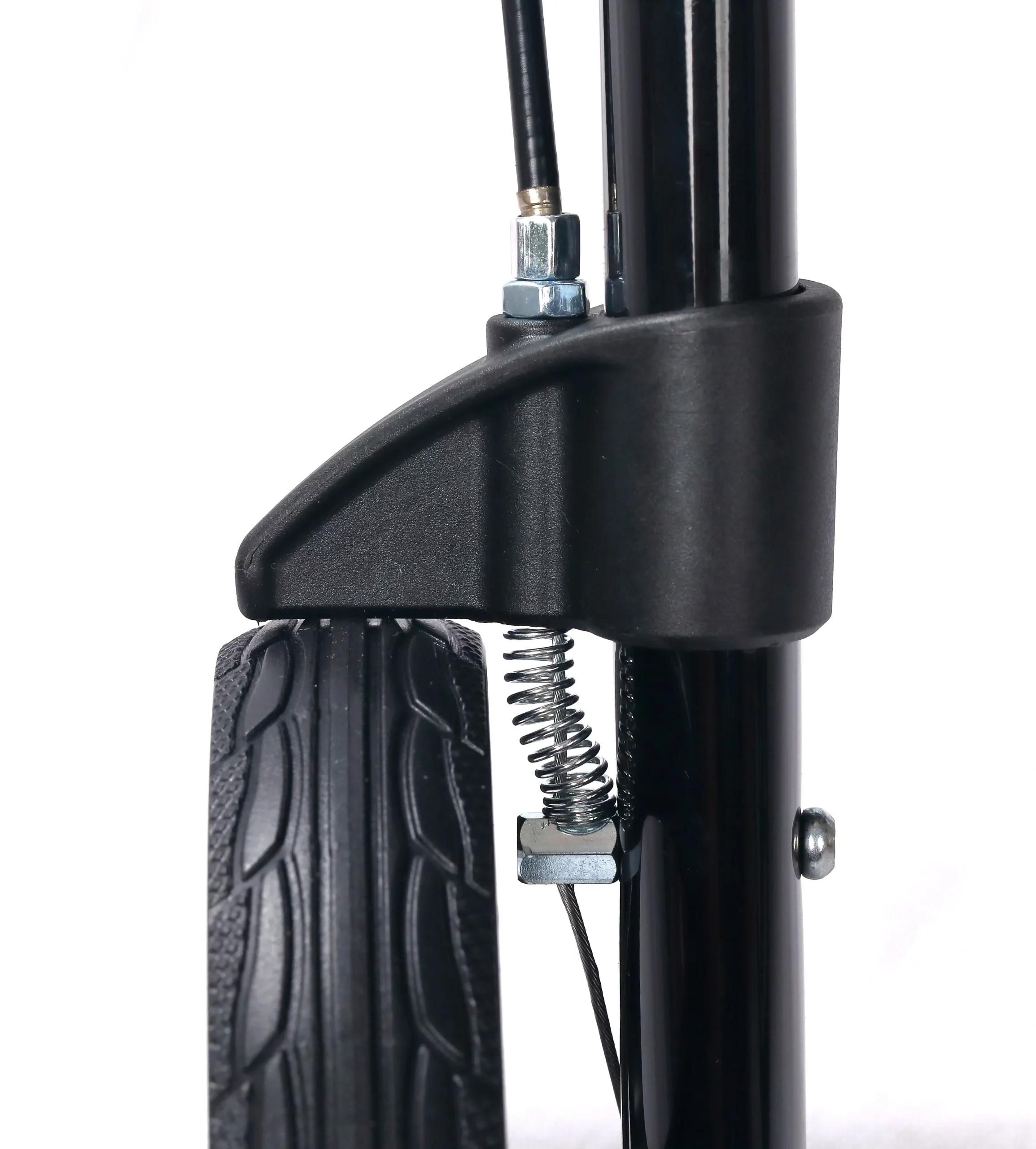
A rollator walker with seat needs the maker's parked-state check before its seat is used under the person's plan. The paired levers and wheel-side cable hardware are visible, but the photographs do not prove how this exact model parks. Obtain current instructions and a trained demonstration.
What must the handover make clear?
A seat is only part of the stop. Oxford Health's four-wheeled rollator guidance calls for brake checks and a fully open aid. State the exact model's approved parking action and both-side check without guessing lever direction.
- Confirm the current model's parking method.
- Review both brake sides under that method.
- Keep personal seated-rest training with the record.
| Question | Answer source |
|---|---|
| How is it parked? | Maker's model instructions |
| Can this person use the seat? | Appropriate individual review |
A visible hand lever is not proof that a rest stop is ready. Key Takeaway: The buyer knows what must be demonstrated before seat use.
Where can a rollator walker with seat provide a rest?

A rollator walker with seat can support a rest only in locations allowed by the maker and suitable for the individual plan. The product-page collage shows grass, paving and a speed bump, but no aid using those surfaces. Treat the images as route questions, not approvals.
What belongs in a stop-location brief?
Take the route into the review. List surfaces, slopes, thresholds, crowding and space to park without blocking others. Ask trained personnel to evaluate the intended stops using the selected model's environment guidance.
- Mark planned rest points on the route.
- Check permitted surfaces and parking conditions.
- Record places that need another solution.
| Location fact | Review question |
|---|---|
| Surface and slope | Is this a permitted rest place? |
| Available space | Can the aid park and be approached? |
A good rest plan starts with a real place, not an outdoor marketing image. Key Takeaway: Your sample trial can target the stops that matter.
How do rollator walker with seat handles affect use?
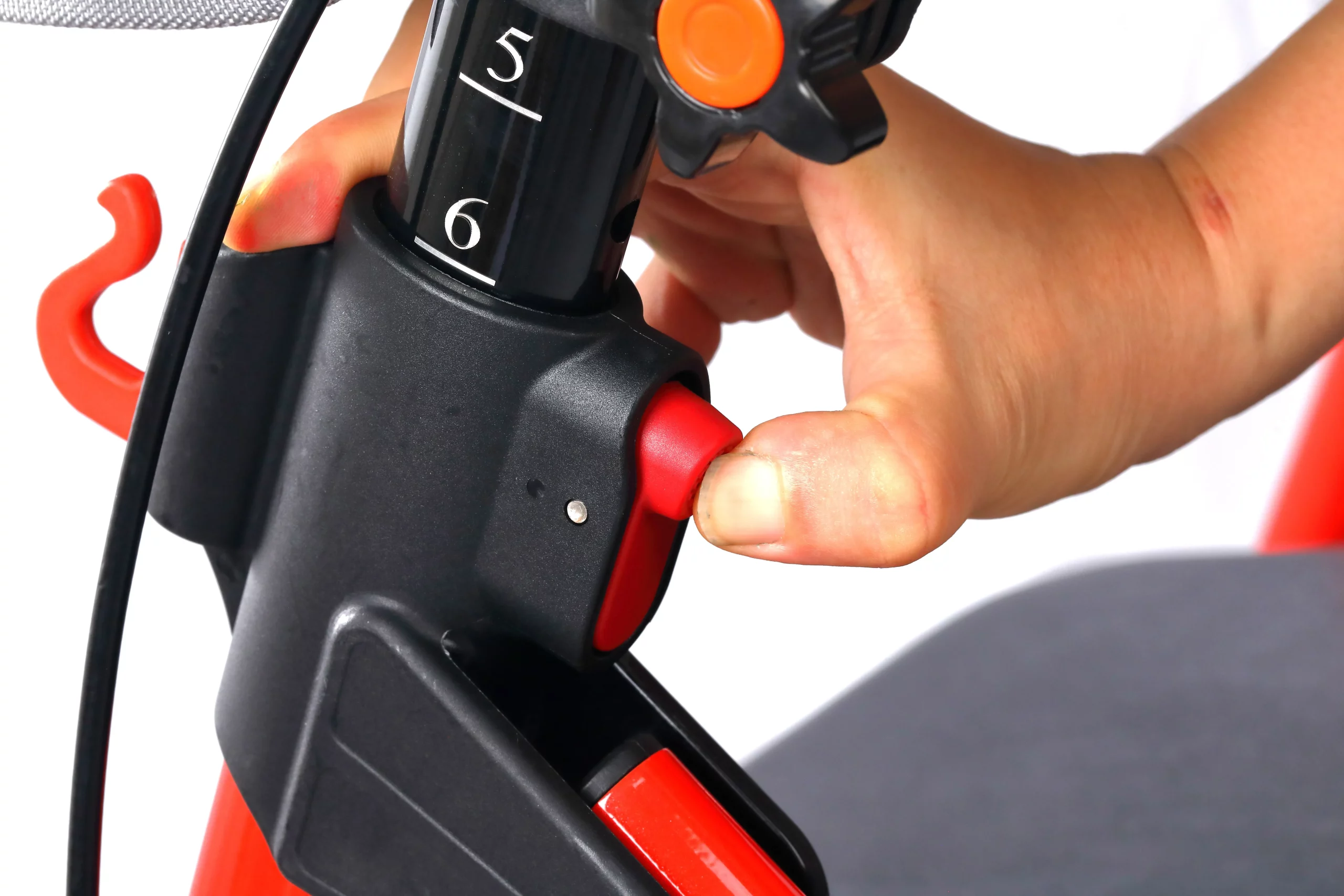
A rollator walker with seat still needs individual handle fit for walking and clear access to both brake levers. The close-up shows an adjustable post with numbered marks, but not the user's correct setting. Keep grip and seat fit as separate decisions.
What should the fitter check together?
Follow the hand from grip to brake. Guy's and St Thomas' walking-aid guidance uses wrist-region height as a starting cue. A trained review must confirm the person can control this actual aid and its levers.
- Record approved grip positions for both sides.
- Review brake reach in the walking setup.
- Keep seat and handle observations distinct.
| Position | Review |
|---|---|
| Hand grips | Individual walking control |
| Seat | Individual rest task |
One comfortable hand position cannot settle the seated-rest question. Key Takeaway: The handover can preserve both parts of the fit.
Can a rollator walker with seat replace a wheelchair?
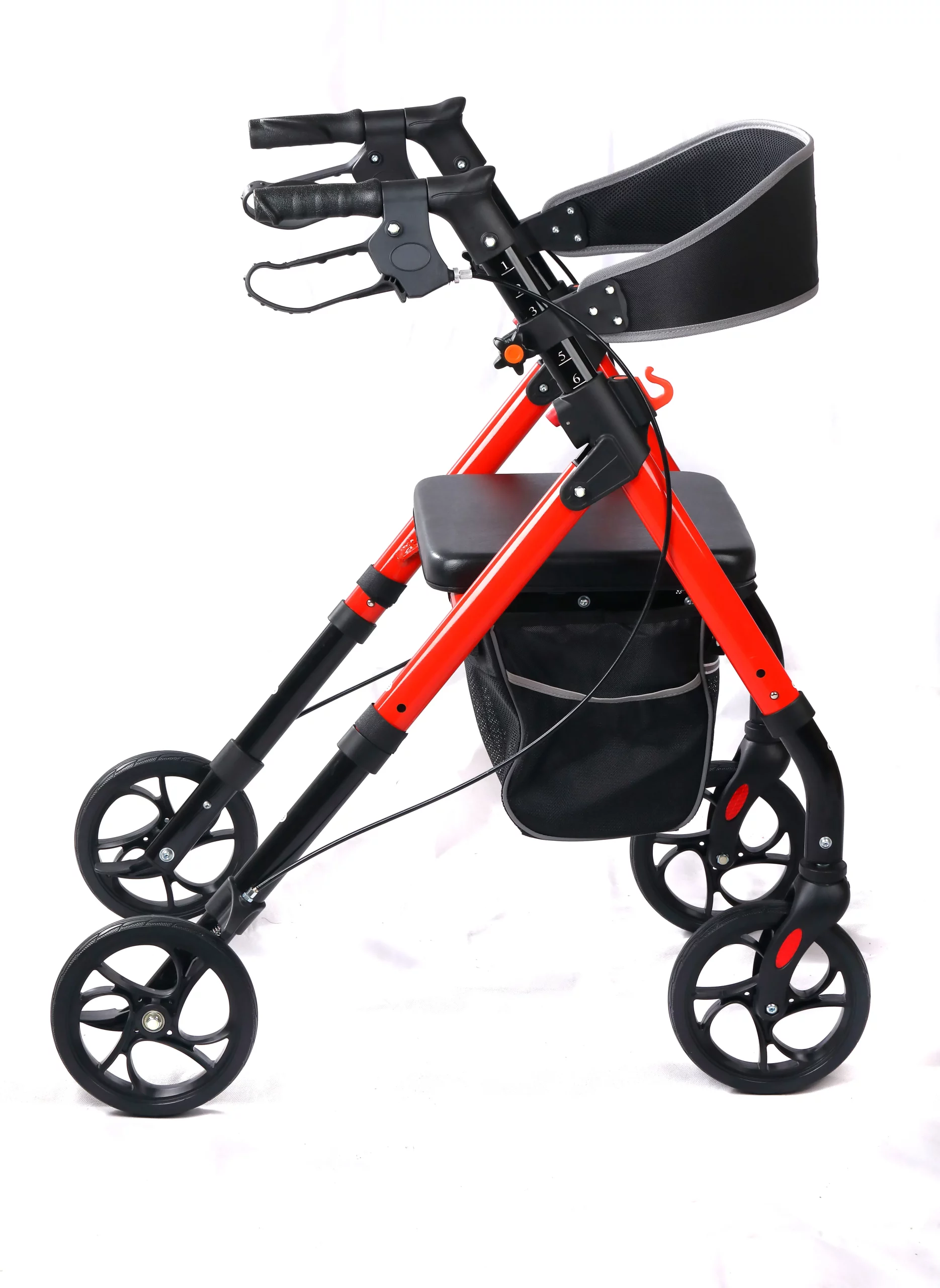
A rollator walker with seat should be treated as a walking aid, not a wheelchair for transporting a seated person, unless the exact product is expressly designed and approved for that use. The pictured model has no verified transit-chair function. Compare the wheelchair range only after the person's mobility needs are assessed.
What should a dealer clarify early?
Separate resting from travelling seated. Ask whether the person needs a brief stationary rest or seated mobility over distance. Do not use a padded rollator seat as proof that someone may be pushed while sitting.
- Identify the intended travel task.
- Request the exact model's seated-use limits.
- Refer a seated-transport need for device selection.
| Need | Product question |
|---|---|
| Stationary rest | Is seat use approved for this person? |
| Seated travel | Is a different device required? |
A rest seat and a transport chair solve different problems. Key Takeaway: You can avoid a dangerous category mix-up at purchase.
How does a rollator walker with seat fold for transport?
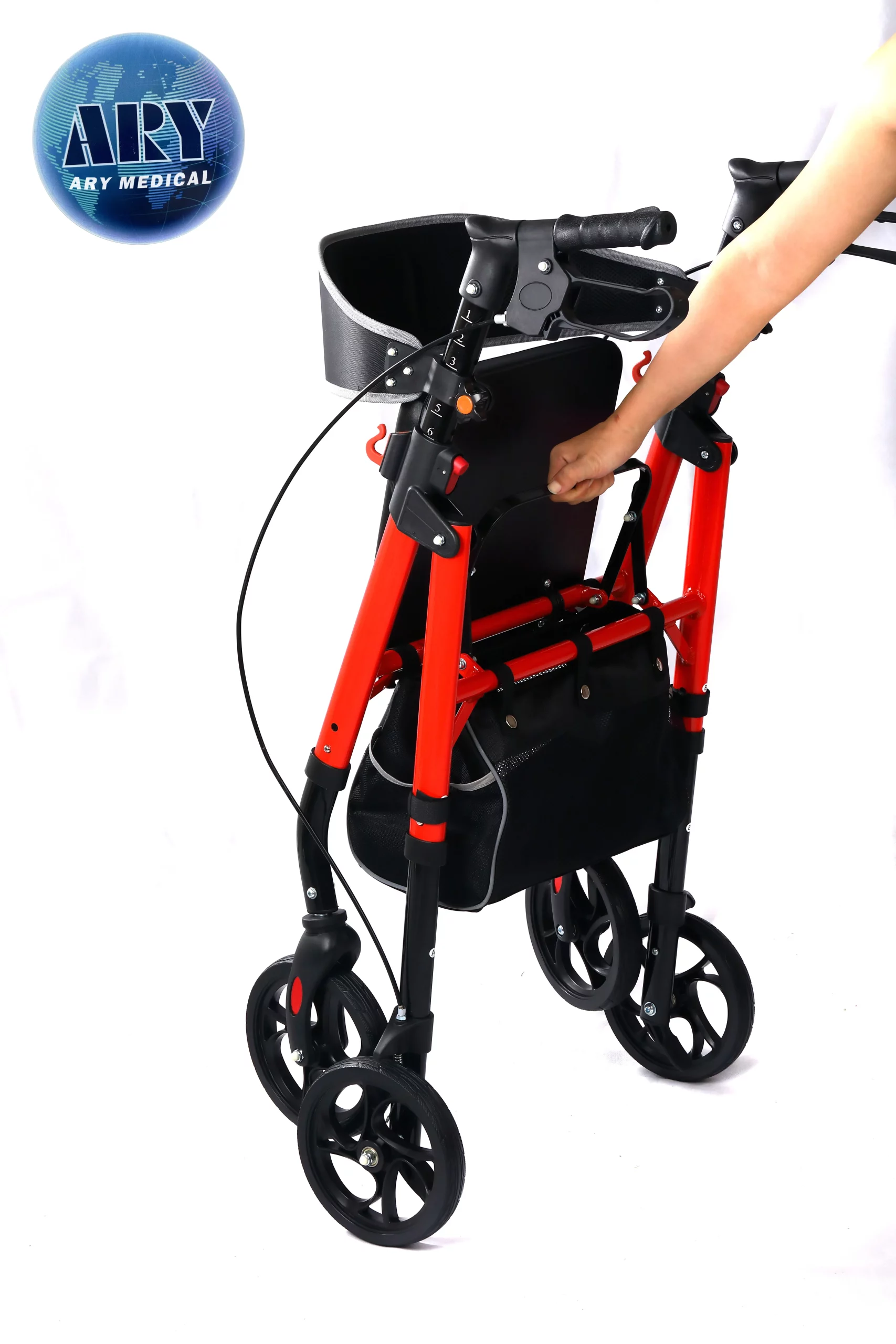
A rollator walker with seat should be folded only by the sequence in its exact model guide. The source image shows a red frame partly collapsed with a hand near an inner strap; it does not teach the full sequence. Reopen completely and check the aid before use.
Which features need protection?
Track the seat and cables through handling. Ask how the padded seat, back strap, bag and brake lines should be positioned. Record handle settings so the aid can return to the user's approved fit.
- Use documented fold and reopening steps.
- Protect cables and fabric components.
- Repeat required brake and frame checks.
| State | What to confirm |
|---|---|
| Compact | Part and cable protection |
| Reopened | Full frame and approved setup |
A folded sample cannot stand in for the ready-to-use aid. Key Takeaway: Transport staff can restore the same reviewed arrangement.
What should a rollator walker with seat handover record?
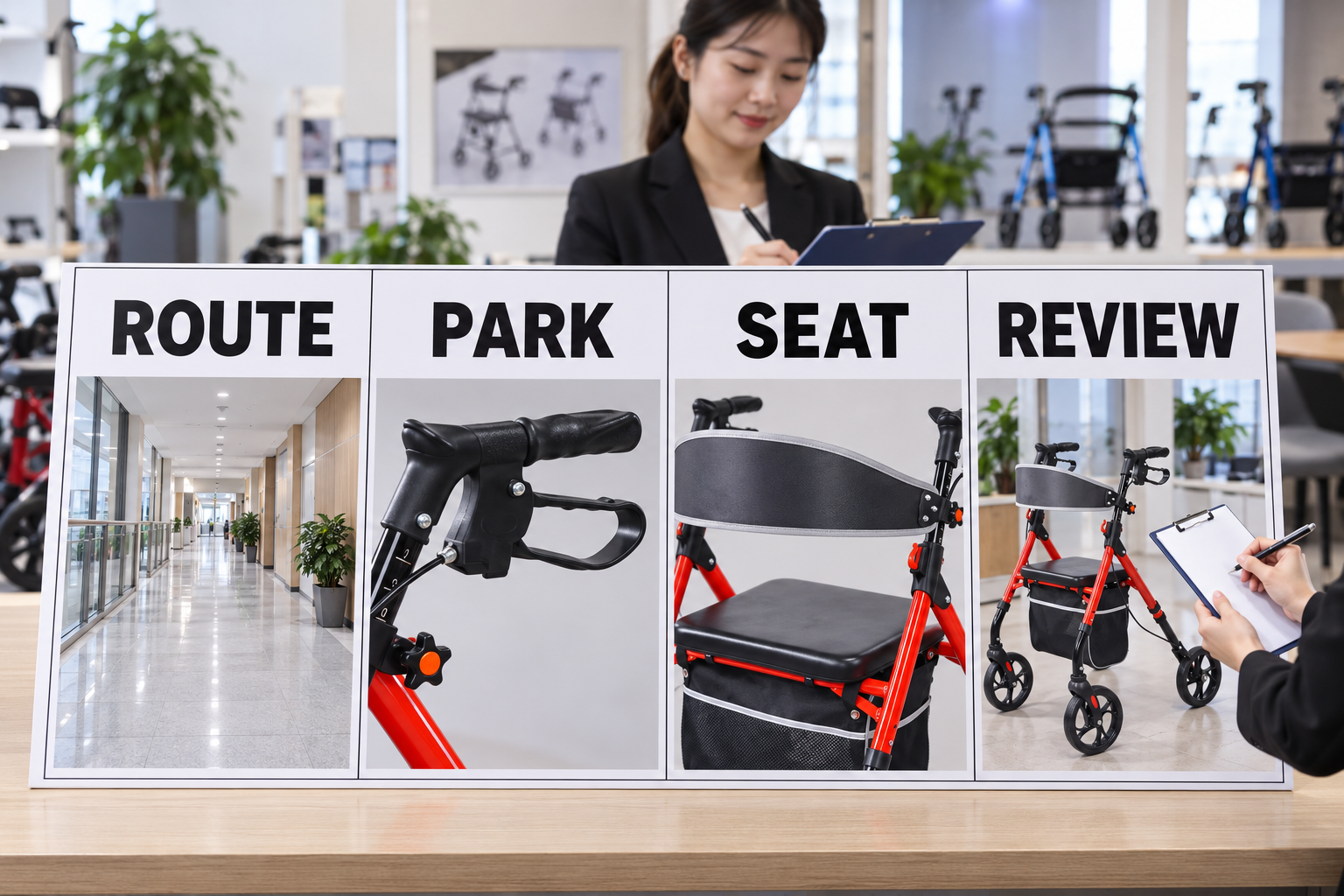
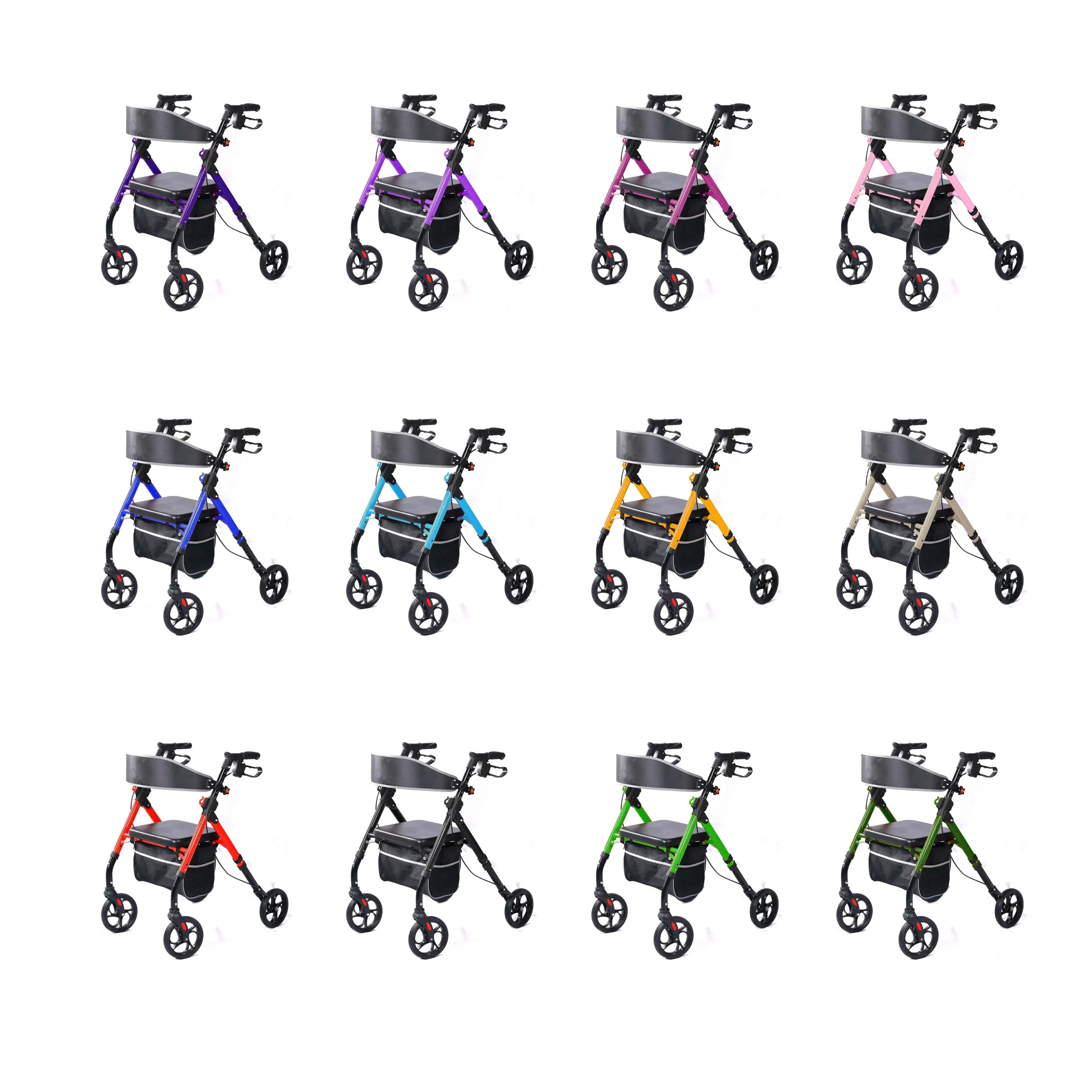
A rollator walker with seat handover should record the exact model, user-fit findings, brake procedure, approved rest locations and service route. Include the current instructions and any unresolved question. The chart above helps structure review but cannot certify the person's fit.
What should another colleague be able to find?
Keep the current decision traceable. Ask the supplier team for product and parts documents. Store the user's trained setup and any later change with the same aid record.
- Record model, seat and handle setup.
- Keep parking and rest-stop training notes.
- Name service and follow-up contacts.
| Record | Use |
|---|---|
| Product and fit | Recreates the assessed configuration |
| Training and service | Shows what to do when conditions change |
A clear file saves the next handler from guessing at a brake or seat rule. Key Takeaway: The rest-stop plan can survive a staff change.
How do you choose a rollator walker with seat?
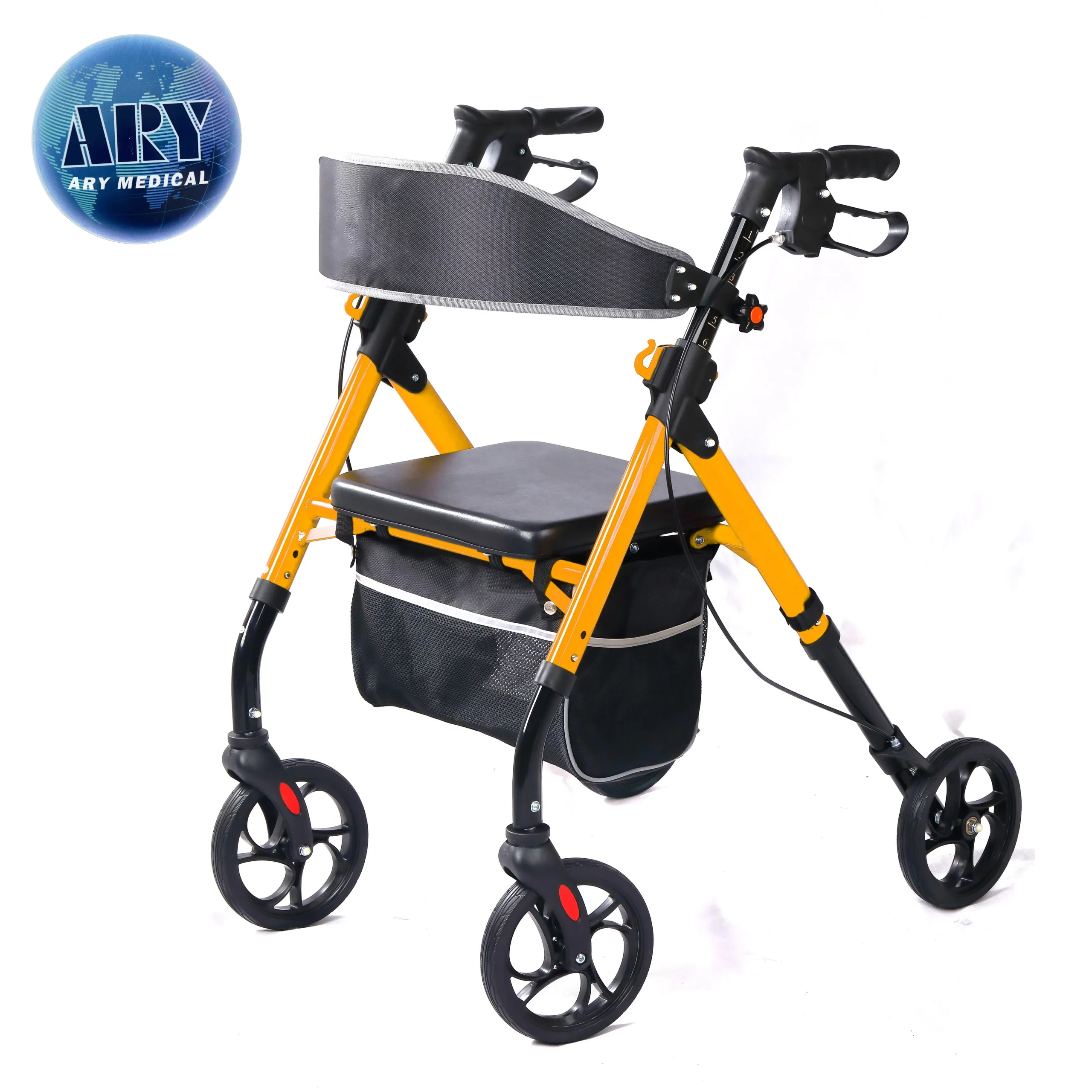
Choose a rollator walker with seat by testing walking control, model-specific parking and a realistic seated rest in the person's route plan. Confirm dimensions and load limits from current product documents, not marketing images. Keep any unresolved fit question with trained staff.
What should your enquiry include?
Send a brief that covers the whole stop. Name the user-assessment contact, intended route, candidate model and rest locations. Ask for the current guide and a sample review before placing a bulk order.
- Request verified model and seat information.
- Review the maker's parking instructions.
- Arrange a trained route and rest trial.
| Buyer brief | Response to request |
|---|---|
| Product and route | Model facts and sample plan |
| User needs | Appropriate fitting and training route |
The product choice should follow a complete walking-and-rest review. Key Takeaway: For model details and samples, contact us. Ary Medical supports clear decisions about walking aids and the rest stops people depend on.
Frequently asked questions
Q1: Can I sit on the rollator as soon as I stop?
Only after the exact model's parking check and the person's approved rest plan. Confirm both sides before seat use.
Q2: What's the best rollator seat height for me?
There is no universal answer. Match verified model dimensions with a trained individual fit review.
Q3: Can someone push me while I sit on this rollator?
Do not assume so. This pictured aid has no verified transit-chair function; ask about a device designed for seated travel.
Q4: How do I know if a route has a good rest stop?
Check the maker's surface limits, space to park and the user's assessed plan at the actual location.
Q5: Can I infer the brake action from a handle photo?
No. Use the exact model's current instructions and a trained demonstration.