
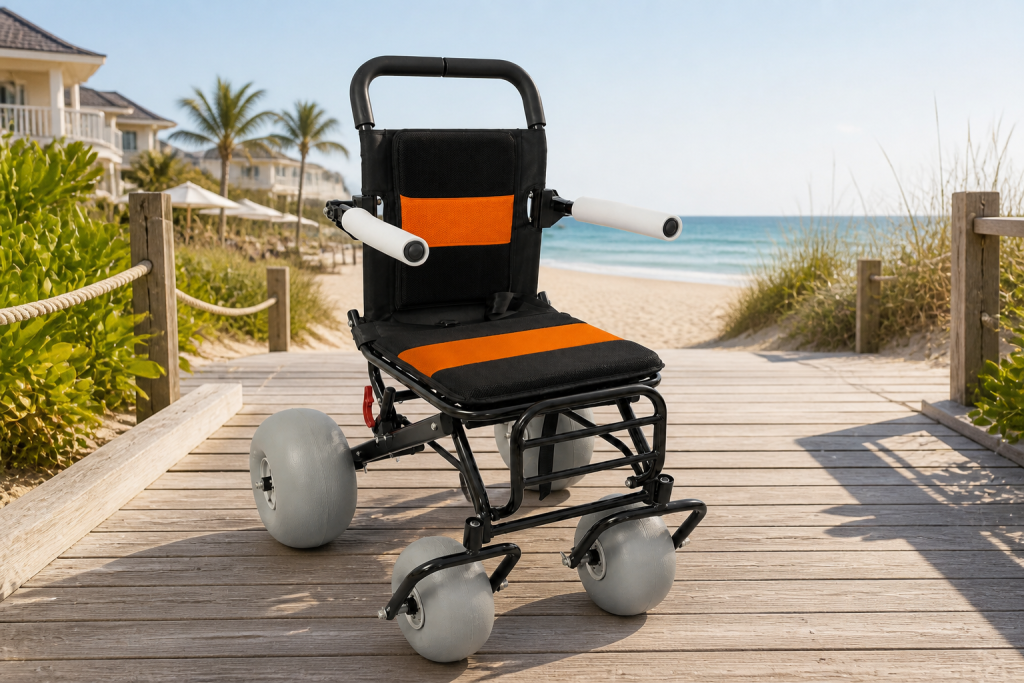
A lightweight beach wheelchair storage plan should move each chair through transport, inspection, rinsing, drying, protected parking, charging when applicable, and shift handoff without skipped steps. Keep exits clear. Separate wet equipment. Record damage before another service period begins. For U.S. facilities, align site procedures with official mobility-device guidance.
Beach resorts often buy mobility equipment with guest service in mind, then leave transport and storage details for staff to solve during a busy shift. That gap creates mixed handoffs, blocked aisles, damp equipment, and uncertain status at the rental desk. A lightweight beach wheelchair storage plan gives operations teams one shared method for moving, checking, drying, parking, and releasing a chair for service. The plan does not need unsupported product promises or a long technical manual. It needs named roles, model-specific instructions, a clear storage bay, and a short record that every shift can read.
This article gives hotel, resort, rental, and recreation managers a practical B2B framework. It treats manufacturer instructions as the product authority and keeps local site policy in control. Teams should adapt each action around their exact chair model, building layout, service route, staffing pattern, and coastal conditions. Staff should never guess about adjustment, repair, cleaning chemistry, or suitability. An unresolved question belongs with an authorized supervisor or supplier contact before equipment returns to guest service.
In practice, Storage work also affects the guest conversation. A chair marked ready should have a current check, a clear route out of storage, and a known staff owner. A chair marked drying, review, or hold should not appear available simply because it sits near the rental desk. Plain status language helps reservations, housekeeping, recreation, and beach teams give the same answer. That consistency protects service quality without making a guarantee about safety, comfort, or individual fit.
Why Does Resort Storage Need a Written Plan?
A Lightweight Beach Wheelchair needs a written storage plan because several departments may touch the same equipment between one guest booking and the next. A shared plan connects the resort’s wider Beach Series service with daily ownership, cleaning, drying, parking, and release decisions. Without that link, one team may treat a chair as ready while another still sees a cleaning or inspection concern. The written plan should stay short enough for seasonal staff and precise enough for a supervisor who reviews handoffs.
Set Clear Equipment Status
Here is the practical point: one visible status keeps a chair from moving through the resort on assumption alone. Use a small set of plain labels such as ready, cleaning, drying, review, or hold. Pair each status with a time and staff owner.
Next, Avoid permanent claims, because equipment condition and route access can change during the day. The status should appear where reservations and operations can see it, yet it should not expose guest information. A manager can use the same vocabulary in a paper tag, digital board, or shift log.
Staff need a direct escalation contact when a chair remains in review or hold.
- Assign one current status to each chair.
- Add a time and staff owner to every status change.
- Keep guest details out of equipment records.
- Give each shift one escalation contact.
- Require an authorized review before a hold ends.
Match the Plan to the Product Model
What keeps the plan grounded: staff should build steps around the exact product instructions rather than a generic wheelchair routine. A lightweight frame, textile seat, arm supports, wheel layout, and removable or adjustable parts may each have model-specific handling guidance. Teams should know where the current instructions live and who can interpret them.
Meanwhile, A product page may support purchasing discussions, but it does not replace the manual supplied with local equipment. If a resort owns more than one model, use a separate check card for each one. Color coding can help staff find the right card, provided every label remains clear and accessible.
- Link each chair identifier with its matching instructions.
- Keep model cards beside the approved storage area.
- Separate routines for equipment with different parts.
- Record supplier guidance that changes a local step.
- Remove an outdated card when a model leaves service.
How Should Teams Move the Chair Between Areas?
A Lightweight Beach Wheelchair should move between storage, service desks, and beach access through a planned route with assigned staff roles. Resort teams can review the chair’s structure on the Lightweight Beach Wheelchair product page, then map that geometry against doors, ramps, lifts, gates, corners, and staging spaces. Staff should not assume that a lower equipment weight makes every route easy. A narrow turn, wet floor, guest traffic, housekeeping cart, or blocked doorway can change the movement plan.
Prepare the Route and Staff Roles
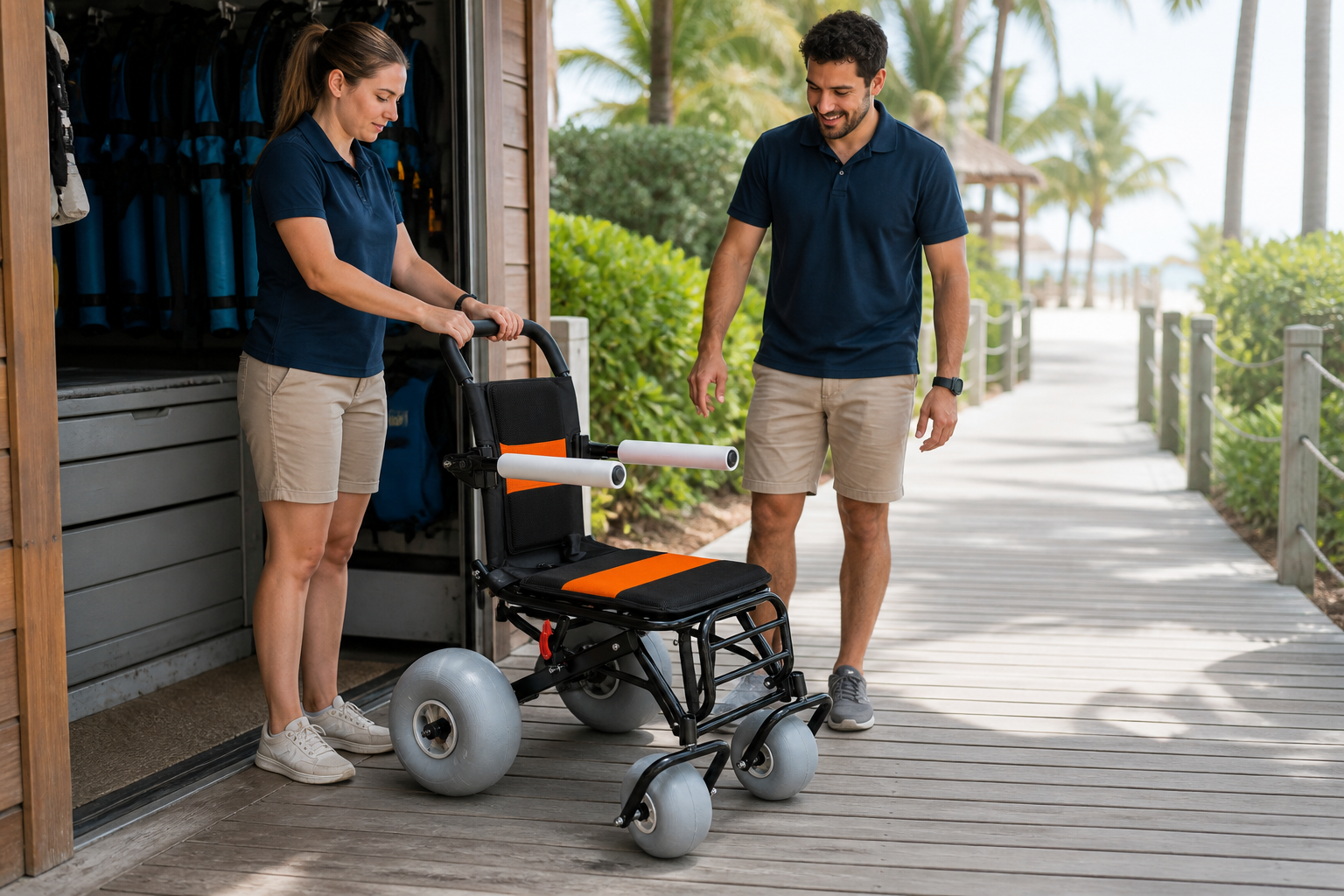
This is where calm service starts: name a route owner before the chair leaves its bay. That person confirms current status, checks the path, and assigns movement roles under resort policy. Walk the route with empty equipment before guest service when the layout has changed or a new team begins work.
For example, Staff should know where they can pause without blocking public access. They should also know which lift, ramp, or gate applies and where a handoff occurs. If the route loses clear space, return the chair to a known location or place movement on hold rather than forcing a workaround.
- Check the route before moving equipment.
- Name one person who leads communication.
- Keep public and emergency paths open.
- Use firm staging points for staff handoffs.
- Pause movement when the route becomes unclear.
Use an Empty-Chair Movement Check
A short trial reveals real friction: move an empty chair at a normal walking pace through each planned doorway, corner, and surface change. Watch wheel clearance, frame clearance, staff footing, and the space needed for a controlled turn. Do not publish measurements unless a qualified site review has verified them and the resort keeps them current.
The purpose of the trial is operational observation, not a performance rating. Staff can note a blocked point with a plain location name and send the concern to the route owner. A new trial should follow any layout change, construction work, furniture move, or access closure.
- Test the outbound and return route with an empty chair.
- Observe clearance at doors, lifts, gates, and corners.
- Keep hands and clothing clear of moving parts.
- Record any point that needs supervisor review.
- Repeat the trial after a site-layout change.
What Should Staff Inspect Before and After Storage?
Still, A Lightweight Beach Wheelchair should receive a visible equipment check before it leaves storage and after it returns. The related portable lightweight terrain chair article can help teams discuss category use, while local instructions govern the actual check. A visual review cannot confirm hidden condition, yet it can identify loose-looking fasteners, fabric damage, trapped debris, unusual wheel movement, missing items, or moisture that calls for a pause. Staff should not improvise repairs unless resort policy names them as trained and authorized.
Use a Visible Equipment Check
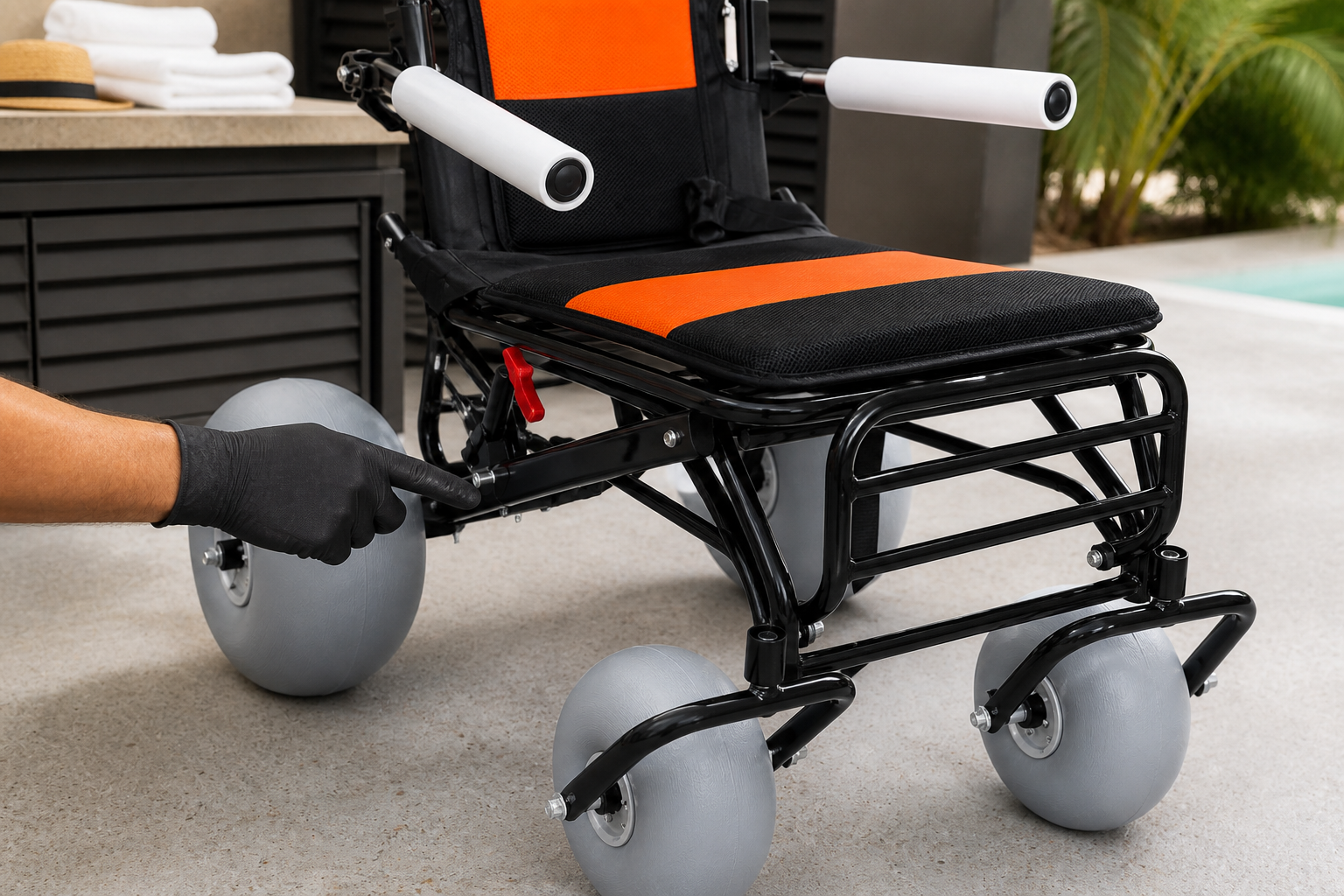
Start with what staff can see: place the empty chair on a firm, level surface and compare it with a known ready-condition reference. Review frame connections, seat and back fabric, arm supports, wheel surfaces, foot support, visible fasteners, and any model-specific attachments. Look for sand, salt residue, cuts, distortion, or a part that sits differently from its normal position. If something looks doubtful, mark the chair for review and move it away from the ready area. A short photo reference can help staff notice change, but it should never replace manufacturer guidance or authorized technical assessment.
- Place empty equipment on firm level ground.
- Compare visible parts with a ready-condition reference.
- Check fabric, frame, wheels, supports, and fasteners.
- Record anything that looks different or incomplete.
- Keep a questionable chair out of guest circulation.
Close Cleaning and Drying Before Release
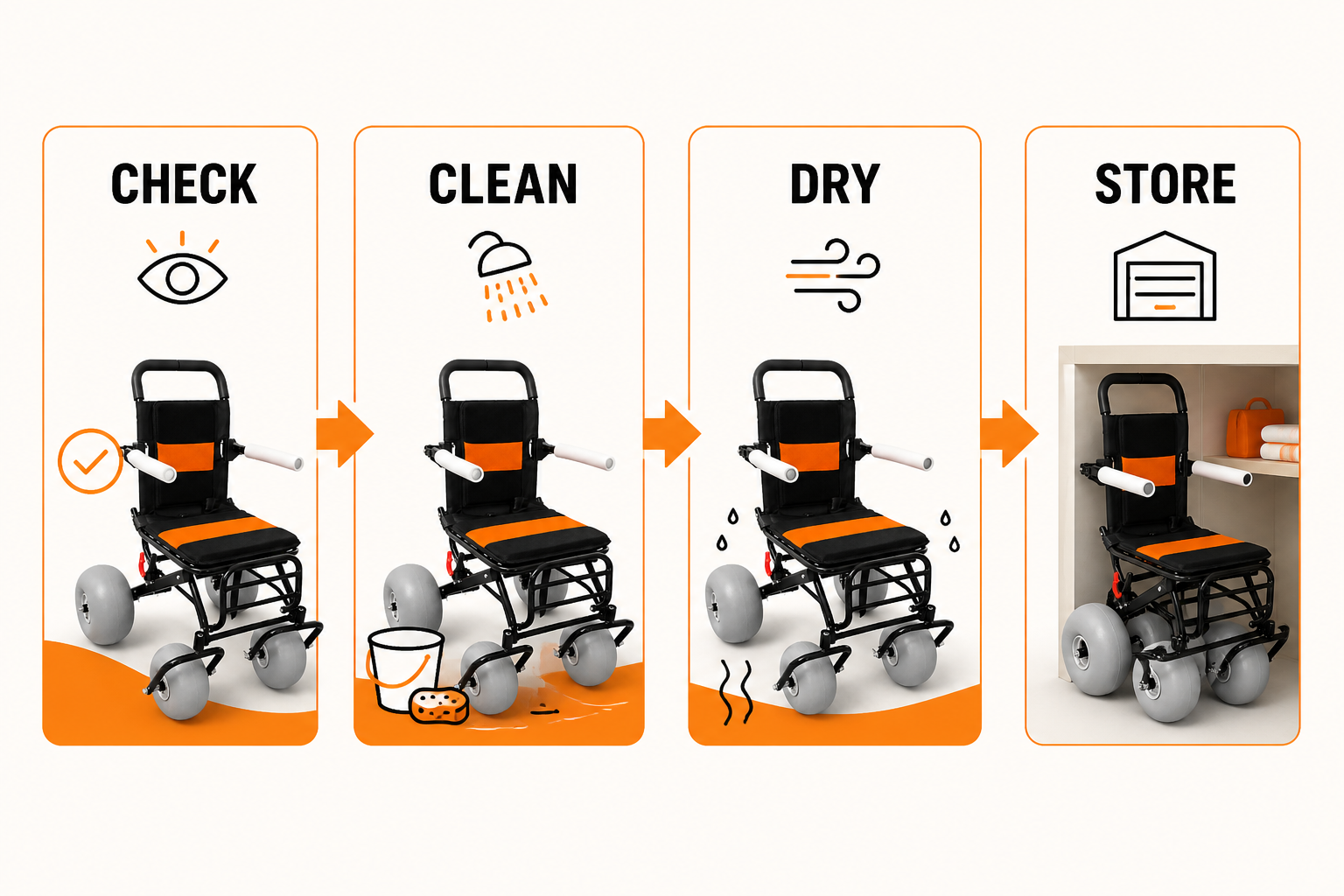
The key is a fixed order: remove loose debris, clean only with methods allowed by product instructions, dry all permitted surfaces, inspect the chair again, and then change status. Staff should not cover damp fabric or park wet equipment in a closed bay. Fresh water may suit some product-care instructions, yet teams must follow the local model guidance rather than assume.
Afterward, Cleaning does not replace inspection, and drying does not close an unresolved hardware concern. The person who changes status should verify that each required step has a recorded owner. A chair can remain in drying or review until those steps close.
- Remove loose sand in the approved cleaning area.
- Follow model guidance for water and cleaning products.
- Let fabric and frame surfaces dry before parking.
- Repeat the visible check after cleaning.
- Change status only after every required step closes.
Where Should a Resort Store the Chair?
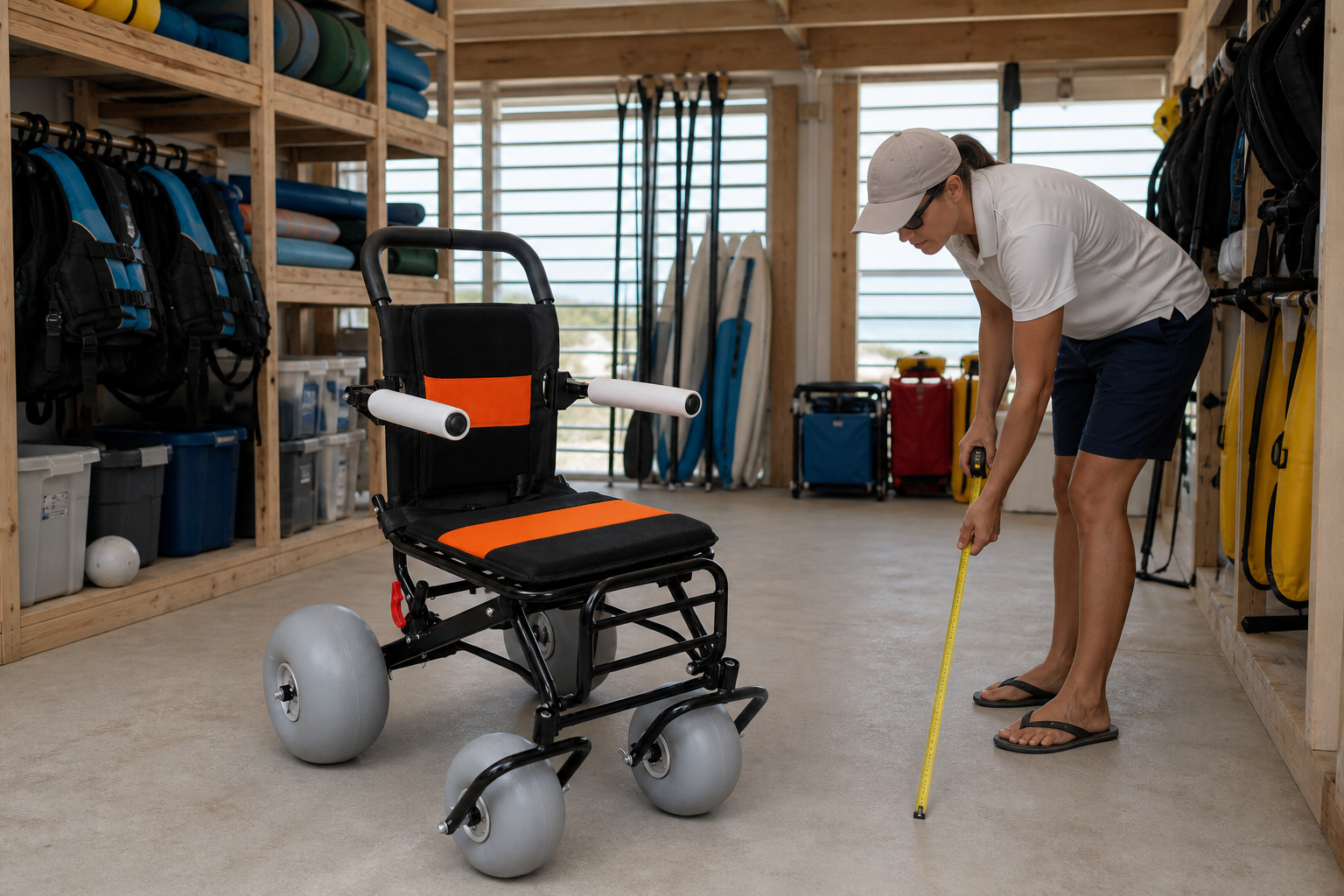
A Lightweight Beach Wheelchair should stay in a dry, ventilated, accessible bay with a clear route to service areas. Resorts comparing transport and parking approaches can also review the folding beach wheelchair article, while local model instructions decide whether folding, removal, or adjustment is allowed. Storage should protect the chair from guest traffic, cleaning carts, sharp items, standing water, and stacked supplies. It should also give staff room for a visible check without pulling equipment into a busy corridor.
Choose a Dry and Accessible Bay
A good bay supports the whole workflow: mark one parking position for each chair and keep the surrounding floor clear. Ventilation should support drying under local building rules. Staff need access to the status tag, model instructions, and inspection card without climbing over other equipment. Keep loose cords, tools, luggage, towels, and chemical containers away from the chair. If a resort stores accessories separately, use a matching identifier so parts do not move between models by mistake. Managers should inspect the bay during routine facility rounds and address leaks, blocked vents, damaged racks, or aisle obstructions.
- Mark one parking position for each chair.
- Keep the aisle and inspection space open.
- Separate chemicals, sharp items, and wet supplies.
- Match accessories with the correct chair identifier.
- Add the bay to routine facility checks.
Plan Seasonal and Low-Use Storage
In practice, Long gaps need active ownership: low-use equipment still needs status, condition review, and a named manager. Follow manufacturer instructions for cleaning, drying, component position, protective covering, wheel support, and review intervals. Do not create an arbitrary calendar from memory. Before the resort returns a chair to service, repeat the visible equipment check and movement route review. Confirm that local instructions, supplier contacts, and staff training records remain current. Equipment that has sat through building work, a storm closure, or storage relocation should receive extra operational attention before a booking appears available.
- Name an owner during any low-use period.
- Follow product guidance for storage position and covering.
- Keep status visible while equipment remains parked.
- Recheck the chair and route before service resumes.
- Review instructions after storage-area changes.
How Can Managers Keep Handoffs Consistent?
A Lightweight Beach Wheelchair handoff stays consistent when each shift records status, location, open concerns, and the next owner. Managers do not need a long narrative. They need enough information for a colleague to make the next decision without guessing. The record should connect equipment status with cleaning, drying, route access, and any review hold. It should also show how a resort contacts the responsible supervisor without exposing private guest notes.
Use Short Records Across Shifts
Keep the record decision-ready: include chair identifier, time, location, status, completed steps, open concerns, and staff owner. Use one vocabulary across recreation, reservations, maintenance, and beach teams. A shift supervisor can scan records for repeated holds, blocked routes, or unclear responsibilities. If a field never affects action, remove it. If staff keep adding free-text explanations for the same issue, create a clearer status or checklist item. Records should follow resort privacy and retention policies. Equipment notes should not become a place for diagnoses, health history, or unrelated guest details.
- Record identifier, time, location, and current status.
- Name the person who owns the next action.
- Keep status terms consistent across departments.
- Exclude medical and unrelated personal details.
- Review repeated holds for a process gap.
Coach Through Observation
Next, Real practice makes the plan usable: managers should watch staff complete a full empty-chair cycle from storage release through return. Ask a trainee to explain status, check the route, move the chair, run the visible review, describe cleaning boundaries, and close the record. Coaches can correct unclear language or missed handoffs in the moment. Training should distinguish hospitality support from technical repair and clinical advice. Repeat observation after staff changes, product changes, storage moves, or repeated questions. A signed checklist may show attendance, yet direct observation gives managers a clearer view of how the workflow operates.
- Run a complete empty-chair practice cycle.
- Ask trainees to state each status change aloud.
- Watch route, handling, inspection, and record steps.
- Correct unclear ownership during the exercise.
- Repeat coaching after product or site changes.
What Do Buyers Ask About Lightweight Chair Storage?
Lightweight Beach Wheelchair buyers often ask about space, folding, cleaning, records, and cross-department ownership. These concise answers keep resort decisions tied to local equipment instructions and operating policy.
Can staff fold every lightweight model for storage? No. Staff should fold or remove parts only when the exact model instructions allow it and resort policy names the process.
Meanwhile, Does low equipment weight remove the need for route checks? No. Doors, turns, ramps, guest traffic, wet floors, and staffing still affect movement through a resort.
Can a damp chair stay in a closed equipment room? Not as a routine assumption. Follow product guidance and local facility rules, keep status visible, and complete permitted drying before release.
What should happen after staff see a loose-looking part? Place the chair on hold and send the concern to an authorized reviewer. Staff should not improvise a repair outside their role.
For example, How much detail belongs in a shift record? Record only what supports the next decision: identity, time, location, status, completed steps, open concern, and owner.
A Lightweight Beach Wheelchair storage plan works when resort teams connect product guidance with a clear bay, a checked route, visible status, and a short handoff record. Managers can adapt this framework around their building, service desk, staff roles, and exact chair model. For product questions, storage planning, or B2B sourcing support, contact us today.
Related planning resources: Review all-terrain route planning, saltwater care steps, commercial rental planning before approving a product, sample, route, or supplier decision.