
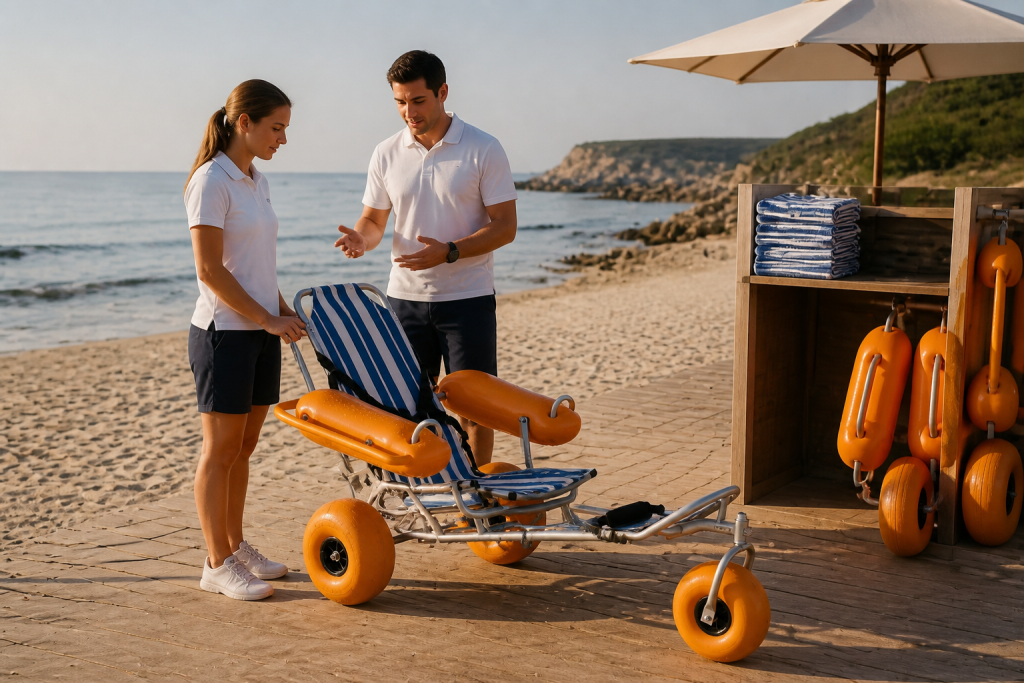
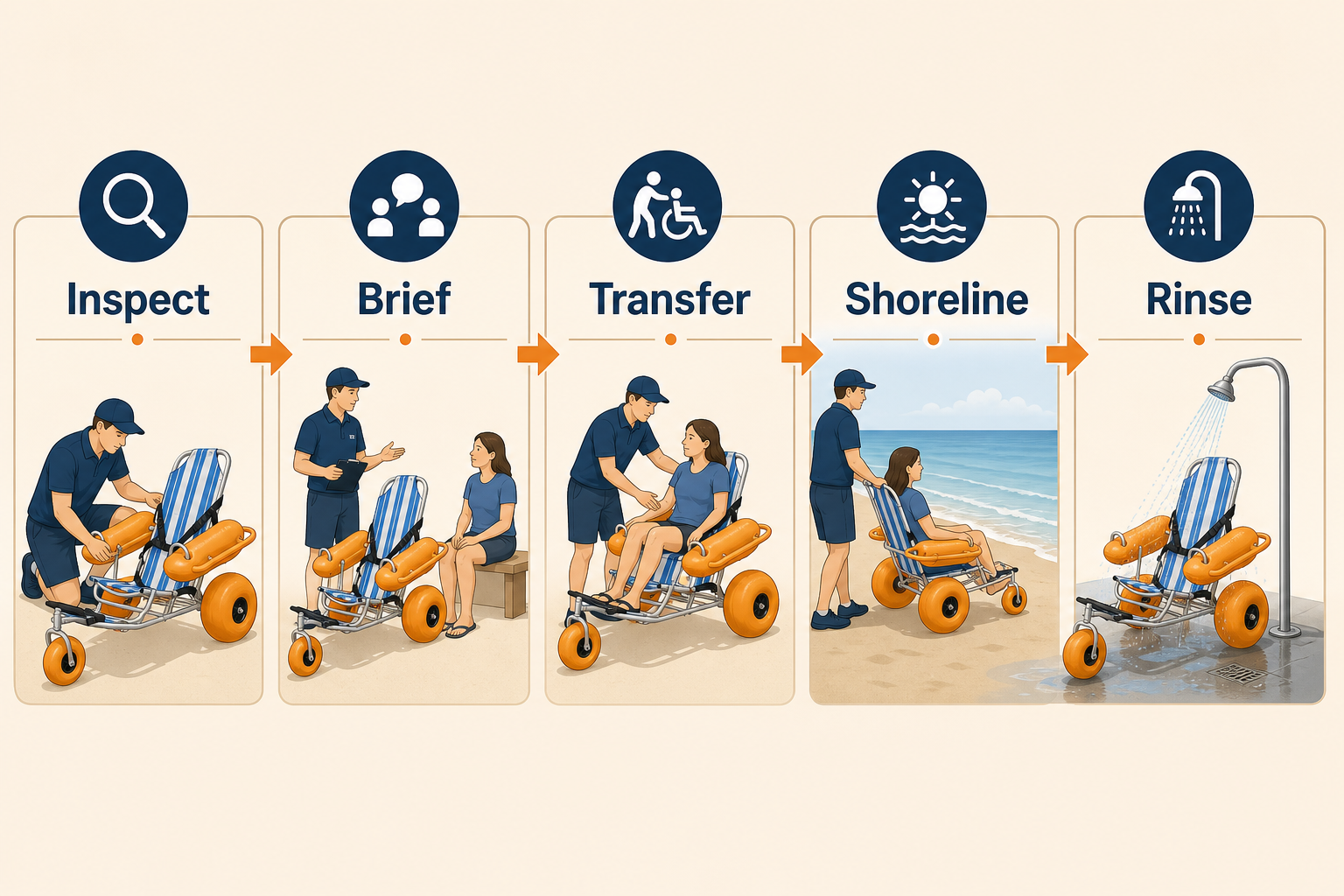
A floating beach wheelchair training plan should define equipment checks, guest briefing, staff positions, shoreline limits, stop rules, water-entry decisions, return steps, rinsing, drying, and records. Train with the actual chair. Keep roles visible. Stop service when conditions fall outside the approved plan. For U.S. facilities, align local procedures with official mobility-device guidance.
A floating beach wheelchair can widen a resort’s shoreline service, yet a rushed handoff can leave staff uncertain about roles, route limits, guest communication, or post-use care. A written training routine gives each shift a shared way to inspect equipment, brief guests, move across sand, approach water, and reset gear. This guide gives resort operators a practical framework without replacing product instructions, local operating rules, or advice from qualified accessibility and aquatic-safety professionals.
Teams can adapt each step to their site, staffing model, weather, shoreline, and chosen chair. The goal stays simple: predictable service, respectful communication, and a documented decision path whenever conditions change.
What should staff check before a floating beach wheelchair handoff?
In practice, A floating beach wheelchair handoff should begin with a calm pre-use check of visible components, route conditions, staffing, and the guest’s stated preferences. Staff should compare the chair with its manufacturer instructions, confirm that every removable component sits where it belongs, and pause service if anything looks loose, worn, damaged, or unfamiliar. The check also covers the planned route from storage through a boardwalk or access mat toward firm sand and any shoreline staging point.
A chair can look ready while a blocked gate, steep patch, incoming tide, or missing teammate makes the service plan unsuitable. A short documented review gives the next decision a sound basis and lets staff explain any delay without guessing.
Which parts deserve a hands-on check?
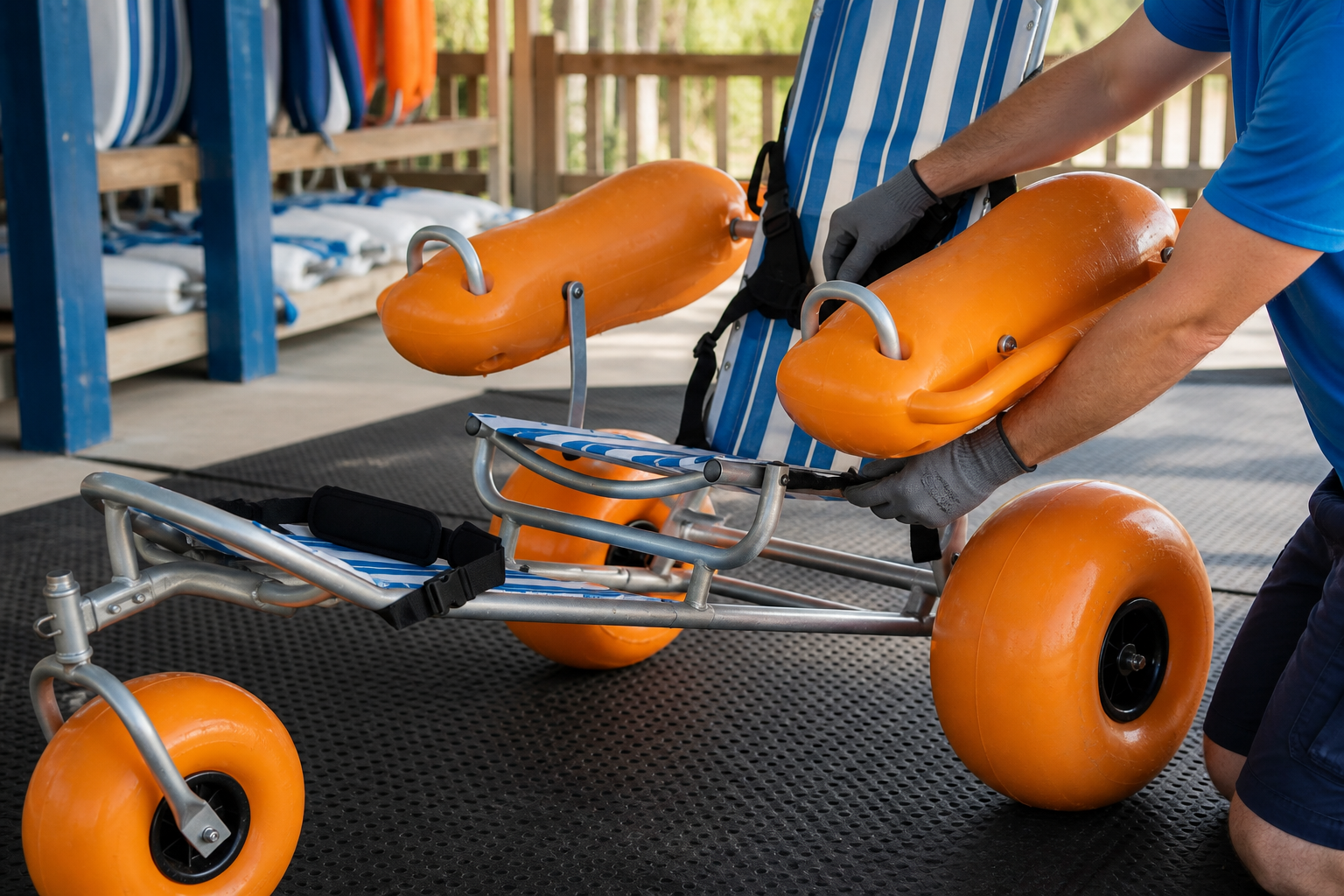
Start with what staff can see and touch. A hands-on check should follow the manufacturer manual and the resort’s approved checklist, with no improvised repairs or assumptions about hidden parts. The floating beach wheelchair product overview gives procurement and training teams a shared product reference, while the supplied manual remains the operating authority for a purchased model. Staff can look for a secure seat, correctly routed supports, clean contact surfaces, free-moving wheels, and frame connections that match the approved setup.
Next, If a chair was disassembled for storage, two trained people can compare assembly against the approved reference before a guest arrives. Any unresolved difference belongs in an out-of-service record, not in a live handoff.
- Confirm seat fabric, supports, straps, footrest, frame joints, and wheel attachments match the approved setup.
- Look for visible wear, sharp edges, trapped sand, loose fittings, or missing parts.
- Move each wheel only as directed and listen for unusual rubbing or resistance.
- Check that rinse, drying, and storage records from the prior use are complete.
- Mark the chair unavailable when staff cannot explain a visible change.
How should teams brief a guest and companion?
A floating beach wheelchair briefing should explain the planned route, staff roles, chair contact points, stopping signals, and any site limits in plain language. Staff should speak directly with the guest, ask how they prefer assistance to be offered, and avoid treating a companion as the decision-maker unless the guest requests that arrangement. The conversation should cover where the service begins and ends, whether a transfer will occur, what staff will do before movement, and how anyone can request a stop.
A respectful briefing also leaves room for questions and gives the guest time to decline or revise a plan. Resort teams gain consistency when they use the same core prompts while adapting tone, pace, and communication method to each person.
What belongs in a two-way briefing?
Meanwhile, Here is the practical test: both guest and staff should be able to restate the plan before movement starts. The briefing is not a sales pitch and should not promise an outcome that depends on water, weather, sand, staffing, or individual needs. Staff can introduce each person by role, describe the route in short stages, identify an agreed stop word or gesture, and ask whether the guest wants a companion involved.
If a transfer falls outside staff training or resort policy, the team should state that boundary early and use the site’s approved referral or support process. The same approach applies when a guest prefers extra time, written communication, or a quieter staging area.
- Ask the guest how staff should communicate and offer physical assistance.
- Name the lead staff member, spotter, route, staging point, and stop signal.
- Describe expected surfaces without promising comfort or ease.
- Confirm where personal items, mobility devices, and companions will remain.
- Record any agreed adaptation that the next shift may need to repeat.
How can staff practice movement before a live handoff?
A floating beach wheelchair training drill should let staff rehearse pushing, spotting, stopping, turning, and verbal coordination with an empty chair on approved dry surfaces. Resort managers can stage practice on the same boardwalk, access mat, firm-sand corridor, and equipment-bay threshold used during service. The exercise should stay within manufacturer instructions and site policy, with a supervisor pausing the drill whenever the route or product setup differs from the approved plan.
For example, Staff gain more from slow repetition than from speed. They can switch roles, call out surface changes, rehearse a stop, and review how the team will respond if a route becomes crowded or blocked. This dry run builds shared language before a guest depends on it.
Who owns each shoreline role during service?
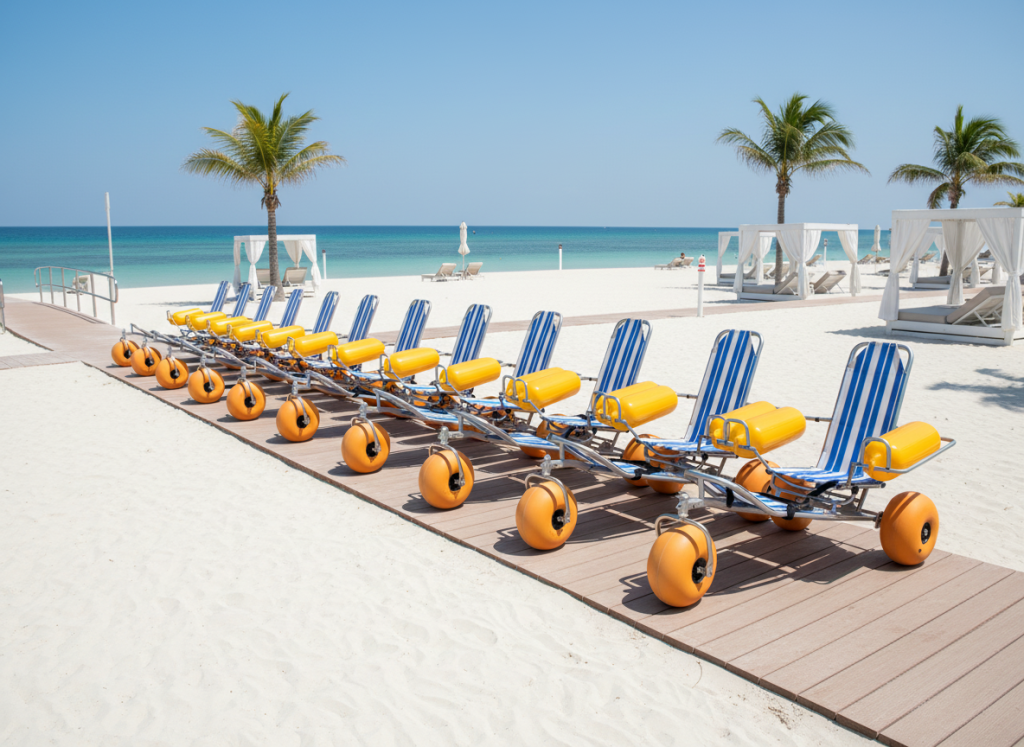
A floating beach wheelchair service works best when one trained lead owns communication and movement decisions while a trained spotter watches the route, chair, surroundings, and guest feedback. A site may assign more staff when its approved procedure calls for them, but every person needs a named role before departure. The lead should avoid giving simultaneous commands with another teammate.
The spotter should report obstacles, crowd movement, water changes, or equipment concerns early enough for a controlled stop. A supervisor or aquatic-safety professional should define water-related boundaries for that location, since a product’s floating design does not replace local rules, weather judgment, lifeguard authority, or direct supervision.
How should roles change near water?
Still, The shoreline changes the decision context. Near water, the team should use the resort’s approved aquatic procedure and any model-specific directions rather than extending a dry-land routine by instinct. Staff can stage the empty chair parallel to the shoreline, verify the planned entry point, confirm communication again, and wait for the responsible supervisor or lifeguard when policy requires that role. The sand-to-surf overview can support procurement discussions about intended environments, while local training determines what staff may do at a given site.
If water, weather, staffing, visibility, crowding, or guest feedback no longer matches the plan, the lead should stop and return to a suitable staging area.
- Keep one person responsible for guest communication and one for route observation.
- Reconfirm stop signals before any shoreline approach.
- Follow lifeguard, municipal, resort, and manufacturer rules without improvisation.
- Keep the route clear of loose gear, hoses, towels, and unattended mobility devices.
- Stop service when approved conditions or staffing are no longer present.

What records make the next shift more consistent?
A floating beach wheelchair record should tell the next shift what chair was used, who completed each check, where service occurred, what was observed, and whether the chair returned to ready status. The record does not need speculative diagnoses or personal detail unrelated to operations. It should use factual language: a wheel rubbed, a strap was set aside for review, the route closed, or a rinse was completed.
Afterward, Supervisors can group records by equipment identifier and date so maintenance staff can see recurring observations without relying on memory. A clear status field such as ready, under review, or unavailable prevents an uncertain chair from moving directly into another handoff. The resort accessibility article can also help teams connect equipment operations with a wider guest-service plan.
How should a resort respond when conditions change?
A floating beach wheelchair plan should pause whenever weather, waves, tide, route condition, crowding, staffing, visibility, or equipment status moves outside the site’s approved operating limits. Staff do not need to debate the guest in that moment or make an improvised exception. They can explain what changed, offer a suitable waiting or rescheduling option, and document the operational reason.
Managers should give frontline staff clear authority to stop a service without pressure from queue length or guest expectations. A stop decision becomes easier when signs, reservation messages, and verbal briefings already describe that service depends on conditions. After any pause, a qualified supervisor can decide whether the plan may resume under written site rules.
What belongs in the post-use reset?
In practice, A floating beach wheelchair reset should follow the model’s care instructions for rinsing, draining, inspection, drying, and storage before anyone marks the chair ready. Salt, sand, sunscreen, and moisture can remain in seams, joints, supports, wheel areas, or contact surfaces, so a quick visual glance does not replace the documented process. Staff should use approved supplies, avoid harsh treatment not listed by the manufacturer, and separate cleaning tasks from repairs that require authorized personnel.
The Beach Series gives buyers a place to compare related beach-access equipment, yet each item still needs its own care plan. A named staff member should close the record only after every required reset task is complete.
How should managers train seasonal and replacement staff?
A floating beach wheelchair training plan should place seasonal and replacement staff through the same role approval used for permanent team members before they join a live handoff. Managers can begin with product identification, site boundaries, communication practice, dry-land drills, stop authority, reporting, and post-use reset. Observation alone should not count as role approval.
Next, Each trainee should complete the tasks assigned to that role under supervision and have a named reviewer record the result. Temporary staffing pressure should not widen a person’s duties beyond completed training. If a supervisor moves to another shift, the written approval record should still tell the team who may lead, spot, clean, inspect, or close equipment status.
Managers can also plan short refresh sessions around real changes rather than repeat a generic lecture. A moved storage area, revised route, changed access mat, updated chair, new shoreline boundary, or altered escalation contact gives the team a concrete reason to practice again. Training materials should show the actual product and site, not a similar model with different parts. Staff who return after a long gap can repeat the approved drill before service. This keeps role decisions tied to current evidence without claiming that attendance alone proves competence.
How can supervisors review a drill without relying on guesses?
A floating beach wheelchair drill should be reviewed against observable actions such as checklist order, role clarity, communication, controlled stops, route awareness, product handling, and accurate records. Supervisors should avoid vague ratings based on confidence or speed. A worker may speak confidently while skipping a check, while another may move slowly and follow every approved step.
Meanwhile, A simple review sheet can record completed, needs practice, or not observed for each task, followed by a note about the next supervised drill. The reviewer should also invite staff to identify unclear instructions or site conflicts because a confusing procedure can create repeated errors across an entire team.
After the drill, the group can walk through one realistic exception, such as a blocked boardwalk, an unfamiliar strap position, a missing teammate, or a guest who changes the plan. Staff should state who stops movement, who communicates, where the chair returns, and how status is recorded. The exercise should end with one agreed action for any gap found. This turns training into a practical feedback loop while keeping technical or aquatic decisions with qualified personnel.
What do resort buyers ask about staff training?
A floating beach wheelchair training program usually raises practical questions about frequency, staffing, transfers, weather, and records. The concise answers below offer planning direction, while the manufacturer manual, local policy, and qualified accessibility or aquatic-safety guidance remain the final references for a particular site and product.
For example, Q1: Does every staff member need the same training? No. Resorts can define role-based training, but only personnel approved for a task should perform it.
Q2: How often should teams practice? Use a documented schedule tied to season openings, staff changes, equipment changes, and supervisor review rather than an arbitrary universal interval.
Q3: Can staff improvise a transfer method? No. Transfers should follow the guest’s preferences, resort policy, staff competence, product guidance, and any qualified support required by the situation.
Still, Q4: Does a floating chair make every water condition suitable? No. Product design does not override local rules, weather, water conditions, supervision needs, or a stop decision.
Q5: What should happen after a failed check? Remove the chair from service, document the observation, and route it to the approved review process before reuse.
How can teams make the program repeatable?
A floating beach wheelchair program becomes repeatable when procurement, guest services, beach operations, maintenance, and supervisors share one approved workflow. Keep training tied to the actual chair, actual route, actual staffing model, and written stop conditions. Review records for patterns, refresh drills when a setup changes, and give employees clear authority to pause service.
Afterward, This approach protects service quality without making claims that any checklist can cover every person or shoreline. If your organization is planning a resort program, rental fleet, or municipal beach service, contact us today with your intended environment and operational questions so your team can discuss a suitable product and documentation package.
Related planning resources: Review pre-service checklist, long-term maintenance, saltwater care steps before approving a product, sample, route, or supplier decision.